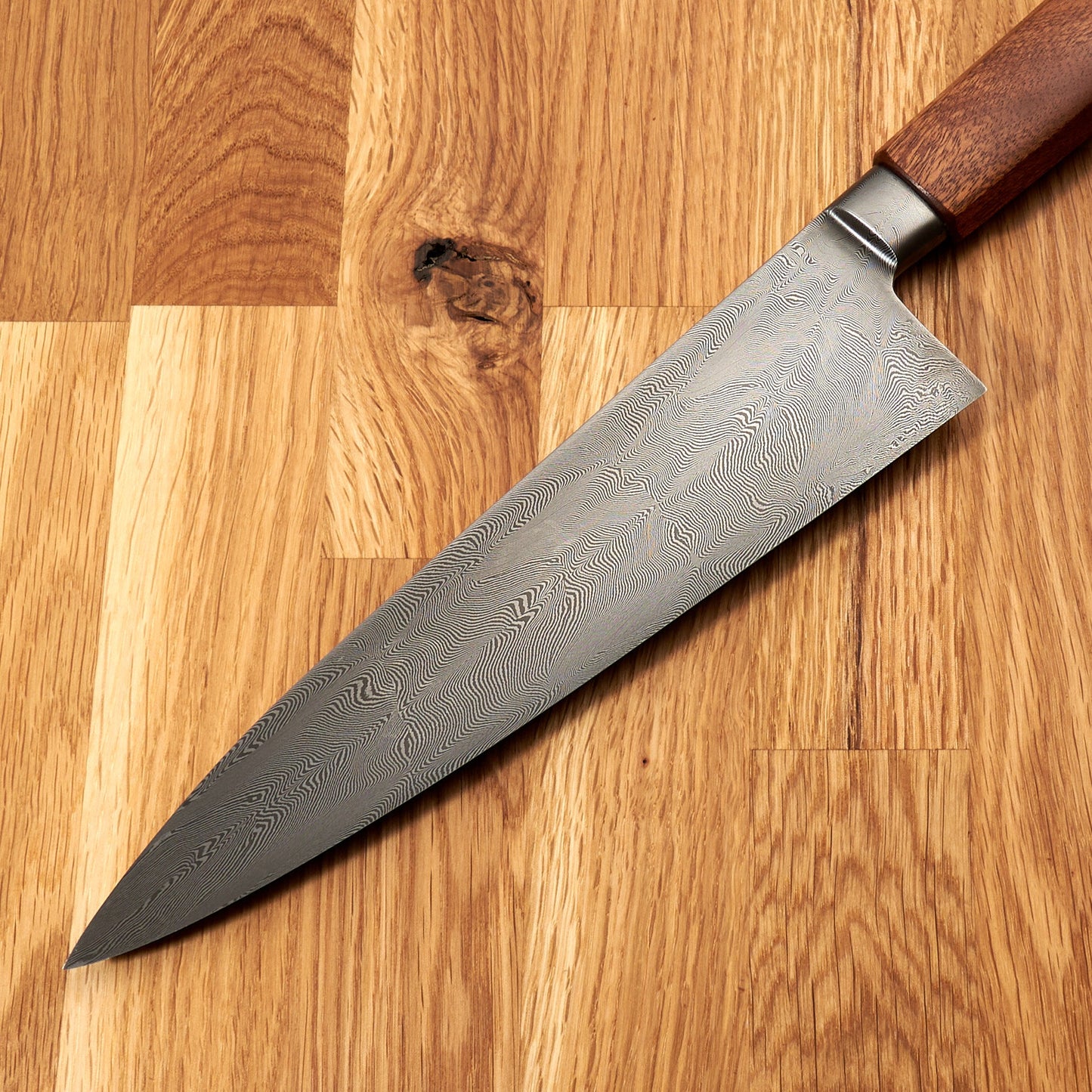
Gyuto 210 mm Mosaik Damaskus, Mahagoni & Messing
Gyuto 210 mm Mosaik Damaskus, Mahagoni & Messing
No longer available
Our Sydney workshop is closed until Monday 9 November. Orders placed now are very welcome and will ship in the order received from Tuesday 10 November. Shipping details
Wenn Tomislav sich an die Herstellung eines Messers macht, kann man sich einiger Dinge sicher sein. Erstens wird es ein wirklich authentisches Stück künstlerischer Handwerkskunst sein. Selten werden Sie auf zwei identische Messer stoßen. Ein einzigartiger Pin in der Saya, eine aggressive Arbeitstiergeometrie oder eine schöne trübe Kasumi-Politur. Dies bedeutet nicht, dass jedes Messer ein Experiment ist, dem es an Passform und Verarbeitung mangelt. Hier geht es um einen kreativen Hunger, einen unnachgiebigen Wunsch, etwas Schönes und Einzigartiges in die Welt zu setzen.
Dieser 210-mm-Gyuto ist zu 100 % ein Erbstück. Mahagoni und Messing begleiten eine wunderschöne Klinge aus Mosaikdamast, die nur als Perfektion bezeichnet werden kann. Ich weiß, ich weiß sprudelnd! Ehrlich gesagt gibt es an diesem Stück wenig bis gar nichts zu bemängeln.
Lassen Sie uns also über die Details sprechen. Das Mosaik ist ein dicht geschichtetes, aber dennoch minimalistisches Muster, das aus 1.2067 deutschem Werkzeugstahl und 75ni8 geschmiedet wurde. Vom geschmiedeten integrierten Griff aus erstreckt sich ein sehr edles Profil mit subtilen Rundungen, durchdachten Abflachungen und einer spitzen Spitze. Alles in allem verfügt die Klinge über einen abschließend abgestimmten konvexen Schliff, der die erste Hälfte der Klingenhöhe von 52 mm mit einer konsistenten distalen Verjüngung von 2,9 mm bis zu einer präzisionsgeschliffenen Spitze in Bruchteilen eines Millimeters verlängert. Perfekt ausbalanciert, exakt am integrierten Klemmpunkt.
Die Passform und das Finish aller Arbeiten von Tomislav sind phänomenal. Er ist ein Meisterhandwerker, der mit Leichtigkeit von der Metallherstellung zur Tischlerei übergeht. Als Enthusiast ist es beeindruckend, solche Arbeiten zu sehen, und jedes Mal, wenn ein neues Stück durchgeht, sind wir von den subtilen, aber durchdachten Details überwältigt. Die Saya ist kraftschlüssig und hat einen speziell geformten Schlitz, der perfekt für den integrierten Griff entworfen wurde, die Tischlerei ist nahtlos und die eckige Form der Saya passt perfekt zu Tomislavs einzigartigem sechseckigem Griffdesign.
Ein wunderschönes Werk von Tomislav alias Radion Breg. Edles Design, tolle Passform und Verarbeitung.
Product Specification
- Blade Type:
- Edge Length: 210mm
- Spine Heel: 2.97mm
- Spine Mid: 2.25mm
- Spine Tip (20mm before): 1.18mm
- Blade Height: 52mm
- Weight: 183g
- Cutting Edge Steel:
- Steel class: Carbon
- HRC: 62
- Blade Construction:
- Blade Finish: Mattpolitur
- Grind:
- Handle Construction:
- Handle Materials: Mahogany
- Handedness: Beidhändig
- Saya / Storage Included: Yes
Shipping & Returns
Shipping & Returns
Shipping
We process orders Monday to Friday from our Sydney workshop. Australian orders are shipped with Australia Post and international orders with DHL Express. Shipping charges are calculated at checkout based on destination, shipment size and weight, and the carrier service available for the order.
Returns
If you're not entirely happy with your purchase, you can return it within 14 days of delivery for a refund. The item must be in its original condition with all original packaging.
- Returns are accepted for 14 days
- The customer is responsible for return shipping costs
- A 15% restocking fee may be applied to change-of-mind returns
- We do not accept returns on second-hand items for change of mind
Faulty or Damaged Items
You must notify us within 5 business days of receiving your order. Photographic evidence of damage is required. Once approved, Modern Cooking will cover return shipping costs.
Product Care
Product Care
Cleaning: Clean by hand with warm water. Avoid wetting the handle when possible.
Sharpening: We advise using whetstones to sharpen your knives and a honing rod or steel to maintain the burr between sharpening sessions.
Reactive Steels: Reactive steels like Aogami Super, Apex Ultra or premium reactive German and Swedish steels are susceptible to rust if not properly cared for. Keep the knife dry between uses and when storing for longer periods, wiping the blade with Tsubaki oil or another food-safe oil is a wise choice. A patina can be a beautiful personal feature on your knife and helps to stop rust forming.
Handle Care: For non-stabilised wooden handles, apply Tsubaki oil or another food-safe oil from time to time. Food-safe wax can be applied to both stabilised and non-stabilised wooden handles. Never apply hot wax or oil as you risk warping or damaging the handle.