Zu Produktinformationen springen
1 von 8

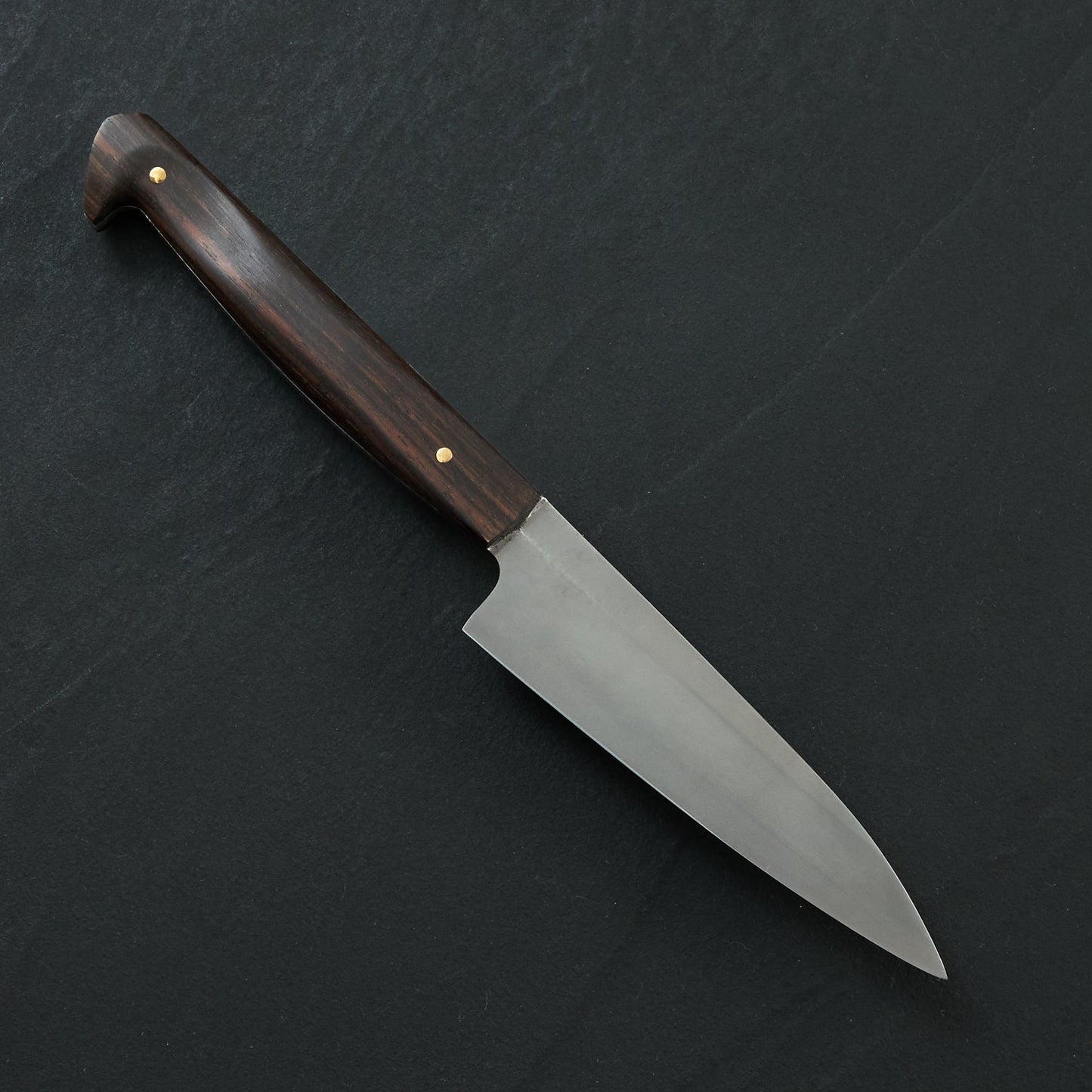
Schälung 100 mm RWL34 Palisander aus Madagaskar-Ebenholz

Schälung 100 mm RWL34 Palisander aus Madagaskar-Ebenholz

By Evan Antzenberger


No longer available

Evan Antzenberger

Reserve your place

We'll only email you when there's something to say. Invitations go out in signup order as new work becomes available.

Präzision, Eleganz und Handwerkskunst vereinen sich in diesem handgefertigten 100-mm-Schälmesser, das vom renommierten französischen Handwerker Evan Antzenberger sorgfältig von Hand geschliffen und vollendet wurde.

Die Klinge besteht aus hochwertigem RWL34-Stahl , einem Hochleistungs-Pulverstahl, der für seine außergewöhnliche Schnitthaltigkeit, Zähigkeit und Korrosionsbeständigkeit bekannt ist. Eine markante säuregeätzte Oberfläche verleiht der Klinge eine einzigartige, raffinierte Textur und erhöht gleichzeitig ihre Widerstandsfähigkeit.

Die durchgehende Erlkonstruktion sorgt für überragende Stabilität und Balance und ermöglicht präzise Kontrolle bei anspruchsvollen Aufgaben wie Schälen, Trimmen und kompliziertem Schneiden. Das klassische Klingenprofil gewährleistet vielseitige Leistung bei zahlreichen Küchenarbeiten.

Der Griff ist aus exquisitem Palisander de Madagascar Ebenholz gefertigt, einem seltenen und reich gemaserten Holz, und ist elegant mit Messingstiften akzentuiert – eine Anspielung auf zeitlose, traditionelle Messerbautechniken. Das Ergebnis ist ein Griff, der sich ebenso luxuriös anfühlt wie er aussieht und sowohl sicheren Halt als auch dauerhafte Schönheit bietet.

Jedes Messer ist ein Spiegelbild von Evan Antzenbergers Engagement, traditionelle Handwerkskunst mit moderner Leistung zu verbinden und so Werkzeuge in Erbstückqualität für anspruchsvolle Köche und Sammler gleichermaßen zu schaffen.

Product Specification
  • Blade Type:
  • Overall Length: 215mm
  • Edge Length: 100mm
  • Spine Heel: 2.35mm
  • Spine Mid: 2.15mm
  • Spine Tip (20mm before): 1.7mm
  • Blade Height: 26.9mm
  • Weight: 72g
  • Cutting Edge Steel:
  • Steel class: Stainless
  • HRC: 65
  • Blade Construction:
  • Blade Finish: Säuregeätzt (Zwangspatina)Satinpolitur
  • Grind:
  • Handle Construction:
  • Handle Materials: Palisander de Madagaskar Ebony
  • Handedness: Beidhändig

Blade type

Paring Knife

The smallest workhorse in the kitchen — a short blade, usually 80 to 100 mm, designed for controlled, in-hand cutting rather than work on the board. Paring knives peel, trim, hull, segment, and carry out the close detail tasks that benefit from the food held in one hand and the knife in the other. The short edge and fine tip give the dexterity those jobs demand.

A paring knife is defined by what it deliberately is not: it has no reach, no height, and no leverage for volume work, and pressing it into service as a small chef's knife is slow and tiring. It is a specialist for precision, and a kitchen is best served by treating it as a complement to a larger knife rather than a substitute.

View full knife type guide →

Cutting edge steel

RWL34 / RWL

Powder metallurgy martensitic stainless tool steel

Typical HRC
60–63
Corrosion class
Stainless
Production
Powder
Origin
Sweden (Damasteel)

RWL34 — usually shortened to RWL — is Damasteel's powder-route stainless equivalent of ATS-34 / CPM-154, and is the bright-and-hard layer in much of the world's high-end stainless damascus. The composition (1.05 percent carbon, 14 percent chromium, 4 percent molybdenum, 0.2 percent vanadium) is essentially ATS-34 chemistry, but the rapid-solidification powder process produces a finer, cleaner microstructure than the conventional ingot route.

In a kitchen knife — usually a Damasteel-pattern blade — RWL34 runs at 60–62 HRC, sharpens cleanly, and produces a refined edge that holds well for the class. Edge retention is in the same band as SG2 at slightly lower hardness; toughness is good; corrosion resistance is excellent. The named association with Robert W. Loveless, the steel's original collaborator on the design, is half of the steel's mystique.

You see RWL most often as a mono-steel core in high-end custom work and as the contrast layer in Damasteel patterns. Among the makers Modern Cooking carries, Bernhard Noitz, Erik Gullikson, Evan Antzenberger, Jeroen Knippenberg, and Birch & Bevel work in RWL. It is a genuinely nice premium stainless that is somewhat under-discussed compared to the American powder steels.

View full steel guide →

Blade construction

Mono Steel

A knife forged from a single piece of steel — no laminations, no clad layers. The simplest and most direct construction. The entire blade is the cutting steel, with no softer outer jacket to protect or contrast it. Most contemporary Western kitchen knives in carbon and stainless steel are mono-steel constructions, as are honyaki and most European bladesmith work.

The trade-off is straightforward: mono-steel knives are easier to forge, sharpen, and reason about, but the entire blade carries the cutting steel's properties — including its reactivity if it's a clean carbon. There is no soft jacket to protect a more brittle core from impact, so the heat treatment and geometry have to do all the work.

View full construction guide →

Grind

Flat

A grind in which the blade tapers in a straight line from the spine down toward the edge, with no curve or hollow in the bevel. The flat grind is the most common geometry on modern double-bevel kitchen knives because it balances cutting performance and durability: thin enough behind the edge to slice well, with enough steel behind it to stay strong.

A true full flat grind, running from spine to edge, is keen but can wedge in dense produce as the food meets the widening blade; many kitchen knives use a partial flat grind that begins lower on the blade to manage that. The flat grind's appeal is its predictability — it sharpens straightforwardly, behaves consistently, and asks nothing unusual of the user.

View full grind guide →

Handle construction

Full Tang

A construction in which the blade steel runs the full length and width of the handle, forming a flat core between two handle scales. The scales are fixed to either face of the tang with pins, rivets, or adhesive, and the tang's outline stays visible as a strip of steel around the top, bottom, and butt of the handle — often with the pin heads showing as a row down each side. It is the dominant construction in Western kitchen and outdoor knives.

Because the steel continues all the way to the butt, the handle is essentially the tang dressed in two scales, and the grip is ground and shaped from that sandwiched assembly as a whole. The extra steel carries weight and balance back toward the hand, giving the solid, blade-and-handle-as-one feel that defines the style, and it leaves the edge of the tang on show as part of the knife's line.

View full construction guide →

Shipping & Returns

Shipping

We process orders 5 days a week (Monday - Friday) and ship from our shop in Sydney, Australia. We ship with FedEx, UPS and DHL.

We are happy to offer free international shipping on a variety of orders depending on location and order value.

Free Shipping Regions and Minimum Order Values

For Australia and New Zealand the minimum is $500AUD. For the rest of the world it is approximately €1000EUR. The discount is applied automatically when you reach the minimum cart value at checkout.

Returns

If you're not entirely happy with your purchase, you can return it within 14 days of delivery for a refund. The item must be in its original condition with all original packaging.

  • Returns are accepted for 14 days
  • The customer is responsible for return shipping costs
  • A 15% restocking fee may be applied to change-of-mind returns
  • We do not accept returns on second-hand items for change of mind

Faulty or Damaged Items

You must notify us within 5 business days of receiving your order. Photographic evidence of damage is required. Once approved, Modern Cooking will cover return shipping costs.

Product Care

Cleaning: Clean by hand with warm water. Avoid wetting the handle when possible.

Sharpening: We advise using whetstones to sharpen your knives and a honing rod or steel to maintain the burr between sharpening sessions.

Reactive Steels: Reactive steels like Aogami Super, Apex Ultra or premium reactive German and Swedish steels are susceptible to rust if not properly cared for. Keep the knife dry between uses and when storing for longer periods, wiping the blade with Tsubaki oil or another food-safe oil is a wise choice. A patina can be a beautiful personal feature on your knife and helps to stop rust forming.

Handle Care: For non-stabilised wooden handles, apply Tsubaki oil or another food-safe oil from time to time. Food-safe wax can be applied to both stabilised and non-stabilised wooden handles. Never apply hot wax or oil as you risk warping or damaging the handle.

Vollständige Details anzeigen