Zu Produktinformationen springen
1 von 7

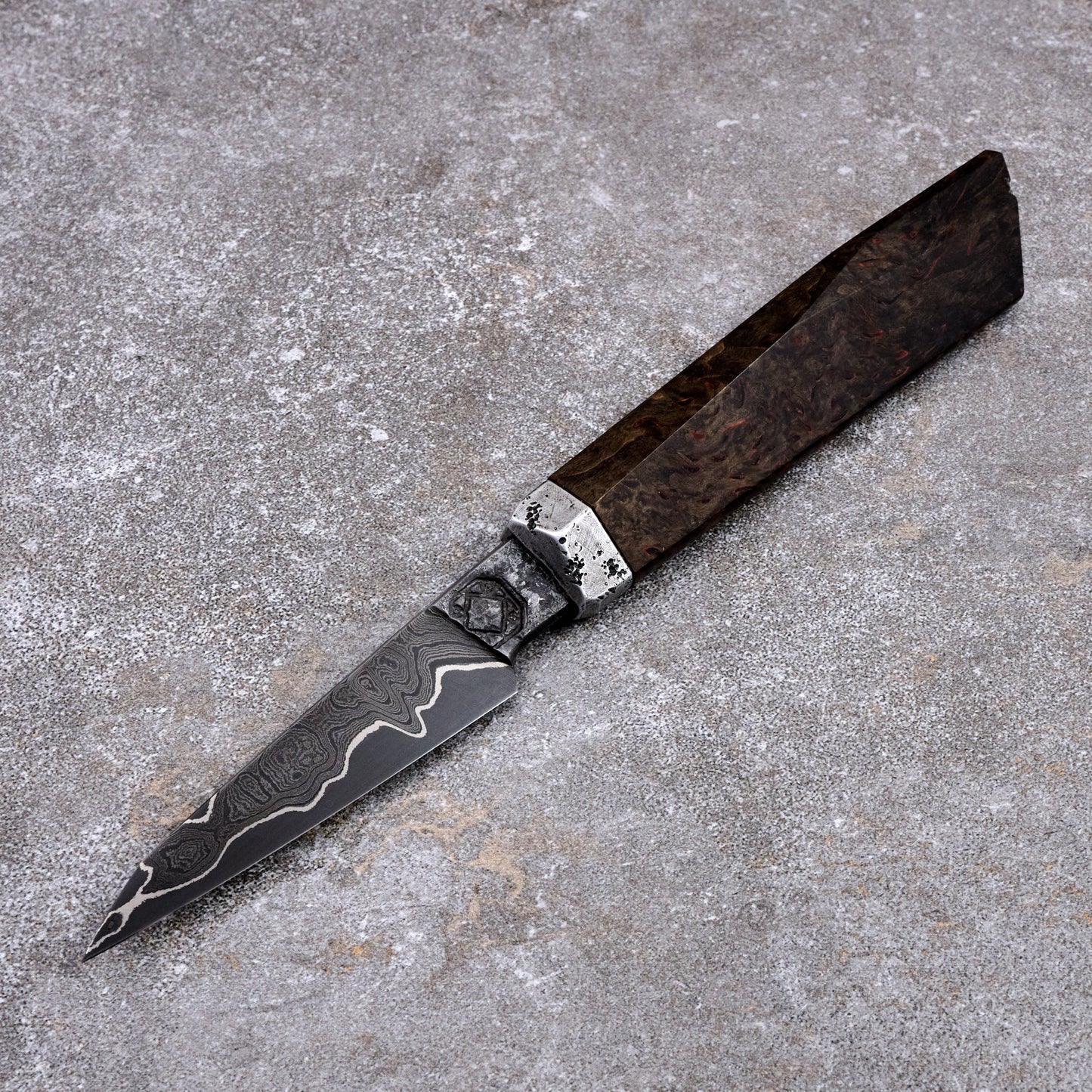
Huber X Karyś Parer 75mm GoMai Damascus, Nickel & Apex Ultra

Huber X Karyś Parer 75mm GoMai Damascus, Nickel & Apex Ultra

By Collaboration


No longer available

Karol Karyś

Reserve your place

We'll only email you when there's something to say. Invitations go out in signup order as new work becomes available.

Dieses hier ist etwas Besonderes. Im September 2022 besuchten wir Martin Huber in Österreich und produzierten einen wunderschönen GoMai-Block, einen unglaublichen Apex Ultra-Kern, umhüllt mit dichtem Damast und einer Nickeldiffusionsschicht. Der Stahl reichte für die Herstellung von zwei Messern, dachten wir zumindest. Wir schickten den Stahl zu Karol Kary nach Polen, und er fertigte einen absolut wunderschönen Gyuto und ein Bunka .

Wie sich herausstellte, war noch ein kleines Stück des Stahls übrig. Als Koch hat man zwei Messer, die für die meisten Aufgaben unverzichtbar sind: das Gyuto und ein Schälmesser. Es mag zwar klein sein, aber seine Einsatzmöglichkeiten sind scheinbar endlos. Entkernen, Einritzen, Zum Schälen, Putzen von Gemüse und zur Not auch zum Entfernen der Silberhaut von Fleisch. Sie werden sicher noch viele weitere Einsatzmöglichkeiten für dieses kleine, aber äußerst vielseitige Universalmesser finden.

Karol hat der Klinge eine außergewöhnlich scharfe und feine Geometrie verliehen. Die nadelförmige und spitz zulaufende Klinge ist skalpellartig und liegt sehr gut in der Hand.

Der atemberaubende GoMai-Stahl wird mit einem unglaublich stabilisierten Griff aus karelischer Birke und Aluminium kombiniert. Charakteristische Texturen und Facetten vervollständigen das außergewöhnlich schöne Schälmesser.

Product Specification
  • Blade Type:
  • Edge Length: 75mm
  • Spine Heel: 2.43mm
  • Spine Mid: 1.38mm
  • Spine Tip (20mm before): 0.62mm
  • Blade Height: 18.9mm
  • Weight: 64g
  • Cutting Edge Steel:
  • Steel class: Carbon
  • HRC: 66
  • Blade Construction:
  • Blade Finish: Schmiedeeisen, Säuregeätzt (erzwungene Patina)
  • Grind:
  • Handle Construction:
  • Handle Materials: Stabilised Karelian Birch, Aluminium
  • Handedness: Beidhändig

Blade type

Paring Knife

The smallest workhorse in the kitchen — a short blade, usually 80 to 100 mm, designed for controlled, in-hand cutting rather than work on the board. Paring knives peel, trim, hull, segment, and carry out the close detail tasks that benefit from the food held in one hand and the knife in the other. The short edge and fine tip give the dexterity those jobs demand.

A paring knife is defined by what it deliberately is not: it has no reach, no height, and no leverage for volume work, and pressing it into service as a small chef's knife is slow and tiring. It is a specialist for precision, and a kitchen is best served by treating it as a complement to a larger knife rather than a substitute.

View full knife type guide →

Cutting edge steel

Apex Ultra

Low-alloy fine-grain carbon tool steel

Typical HRC
64–68
Corrosion class
Carbon
Production
Conventional
Origin
Austria (ApexUltra project — developed by Larrin Thomas, Marco Guldimann and Tobias Hangler; FFG-funded, associated with Messerschmiede Hangler)

Apex Ultra is one of the most carefully engineered non-stainless kitchen knife steels in modern circulation — a steel designed from the ground up specifically for handmade knives, rather than borrowed from another industry. It was developed by metallurgist Larrin Thomas together with smiths Marco Guldimann and Tobias Hangler. It is a low-alloy carbon steel — roughly 1.25 percent carbon, 2.6 percent tungsten, 1.5 percent chromium and a 0.4 percent vanadium addition, with manganese and silicon kept low. That composition is tuned for high purity and a fine, evenly distributed mix of chromium-enriched iron carbides, tungsten carbides and vanadium carbides — the structure that lets it hold a very hard edge without the coarse carbides or plate martensite that sap toughness in other high-hardness carbon steels.

What this means for a cook is unusual permission. Apex Ultra carries very high toughness in the 66+ HRC range — the highest of any knife steel its developers have tested at that hardness — so you can ask a maker to grind it thin and run the heat treatment hard, and the edge will hold far longer than the carbon steels smiths usually forge, without microchipping. It forges and forge-welds much like 52100 or 1.2562, sharpens cleanly on natural and synthetic stones without needing diamond plates, and its modest chromium slows patina a little — though it is not stainless and should be cared for as a carbon steel.

Apex Ultra has become a signature steel of the European maker community, and the Modern Cooking catalogue carries an unusually deep bench of smiths working in it. Tobias Hangler himself heads that group, alongside Marco Guldimann, Benjamin Kamon, Martin Huber, Jonas Johnsson, Karol Karyś, Birch & Bevel, and MCx. It is genuinely a step forward — one of the relatively few cases where the marketing claims and the underlying metallurgical data are saying the same thing.

View full steel guide →

Blade construction

Laminated Steel

A category covering knives built from multiple layers of different steels forge-welded together. The hard cutting steel is sandwiched between softer outer layers (cladding) that protect the core, add toughness, and often contribute visual contrast.

The most common laminated constructions in the Modern Cooking catalogue are:

SanMai (三枚) — three layers: hard cutting steel in the centre, softer cladding on both sides. The traditional and most common form.

GoMai (五枚) — five layers: a hard core, two intermediate layers, and two outer layers. Adds visual depth and structural complexity.

KuMai (九枚) — nine layers: similar logic, with more cladding layers for additional pattern and structural variation.

GoMai and KuMai are often chosen not only for the additional layers and visual depth, but also because the intermediate layers can act as a nickel diffusion barrier — limiting carbon migration out of the core into the cladding during forge welding, and protecting the core's intended carbon content through the heat of the forging process.

In all cases the cutting performance is determined by the core steel; the outer layers are cosmetic and structural. The lamination contributes corrosion protection (when a stainless jacket clads a carbon core), reduced reactivity, and the visible boundary between core and cladding that gives the knife its character.

View full construction guide →

Grind

Convex

A grind whose bevel bulges outward in a gentle curve from spine to edge, rather than running flat. That extra steel directly behind the edge makes a convex grind notably strong and resistant to chipping, while the curved geometry helps food release and lets the blade glide through dense ingredients with less wedging than a flat grind.

The strength comes at the cost of ultimate thinness and ease of maintenance. A convex edge has more metal behind it, so it is not quite as effortlessly keen as a thinly flat-ground edge, and it is harder to sharpen freehand — holding the curve takes a stropping technique or a deliberate hand rather than a single fixed angle. The reward is an exceptionally tough, smooth-cutting edge.

View full grind guide →

Handle construction

Hidden Tang

A construction in which the tang runs into the handle but stays concealed inside it, rather than showing between two scales. A narrower tang — a full-length stick or a shorter projection — is set into a drilled or burned channel in a one-piece handle and secured with adhesive, a friction fit, or a threaded fitting drawn up against the blade. This is the traditional construction of Japanese wa-handles and many European hidden-tang knives.

The design puts the handle material in charge of the look and feel: a single piece of wood, horn, or composite — often with a ferrule or spacers at the front — is shaped into any cross-section the maker wants, from the classic octagonal and D-shaped wa profiles to fully rounded Western forms. With no steel showing along the grip, the handle can be slim and light, and is frequently made to be removed and replaced, with the balance sitting toward the blade.

View full construction guide →

Shipping & Returns

Shipping

We process orders 5 days a week (Monday - Friday) and ship from our shop in Sydney, Australia. We ship with FedEx, UPS and DHL.

We are happy to offer free international shipping on a variety of orders depending on location and order value.

Free Shipping Regions and Minimum Order Values

For Australia and New Zealand the minimum is $500AUD. For the rest of the world it is approximately €1000EUR. The discount is applied automatically when you reach the minimum cart value at checkout.

Returns

If you're not entirely happy with your purchase, you can return it within 14 days of delivery for a refund. The item must be in its original condition with all original packaging.

  • Returns are accepted for 14 days
  • The customer is responsible for return shipping costs
  • A 15% restocking fee may be applied to change-of-mind returns
  • We do not accept returns on second-hand items for change of mind

Faulty or Damaged Items

You must notify us within 5 business days of receiving your order. Photographic evidence of damage is required. Once approved, Modern Cooking will cover return shipping costs.

Product Care

Cleaning: Clean by hand with warm water. Avoid wetting the handle when possible.

Sharpening: We advise using whetstones to sharpen your knives and a honing rod or steel to maintain the burr between sharpening sessions.

Reactive Steels: Reactive steels like Aogami Super, Apex Ultra or premium reactive German and Swedish steels are susceptible to rust if not properly cared for. Keep the knife dry between uses and when storing for longer periods, wiping the blade with Tsubaki oil or another food-safe oil is a wise choice. A patina can be a beautiful personal feature on your knife and helps to stop rust forming.

Handle Care: For non-stabilised wooden handles, apply Tsubaki oil or another food-safe oil from time to time. Food-safe wax can be applied to both stabilised and non-stabilised wooden handles. Never apply hot wax or oil as you risk warping or damaging the handle.

Vollständige Details anzeigen