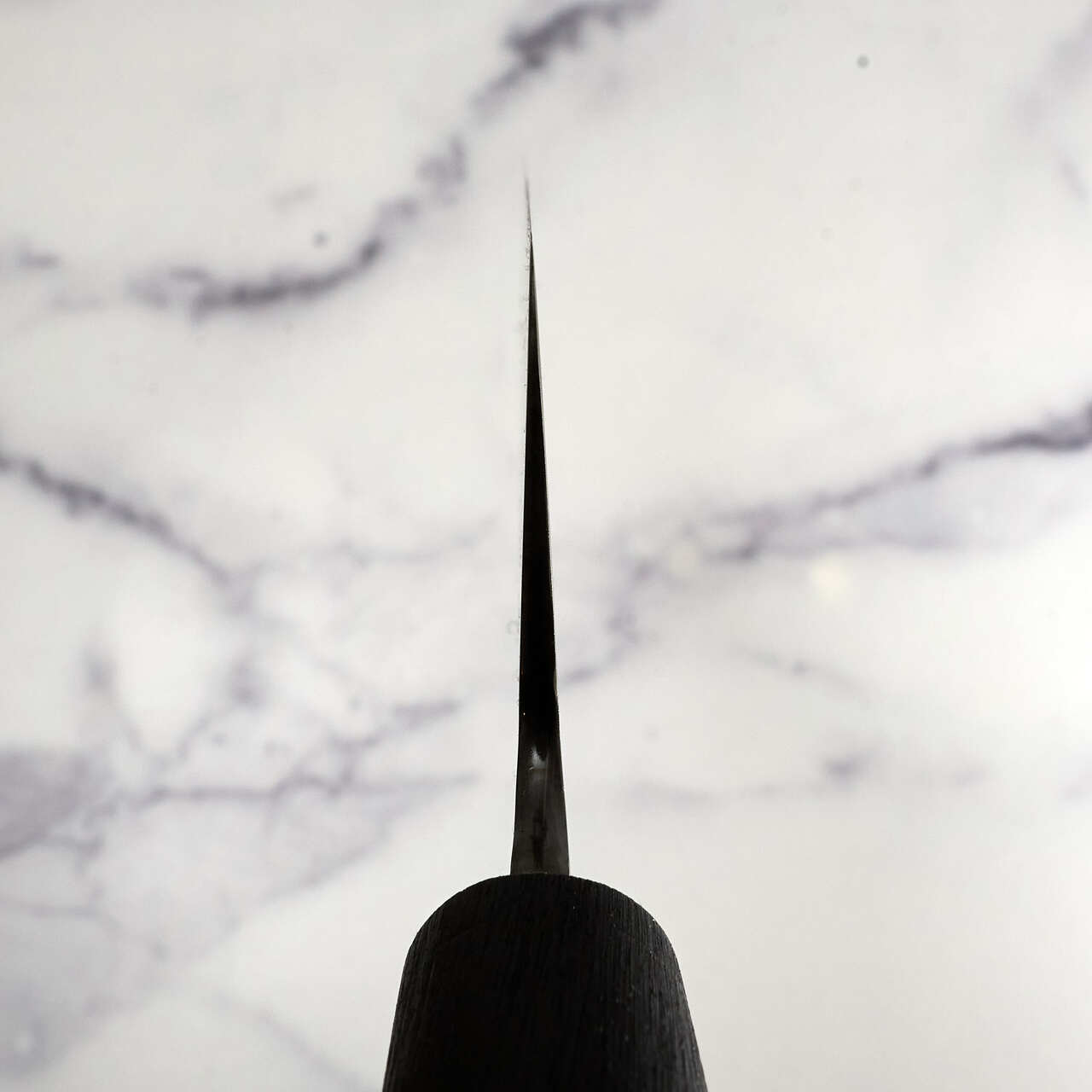
170 mm Nakiri OB Wootz mit Composite-Griff
170 mm Nakiri OB Wootz mit Composite-Griff
No longer available
Our Sydney workshop is closed until Monday 9 November. Orders placed now are very welcome and will ship in the order received from Tuesday 10 November. Shipping details
Eine Kombination von Elementen macht Wootz-Stahl für die Messerherstellung interessant. Erstens ist seine Assoziation mit den Ursprüngen des Damaststahls. Die Wahrheit ist, dass niemand wirklich weiß, woher Damaststahl stammt oder wie er ursprünglich hergestellt wurde. Wenn wir uns heute auf Damaskus beziehen, beziehen wir uns am häufigsten auf gemusterten Stahl, den geschichteten Stahl, der durch die gemeinsame Verwendung verschiedener weicher und harter Stähle hergestellt wird.
Wootz-Stahl bezieht sich auf Tiegelstahl. Es wird hergestellt, indem eine Kombination von Elementen in einem Tiegel geschmolzen wird, um einen kleinen Barren aus kohlenstoffreichem Stahl zu bilden, der dann auf eine bestimmte Weise geschmiedet und thermisch zykliert wird, was zu hochfeinen Karbidbändern führt, die das endgültige Muster erzeugen, wenn der Stahl geätzt wird.
Der hohe Kohlenstoffgehalt und die raffinierten Karbide können extrem zähe Stähle erzeugen, die sehr feine Kanten annehmen. Das Problem ist, dass es in den meisten Fällen wirklich schwierig ist, den endgültigen Gehalt eines Tiegelstahls zu kennen, und es möglich ist, dass der Kohlenstoffgehalt viel niedriger ist als oft vorhergesagt.
Jezz bei Oblivion Blades lässt jeden seiner Barren testen, um genau zu wissen, wie viel von jedem Element darin enthalten ist. Diese Klinge enthält sehr vernünftige 1,6 C 0,4 W 0,35 Cr, es ist ein sehr anständiges Stück Wootz.
Also, mit dem technischen Zeug aus dem Weg, ein wenig über die Klinge selbst.
Erstens mag der abgewinkelte Griff für ein Nakiri etwas unorthodox erscheinen, aber der Winkel passt perfekt zum Profil der Klinge, die sich zur Messerspitze hin verjüngt. Im Gebrauch löst diese Geometrie tatsächlich Verspannungen im Handgelenk und würde meiner Meinung nach die Ermüdung im Laufe der Zeit verringern.
Wenn Sie die Ursprünge des Nakiri kennen, wurde es zunächst als einfach zu handhabendes Gemüsemesser hauptsächlich für zu Hause entwickelt. Das Messer wurde dem japanischen Usuba nachempfunden, das für einen bestimmten Schneidstil namens Katsuramuki oder Rotary Peeling verwendet wird, eine Technik, bei der ein Stück Gemüse in einer Hand gehalten und eine dünne Schicht abgezogen wird, indem das Gemüse gegen die Klinge gedreht wird, während es bewegt wird Messer in einer subtilen Auf- und Abbewegung. Aufgrund meiner begrenzten Erfahrung mit dieser Technik glaube ich, dass das abgewinkelte Design diesen Vorgang ein wenig einfacher machen würde.
Die Klinge ist an der Kante sehr dünn, etwa 0,2 mm, und bleibt etwa 1 cm über der Kante ziemlich dünn, was dem Messer eine rasiermesserähnliche Eigenschaft verleiht, die sich perfekt für die Gemüsezubereitung eignet. Das Messer ist gut ausbalanciert für einen Zangengriff und der Schwerpunkt liegt genau auf den Oblivion-Klingen, dem Herstellerzeichen.
Tiegelstahl oder Wootz ist ein sehr arbeitsintensiver Stahl in der Herstellung und ein Premium-Küchenmesser dieses Standards in einem so einzigartigen Kohlenstoffstahl zu finden, ist eine absolute Seltenheit. Jezz ist ein sehr talentierter Messermacher und Stahlproduzent, und die Kombination führt zu einigen erstaunlichen Küchenmessern. Dies ist absolut keine Ausnahme. Eine großartige 170-mm-Nakiri aus erstaunlich robustem Stahl und mit einer Menge Stil!
Product Specification
- Blade Type:
- Edge Length: 170mm
- Spine Heel: 3.55mm
- Spine Mid: 3.05mm
- Spine Tip (20mm before): 2.2mm
- Blade Height: 59mm
- Weight: 272g
- Cutting Edge Steel:
- Steel class: Carbon
- HRC: 63
- Blade Construction:
- Blade Finish: Mattpolitur
- Grind:
- Handle Construction:
- Handle Materials: OB Composite, Brass Pin, Tasmanian Oak dowel
- Handedness: Beidhändig
Shipping & Returns
Shipping & Returns
Shipping
We process orders Monday to Friday from our Sydney workshop. Australian orders are shipped with Australia Post and international orders with DHL Express. Shipping charges are calculated at checkout based on destination, shipment size and weight, and the carrier service available for the order.
Returns
If you're not entirely happy with your purchase, you can return it within 14 days of delivery for a refund. The item must be in its original condition with all original packaging.
- Returns are accepted for 14 days
- The customer is responsible for return shipping costs
- A 15% restocking fee may be applied to change-of-mind returns
- We do not accept returns on second-hand items for change of mind
Faulty or Damaged Items
You must notify us within 5 business days of receiving your order. Photographic evidence of damage is required. Once approved, Modern Cooking will cover return shipping costs.
Product Care
Product Care
Cleaning: Clean by hand with warm water. Avoid wetting the handle when possible.
Sharpening: We advise using whetstones to sharpen your knives and a honing rod or steel to maintain the burr between sharpening sessions.
Reactive Steels: Reactive steels like Aogami Super, Apex Ultra or premium reactive German and Swedish steels are susceptible to rust if not properly cared for. Keep the knife dry between uses and when storing for longer periods, wiping the blade with Tsubaki oil or another food-safe oil is a wise choice. A patina can be a beautiful personal feature on your knife and helps to stop rust forming.
Handle Care: For non-stabilised wooden handles, apply Tsubaki oil or another food-safe oil from time to time. Food-safe wax can be applied to both stabilised and non-stabilised wooden handles. Never apply hot wax or oil as you risk warping or damaging the handle.