Zu Produktinformationen springen
1 von 6

Nakiri 200mm Honyaki 135CR3

Nakiri 200mm Honyaki 135CR3

By Evan Antzenberger


No longer available

Evan Antzenberger

Reserve your place

We'll only email you when there's something to say. Invitations go out in signup order as new work becomes available.

Entdecken Sie die perfekte Mischung aus französischer Handwerkskunst und kulinarischem Können in diesem Nakiri-Meisterwerk von Evan Antzenberger, das mit größter Sorgfalt im Honyaki-Stil hergestellt wurde. Dieses Nakiri ist ein Beweis für außergewöhnliche Kunstfertigkeit, die über das Gewöhnliche hinausgeht.

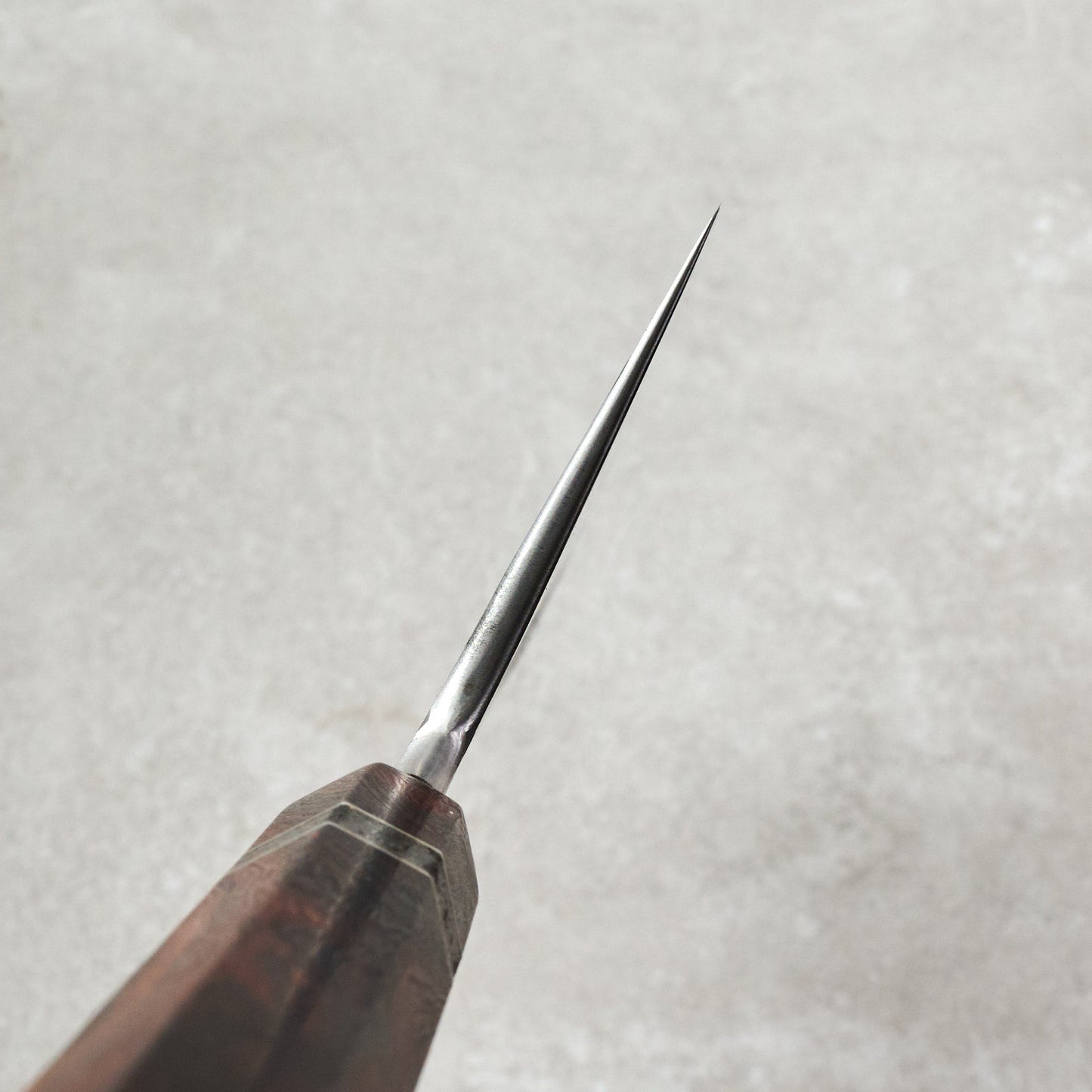
Mit einer vielseitigen Kantenlänge von 200 mm schafft diese Klinge ein Gleichgewicht zwischen Nutzen und Benutzerfreundlichkeit. Die unterschiedlichen Rückenmaße erzeugen eine allmähliche Verjüngung und gewährleisten müheloses Schneiden von der Ferse bis zur Spitze. Die Klinge besteht aus 135Cr3-Stahl, der als Hochleistungs-Küchenstahl bekannt und bei den französischen Herstellern beliebt ist. Sie behält eine dauerhafte Schärfe und bietet Zuverlässigkeit bei jedem Schnitt. Mit einem Gewicht von 414 g fühlt sich das Nakiri solide und dennoch ausgewogen an und ist an der Schneide mit konvexen Fasen unglaublich dünn und scharf.

Der Charme des Nakiri geht über die Leistung hinaus. Die säuregeätzte und matt polierte Oberfläche erzeugt eine unverwechselbare Patina und legt eine schöne Palette von Legierungsbändern im Stahl frei. Eine versteckte Griffkonstruktion aus Eisenholz, TruStone und Messing kombiniert Komfort und Eleganz und ist sowohl für Links- als auch für Rechtshänder geeignet.

Evan Antzenbergers Nakiri geht über seine Rolle als Küchenwerkzeug hinaus; es ist eine Hommage an Präzision, Stil und Handwerkskunst. Während Sie in der Küche kulinarische Köstlichkeiten zubereiten, erhebt dieses Nakiri das Kochen zu einer Kunstform und verspricht ein Erlebnis, das Nutzen und Ästhetik nahtlos miteinander verbindet.

Product Specification
  • Blade Type:
  • Edge Length: 200mm
  • Spine Heel: 5.08mm
  • Spine Mid: 3.15mm
  • Spine Tip (20mm before): 3.14mm
  • Blade Height: 72mm
  • Weight: 414g
  • Cutting Edge Steel:
  • Steel class: Carbon
  • HRC: 65
  • Blade Construction:
  • Blade Finish: Säuregeätzt (erzwungene Patina), Mattpolitur
  • Grind:
  • Handle Construction:
  • Handle Materials: Ironwood, Brass
  • Handedness: Beidhändig

Blade type

Nakiri

菜切

A double-bevel vegetable knife with a tall, rectangular blade and a straight edge that meets the board along its full length. That flat profile is built for one job done exceptionally well: clean, full-contact push and chop cuts through vegetables, with the height giving knuckle clearance and a broad face to guide sliced produce. There is no belly to rock, because rocking is not what it is for.

The nakiri's specialisation is also its limit. It is superb on vegetables and unhurried prep, but the straight edge and squared-off tip make it poor at the tip work, rocking, and protein tasks a gyuto or santoku handle easily. It is best understood as a dedicated vegetable knife that earns its place alongside a more general blade rather than replacing one.

View full knife type guide →

Cutting edge steel

135Cr3

Plain high-carbon tool steel

Typical HRC
62–65
Corrosion class
Carbon
Production
Conventional
Origin
AFNOR / DIN; closely overlaps 1.2008

Editorial note: despite the "Cr3" suffix, which superficially suggests a low-carbon case-hardening grade, 135Cr3 is in fact a through-hardening high-carbon tool steel. The name is occasionally a source of confusion when buyers see the steel listed in older catalogues alongside true case-hardening grades like 16MnCr5; in practice 135Cr3 is interchangeable with 1.2008 for kitchen knife purposes.

The editorial profile follows 1.2008: a respectable, traditional European high-carbon at 62–65 HRC, with moderate edge retention, good toughness for the hardness, and conventional patina behaviour. It is most often seen in French and German workshop production where the carbon-steel idiom is part of the maker's identity. Among the makers Modern Cooking carries, Yanick Puig, Milan Gravier, Guirec Péron, and Jonas Johnsson work in 135Cr3.

Also known as:1.2008

View full steel guide →

Blade construction

Honyaki

The traditional Japanese single-steel forging technique, in which a high-carbon mono-steel blade is differentially hardened — clay is applied to the spine before quench, leaving only the edge to fully harden. The result is a hard cutting edge and a softer spine that improves toughness, plus the hamon (temper line) that defines the visual signature of the technique.

Honyaki is the high-water mark of Japanese knifemaking. The technique is unforgiving; a failed differential quench cracks the blade. Honyaki knives are almost always from a single high-purity carbon steel — Shirogami #1 is the canonical choice — and are priced and treated accordingly.

View full construction guide →

Grind

Convex

A grind whose bevel bulges outward in a gentle curve from spine to edge, rather than running flat. That extra steel directly behind the edge makes a convex grind notably strong and resistant to chipping, while the curved geometry helps food release and lets the blade glide through dense ingredients with less wedging than a flat grind.

The strength comes at the cost of ultimate thinness and ease of maintenance. A convex edge has more metal behind it, so it is not quite as effortlessly keen as a thinly flat-ground edge, and it is harder to sharpen freehand — holding the curve takes a stropping technique or a deliberate hand rather than a single fixed angle. The reward is an exceptionally tough, smooth-cutting edge.

View full grind guide →

Handle construction

Hidden Tang

A construction in which the tang runs into the handle but stays concealed inside it, rather than showing between two scales. A narrower tang — a full-length stick or a shorter projection — is set into a drilled or burned channel in a one-piece handle and secured with adhesive, a friction fit, or a threaded fitting drawn up against the blade. This is the traditional construction of Japanese wa-handles and many European hidden-tang knives.

The design puts the handle material in charge of the look and feel: a single piece of wood, horn, or composite — often with a ferrule or spacers at the front — is shaped into any cross-section the maker wants, from the classic octagonal and D-shaped wa profiles to fully rounded Western forms. With no steel showing along the grip, the handle can be slim and light, and is frequently made to be removed and replaced, with the balance sitting toward the blade.

View full construction guide →

Shipping & Returns

Shipping

We process orders 5 days a week (Monday - Friday) and ship from our shop in Sydney, Australia. We ship with FedEx, UPS and DHL.

We are happy to offer free international shipping on a variety of orders depending on location and order value.

Free Shipping Regions and Minimum Order Values

For Australia and New Zealand the minimum is $500AUD. For the rest of the world it is approximately €1000EUR. The discount is applied automatically when you reach the minimum cart value at checkout.

Returns

If you're not entirely happy with your purchase, you can return it within 14 days of delivery for a refund. The item must be in its original condition with all original packaging.

  • Returns are accepted for 14 days
  • The customer is responsible for return shipping costs
  • A 15% restocking fee may be applied to change-of-mind returns
  • We do not accept returns on second-hand items for change of mind

Faulty or Damaged Items

You must notify us within 5 business days of receiving your order. Photographic evidence of damage is required. Once approved, Modern Cooking will cover return shipping costs.

Product Care

Cleaning: Clean by hand with warm water. Avoid wetting the handle when possible.

Sharpening: We advise using whetstones to sharpen your knives and a honing rod or steel to maintain the burr between sharpening sessions.

Reactive Steels: Reactive steels like Aogami Super, Apex Ultra or premium reactive German and Swedish steels are susceptible to rust if not properly cared for. Keep the knife dry between uses and when storing for longer periods, wiping the blade with Tsubaki oil or another food-safe oil is a wise choice. A patina can be a beautiful personal feature on your knife and helps to stop rust forming.

Handle Care: For non-stabilised wooden handles, apply Tsubaki oil or another food-safe oil from time to time. Food-safe wax can be applied to both stabilised and non-stabilised wooden handles. Never apply hot wax or oil as you risk warping or damaging the handle.

Vollständige Details anzeigen