Zu Produktinformationen springen
1 von 7

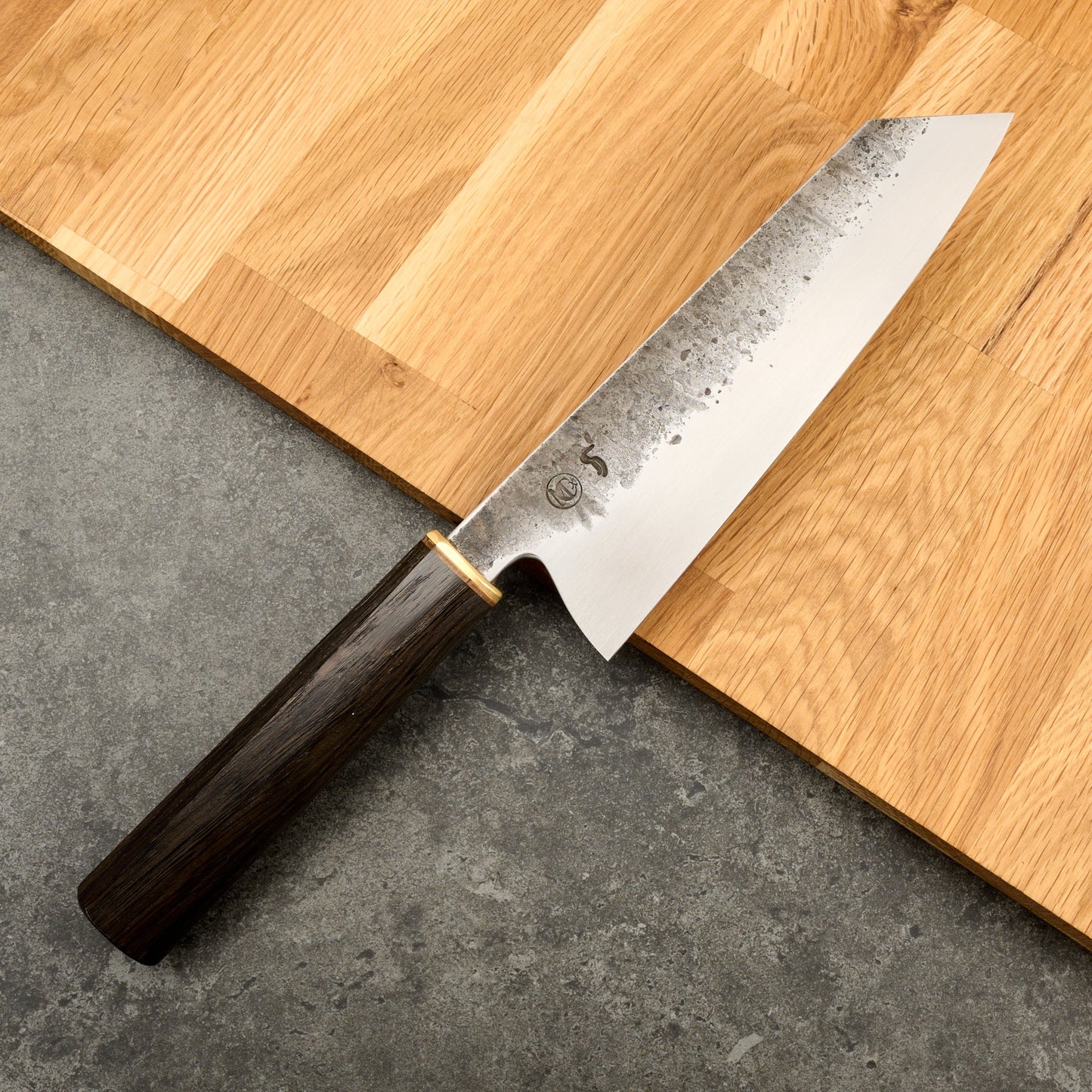
Bunka 190 mm Ebonisierte Eiche & Messing

Bunka 190 mm Ebonisierte Eiche & Messing

By MCX


Normaler Preis CHF 321.00
Normaler Preis Verkaufspreis CHF 321.00
Sale Ausverkauft
Inkl. Steuern. Versand wird beim Checkout berechnet

Nicht vorrätig

Anzahl
Diese MCX Bunka 190 mm wurde wieder einmal in Zusammenarbeit mit dem schwedischen Klingenschmied Fredrik Spåre entworfen. Das Messerdesign ist ein wenig von HADO Knives inspiriert, aber Fredrik ist auch ein großer Fan des Bunka und hat dem Messer sein eigenes klassisches Aussehen und Gefühl verliehen. Wir wollten etwas Subtileres in seinem Design liefern, mit klaren Linien und einem etwas weniger aggressiven Styling bei diesem Messer.

Mit dem klassischen, sich verjüngenden MCX-Rokkaku-Hanmaru-Griff, diesmal aus ebonisierter Eiche mit einem Abstandshalter aus Birkenrinde und einem Kropf aus Messing. Das Messer fühlt sich flink und leicht an und ist perfekt ausbalanciert. Etwas länger als ein traditionelles japanisches Bunka und mit einer distaleren Verjüngung ist die Klinge ein perfektes Alltagsmesser.

Die Klinge selbst ist aus 1.2419 Premium-Kohlenstoffstahl geschmiedet, es ist ein harter und zäher Stahl und hält eine sehr zahnige und scharfe Kante. Das Profil ist ein klassisches Bunka, eine relativ flache, subtile Kurve mit einer spitzen K-Spitze.

Die Klinge ist mit einem natürlichen Brute-de-Forge-Finish am Rücken und satinierten, polierten Fasen versehen, die Fredrik von Hand mit Wetzsteinen vollendet. Das Gesamtpaket ist ein dezent und klassisch aussehendes Messer, mit dem man gerne arbeitet.
Product Specification
  • Blade Type:
  • Edge Length: 190mm
  • Spine Heel: 3.55mm
  • Spine Mid: 1.8mm
  • Spine Tip (20mm before): 1.4mm
  • Blade Height: 53.3mm
  • Weight: 154g
  • Cutting Edge Steel:
  • Steel class: Carbon
  • HRC: 64
  • Blade Construction:
  • Blade Finish: Schmiedeeisen
  • Grind:
  • Handle Construction:
  • Handle Materials: Ebonised Oak, Birch Bark, Brass
  • Handedness: Beidhändig

Blade type

Bunka

文化

A close cousin of the santoku, distinguished by its reverse-tanto tip — an angular k-tip where the spine drops sharply to meet a mostly flat edge. The flat profile excels at push cutting, and the aggressive tip gives back the fine point work a santoku's rounded nose gives up, making the bunka a versatile mid-length all-rounder with a distinctive silhouette.

The bunka's appeal is as much geometry as style: the angular tip is excellent for detail and scoring but asks for a little respect, since the point sits lower and sharper than on a curved blade. Performance otherwise tracks the santoku closely, so the choice between them usually comes down to tip preference and how the knife feels in the hand.

View full knife type guide →

Cutting edge steel

1.2419

Low-alloy tungsten-chromium tool steel

Typical HRC
62–65
Corrosion class
Carbon
Production
Conventional
Origin
Germany (DIN 105WCr6); approximately the European 125SC family in spirit but more alloyed

1.2419 is the German tungsten-chromium tool steel that sits a clear step above the simple carbons in alloy content, with about 1.05 percent carbon, 1.0 percent chromium, and 1.1 percent tungsten. It is closely related to 1.2519 (which adds vanadium) and to its leaner sub-variant 1.2419.05.

In a kitchen knife it runs at 63–64 HRC, sharpens cleanly, and produces an edge with notably better wear resistance than W2 or 80CrV2. The W- and Cr-rich carbides do real work; toughness is good for the hardness, and patina behaviour is moderate. It is a steel that rewards a maker who can dial in heat treatment and grain control.

European bladesmiths have used 1.2419 for kitchen and outdoor knives for decades. It is well respected in the Solingen tradition and remains a credible choice for a refined carbon-edge knife. Among the makers Modern Cooking carries, Martin Huber, Karol Karyś, Fredrik Spåre, Michał Lipiński, and Birch & Bevel work in this steel. The community sometimes discusses 1.2419 in the same breath as Aogami #1 — not chemically identical, but in a similar performance neighbourhood.

View full steel guide →

Blade construction

Mono Steel

A knife forged from a single piece of steel — no laminations, no clad layers. The simplest and most direct construction. The entire blade is the cutting steel, with no softer outer jacket to protect or contrast it. Most contemporary Western kitchen knives in carbon and stainless steel are mono-steel constructions, as are honyaki and most European bladesmith work.

The trade-off is straightforward: mono-steel knives are easier to forge, sharpen, and reason about, but the entire blade carries the cutting steel's properties — including its reactivity if it's a clean carbon. There is no soft jacket to protect a more brittle core from impact, so the heat treatment and geometry have to do all the work.

View full construction guide →

Grind

Convex

A grind whose bevel bulges outward in a gentle curve from spine to edge, rather than running flat. That extra steel directly behind the edge makes a convex grind notably strong and resistant to chipping, while the curved geometry helps food release and lets the blade glide through dense ingredients with less wedging than a flat grind.

The strength comes at the cost of ultimate thinness and ease of maintenance. A convex edge has more metal behind it, so it is not quite as effortlessly keen as a thinly flat-ground edge, and it is harder to sharpen freehand — holding the curve takes a stropping technique or a deliberate hand rather than a single fixed angle. The reward is an exceptionally tough, smooth-cutting edge.

View full grind guide →

Handle construction

Hidden Tang

A construction in which the tang runs into the handle but stays concealed inside it, rather than showing between two scales. A narrower tang — a full-length stick or a shorter projection — is set into a drilled or burned channel in a one-piece handle and secured with adhesive, a friction fit, or a threaded fitting drawn up against the blade. This is the traditional construction of Japanese wa-handles and many European hidden-tang knives.

The design puts the handle material in charge of the look and feel: a single piece of wood, horn, or composite — often with a ferrule or spacers at the front — is shaped into any cross-section the maker wants, from the classic octagonal and D-shaped wa profiles to fully rounded Western forms. With no steel showing along the grip, the handle can be slim and light, and is frequently made to be removed and replaced, with the balance sitting toward the blade.

View full construction guide →

Shipping & Returns

Shipping

We process orders 5 days a week (Monday - Friday) and ship from our shop in Sydney, Australia. We ship with FedEx, UPS and DHL.

We are happy to offer free international shipping on a variety of orders depending on location and order value.

Free Shipping Regions and Minimum Order Values

For Australia and New Zealand the minimum is $500AUD. For the rest of the world it is approximately €1000EUR. The discount is applied automatically when you reach the minimum cart value at checkout.

Returns

If you're not entirely happy with your purchase, you can return it within 14 days of delivery for a refund. The item must be in its original condition with all original packaging.

  • Returns are accepted for 14 days
  • The customer is responsible for return shipping costs
  • A 15% restocking fee may be applied to change-of-mind returns
  • We do not accept returns on second-hand items for change of mind

Faulty or Damaged Items

You must notify us within 5 business days of receiving your order. Photographic evidence of damage is required. Once approved, Modern Cooking will cover return shipping costs.

Product Care

Cleaning: Clean by hand with warm water. Avoid wetting the handle when possible.

Sharpening: We advise using whetstones to sharpen your knives and a honing rod or steel to maintain the burr between sharpening sessions.

Reactive Steels: Reactive steels like Aogami Super, Apex Ultra or premium reactive German and Swedish steels are susceptible to rust if not properly cared for. Keep the knife dry between uses and when storing for longer periods, wiping the blade with Tsubaki oil or another food-safe oil is a wise choice. A patina can be a beautiful personal feature on your knife and helps to stop rust forming.

Handle Care: For non-stabilised wooden handles, apply Tsubaki oil or another food-safe oil from time to time. Food-safe wax can be applied to both stabilised and non-stabilised wooden handles. Never apply hot wax or oil as you risk warping or damaging the handle.

Vollständige Details anzeigen