Gyuto 240mm 100Cr6 Integral
Gyuto 240mm 100Cr6 Integral
By Martin Huber
No longer available
Our Sydney workshop is closed until Monday 9 November. Orders placed now are very welcome and will ship in the order received from Tuesday 10 November. Shipping details
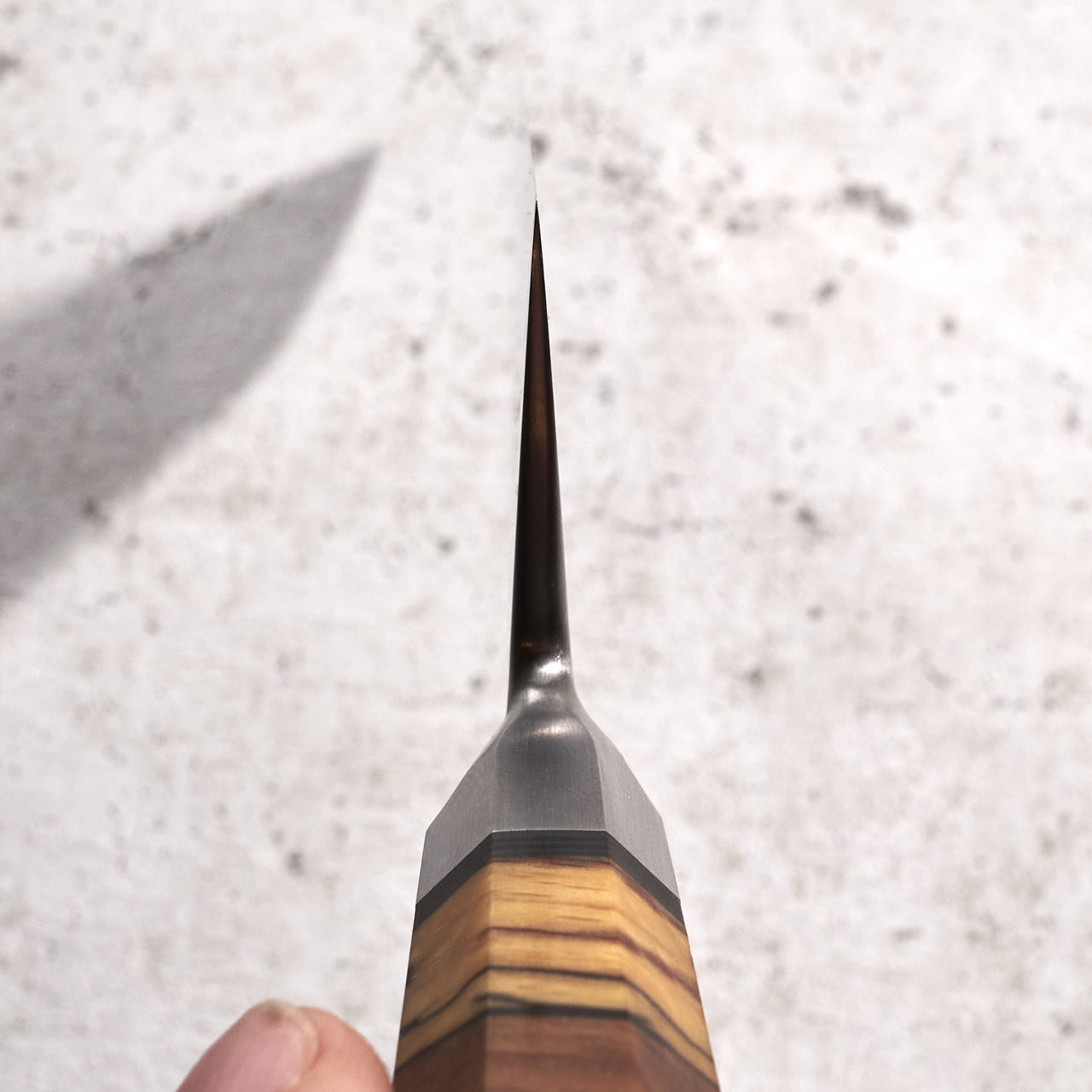
Martin Huber Gyuto 240 mm mit geschmiedetem Integralgriff, verschraubter Konstruktion mit verstecktem Erl und einer Klinge aus Monostahl (100Cr6). Die Klinge verfügt über ein hochglanzpoliertes, geschmiedetes Finish in der Nähe des Rückens, das eine schöne strukturierte Oberfläche zum Kneifen bietet. Unten wurde das Gesicht satiniert mit sichtbaren, aber konsistenten Schleiflinien, die diagonal nach unten zum Rand der Klinge reichen. Es ist ein wunderschöner Effekt, der perfekt mit der zementartigen Textur der geschmiedeten Oberfläche am Rücken harmoniert.
Wenn es um die Geometrie geht, weist dieses Holz einige aggressive Linien auf. Ein relativ dicker, aber spitz zulaufender Rücken und eine nadelähnliche K-Spitze sorgen für eine vielseitige Klinge, die ich als flinkes Arbeitstier bezeichnen würde. Das Kantenprofil ist ein klassisches japanisches Gyuto. Eine schön konvexe Klinge mit einer dünnen, scharfen Kante und einem robusten, aber spitz zulaufenden Rücken.
Es ist nur Ästhetik, aber Martin hat dieser Klinge ein Paar 45-Grad-Facetten entlang der Wirbelsäule gegeben, die sehr cool aussehen. Sie fühlen sich glatt an und wirken sich nur aus ästhetischer Sicht auf die Klinge aus, aber es ist ein nettes Merkmal und ein einzigartiges Aussehen.
Greifen Sie nach dem Griff und Sie werden sehr beeindruckt sein. Das geschmiedete Integral fühlt sich im Notfall sehr angenehm an und das Messer ist perfekt über diesen abgewinkelten Schultern ausbalanciert. Eine maßgeschneiderte achteckige Kombination aus Stahl, Karbon und einem schönen Stück stabilisierter, gespaltener Buche sorgt für eine sehr edle Kombination. Gepaart mit der polierten Klinge aus 100Cr6-Stahl ist das Gesamtpaket zu 100 % auf den Punkt gebracht!
Product Specification
- Blade Type:
- Edge Length: 240mm
- Spine Heel: 4.6mm
- Spine Mid: 3.26mm
- Spine Tip (20mm before): 1.2mm
- Blade Height: 55mm
- Weight: 281g
- Cutting Edge Steel:
- Steel class: Carbon
- HRC: 61+
- Blade Construction:
- Blade Finish: Schmiedeeisen
- Grind:
- Handle Construction:
- Handle Materials: Stabilised, Spalted Beech, Carbon
- Handedness: Beidhändig
Shipping & Returns
Shipping & Returns
Shipping
We process orders Monday to Friday from our Sydney workshop. Australian orders are shipped with Australia Post and international orders with DHL Express. Shipping charges are calculated at checkout based on destination, shipment size and weight, and the carrier service available for the order.
Returns
If you're not entirely happy with your purchase, you can return it within 14 days of delivery for a refund. The item must be in its original condition with all original packaging.
- Returns are accepted for 14 days
- The customer is responsible for return shipping costs
- A 15% restocking fee may be applied to change-of-mind returns
- We do not accept returns on second-hand items for change of mind
Faulty or Damaged Items
You must notify us within 5 business days of receiving your order. Photographic evidence of damage is required. Once approved, Modern Cooking will cover return shipping costs.
Product Care
Product Care
Cleaning: Clean by hand with warm water. Avoid wetting the handle when possible.
Sharpening: We advise using whetstones to sharpen your knives and a honing rod or steel to maintain the burr between sharpening sessions.
Reactive Steels: Reactive steels like Aogami Super, Apex Ultra or premium reactive German and Swedish steels are susceptible to rust if not properly cared for. Keep the knife dry between uses and when storing for longer periods, wiping the blade with Tsubaki oil or another food-safe oil is a wise choice. A patina can be a beautiful personal feature on your knife and helps to stop rust forming.
Handle Care: For non-stabilised wooden handles, apply Tsubaki oil or another food-safe oil from time to time. Food-safe wax can be applied to both stabilised and non-stabilised wooden handles. Never apply hot wax or oil as you risk warping or damaging the handle.