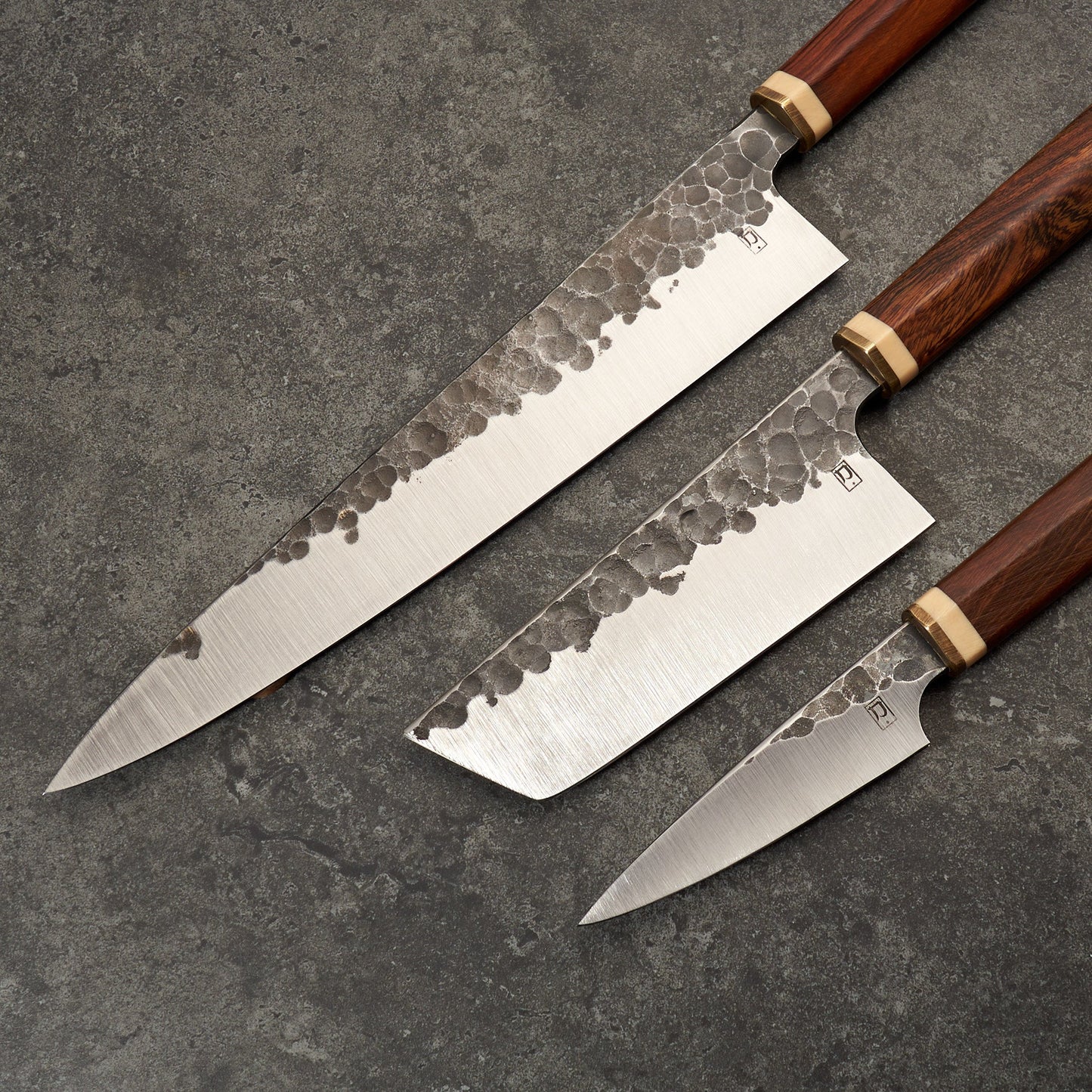
Wabi Sabi Küchenmesser-Set
Wabi Sabi Küchenmesser-Set
By Jim Dobbler
No longer available
Our Sydney workshop is closed until Monday 9 November. Orders placed now are very welcome and will ship in the order received from Tuesday 10 November. Shipping details
Das Wabi Sabi Küchenmesserset des amerikanischen Handwerksmeisters Jim Dobbler ist eine Auswahl einiger der nützlichsten Messer in der Waffenkammer des Kochs und in sehr passenden Größen. Dieses Gyuto-, Nakiri- und Petty-Set komplett mit Piotr dem Bären-Wandmagneten ist das ultimative Küchenmesser-Starter-Kit.
Das Herzstück des Sets ist ein vielseitiges 265-mm-Gyuto mit einem schlanken und eleganten Profil mit einem starren, sich verjüngenden Rücken. An der Kante ist das Messer etwa 25 % flach, mit einem schönen Bauch, der vor der Spitze in einer engen Kurve endet. Das Blatt fühlt sich auf dem Board sehr angenehm an, mit einem zufriedenstellenden Gewicht und einer zufriedenstellenden Balance. Das Profil eignet sich gut für Push/Pull-Cuts und wird für diese Rock Choppers bequem schaukeln. Ausgewogen für einen Zangengriff, das Gleichgewicht kann an der Markierung „Dobbler Made“ gefunden werden.
Neben dem Gyuto gibt es ein 130-mm-Nakiri-Gemüsemesser. Das Profil, eine Hommage an das Usuba-Erbe, ist sehr flach mit einer leichten Krümmung kurz vor dem Klingenende. Mit 130 mm fühlt sich die Klinge flink und agil an, bequemes Arbeiten mit Produkten in der Hand oder auf dem Brett. Die Kante ist superdünn und fühlt sich rasiermesserscharf an, perfekt für die detaillierte Gemüsezubereitung.
Abgerundet wird das Set durch einen 100 mm Petty. Neben dem Gyuto ist es eines der vielseitigsten Zubereitungsmesser und eine perfekte Ergänzung für dieses Set. Hier findet sich ein Spitzprofil mit ähnlichem Profil wie beim Gyuto. Es ist ein großartiges kleines Messer für Handarbeit und detailliertes Trimmen.
Die Klingen sind alle aus AEB-L-Edelstahl geschmiedet, einem sehr hochwertigen Stahl mit großer Schnitthaltigkeit und Härte (64HRC). Die Klingen sind alle unterschiedlich stark hohlgeschliffen, das Gyuto zum Beispiel ist ein sehr subtiler Hohlschliff, während das Petty und das Nakiri stärker ausgeprägt sind, je nach ihrem jeweiligen Verwendungszweck. Diese Hohlschliff-Geometrie verleiht den Klingen eine sehr scharfe Kante und eine hervorragende Schneidleistung.
Die Griffe bestehen aus einer Kombination aus Arizona-Eisenholz, Elfenbeinimitat und patiniertem Messing. Die Kombination ist umwerfend!
Passform und Verarbeitung dieser Klingen sind auf höchstem Niveau und in Kombination mit dem ultra-Premium 30 cm Piotr the Bear Küchenmesser-Magnet zur Wandmontage in amerikanischem Nussbaum haben Sie das ultimative Küchenmesser-Set.
Inbegriffen:
- Jim Dobbler Gyuto 265 mm AEB-l Wabi Sabi Serie
- Jim Dobbler Nakiri 130 mm AEB-l Wabi Sabi Serie
- Jim Dobbler Petty 100 mm AEB-l Wabi Sabi Serie
- Piotr the Bear 30cm Küchenmessermagnet zur Wandmontage American Walnut
Product Specification
- Blade Type:
- Edge Length: 265mm | 130mm | 100mm
- Spine Heel: 3.2mm | 3.2mm | 3.2mm
- Spine Mid: 2.8mm | 2.9mm | 3mm
- Spine Tip (20mm before): 1.5mm | 2.8mm | 1.4mm
- Blade Height: 53mm | 53.5mm | 28mm
- Weight: 2.35g | 1.94g | 90g
- Cutting Edge Steel:
- Steel class: Carbon
- HRC: 64+
- Blade Construction:
- Blade Finish: Strukturiert, Kurouchi
- Grind:
- Handle Construction:
- Handle Materials: Arizona Ironwood, Imitation Ivory and patinated brass
- Handedness: Beidhändig
Shipping & Returns
Shipping & Returns
Shipping
We process orders Monday to Friday from our Sydney workshop. Australian orders are shipped with Australia Post and international orders with DHL Express. Shipping charges are calculated at checkout based on destination, shipment size and weight, and the carrier service available for the order.
Returns
If you're not entirely happy with your purchase, you can return it within 14 days of delivery for a refund. The item must be in its original condition with all original packaging.
- Returns are accepted for 14 days
- The customer is responsible for return shipping costs
- A 15% restocking fee may be applied to change-of-mind returns
- We do not accept returns on second-hand items for change of mind
Faulty or Damaged Items
You must notify us within 5 business days of receiving your order. Photographic evidence of damage is required. Once approved, Modern Cooking will cover return shipping costs.
Product Care
Product Care
Cleaning: Clean by hand with warm water. Avoid wetting the handle when possible.
Sharpening: We advise using whetstones to sharpen your knives and a honing rod or steel to maintain the burr between sharpening sessions.
Reactive Steels: Reactive steels like Aogami Super, Apex Ultra or premium reactive German and Swedish steels are susceptible to rust if not properly cared for. Keep the knife dry between uses and when storing for longer periods, wiping the blade with Tsubaki oil or another food-safe oil is a wise choice. A patina can be a beautiful personal feature on your knife and helps to stop rust forming.
Handle Care: For non-stabilised wooden handles, apply Tsubaki oil or another food-safe oil from time to time. Food-safe wax can be applied to both stabilised and non-stabilised wooden handles. Never apply hot wax or oil as you risk warping or damaging the handle.