Zu Produktinformationen springen
1 von 4

Petty 100 mm AEB-L Wabi Sabi

Petty 100 mm AEB-L Wabi Sabi

By Jim Dobbler


No longer available

Jim Dobbler

Reserve your place

We'll only email you when there's something to say. Invitations go out in signup order as new work becomes available.

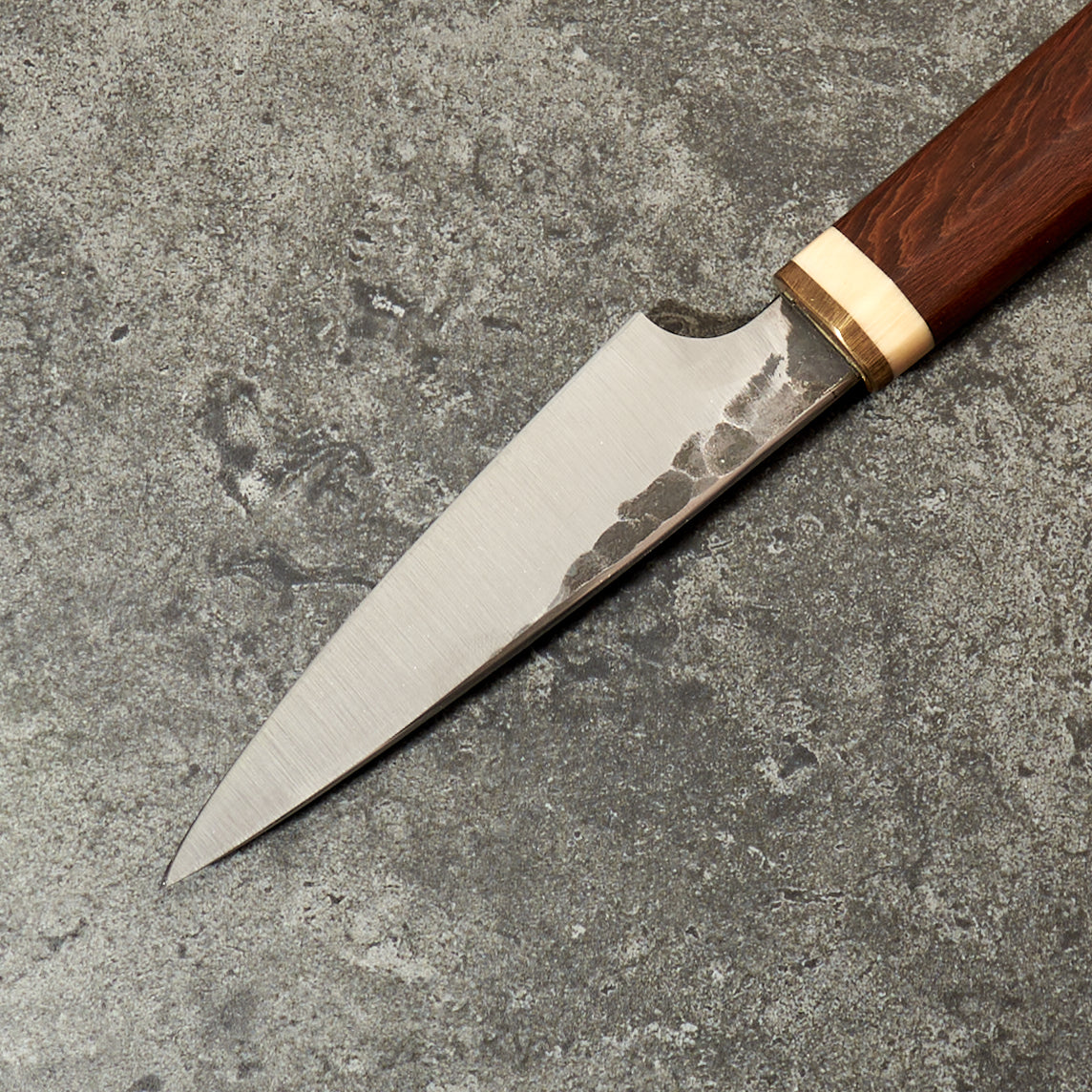
Ein von Jim Dobbler geschmiedeter 100 mm Petty. Neben dem Gyuto ist es eines der vielseitigsten Zubereitungsmesser und eine perfekte Ergänzung in jeder Küche. Hier findet sich ein spitzes Profil ähnlich dem größeren Wabi Sabi Gyuto. Es ist ein großartiges kleines Messer für Handarbeit und detailliertes Trimmen.

Die Klinge ist aus rostfreiem AEB-L-Stahl geschmiedet, einem sehr hochwertigen Stahl mit großer Schnitthaltigkeit und Härte (64 HRC). Mit einer subtilen Hohlschliffgeometrie ist die Klinge sehr scharf und eignet sich hervorragend für feine Detailarbeiten. Der Hohlschliff verleiht diesem kleinen Petty eine rasiermesserscharfe Kante und das spitze Profil ist eine Freude beim Trimmen, Schälen und Schälen, wie es der Zweck dieses Messers ist.

Der Griff besteht aus einer Kombination aus Arizona-Eisenholz, Elfenbeinimitat und patiniertem Messing. Die Kombination ist umwerfend!

Passform und Verarbeitung dieser Klinge sind auf höchstem Niveau und es ist eine Freude, das Messer zu benutzen.

    Product Specification
    • Blade Type:
    • Edge Length: 100mm
    • Spine Heel: 3.2mm
    • Spine Mid: 3mm
    • Spine Tip (20mm before): 1.4mm
    • Blade Height: 28mm
    • Weight: 90g
    • Cutting Edge Steel:
    • Steel class: Carbon
    • HRC: 64+
    • Blade Construction:
    • Blade Finish: Strukturiert, Kurouchi
    • Grind:
    • Handle Construction:
    • Handle Materials: Arizona Ironwood, Imitation Ivory and patinated brass
    • Handedness: Beidhändig

    Blade type

    Petty

    ペティ

    The Japanese small utility knife — the name comes from the French petit — typically 120 to 150 mm. A petty bridges the gap between a paring knife and a chef's knife: long enough for in-hand work like peeling and trimming, yet precise enough for detailed board tasks such as slicing shallots, segmenting fruit, or breaking down small items where a full-size blade is unwieldy.

    Its versatility is the point, and so is its ceiling. A petty is nimble and confidence-inspiring for fine work, but the short blade and light build make it inefficient for high-volume chopping or anything large. Most cooks keep one as the constant companion to a larger knife rather than as a primary.

    View full knife type guide →

    Cutting edge steel

    AEB-L

    Fine-grain martensitic stainless steel

    Typical HRC
    60–63
    Corrosion class
    Stainless
    Production
    Conventional
    Origin
    Sweden (Uddeholm)

    AEB-L is the original fine-grain razor stainless — a steel developed for safety razor blades and rediscovered by knifemakers as one of the most refined stainless choices available. About 0.67 percent carbon and 13 percent chromium, with very low impurity content, allow the steel to take a near-carbon-grade edge while remaining genuinely stainless.

    In a custom or boutique kitchen knife AEB-L typically lands at 60–62 HRC, sharpens with the easy feel of a clean carbon, and produces a polished apex that holds an edge longer than its modest carbide content might suggest. Toughness is exceptional: at 62 HRC, AEB-L compares well to 52100 at the same hardness in published toughness data, which is the point that contemporary metallurgical writing on the steel has emphasised. It is the steel that taught a generation of makers that stainless need not feel coarse.

    AEB-L is heavily used in the modern American custom scene and is an honest answer to the cook who wants the feel of a clean carbon without the maintenance burden. Among the makers Modern Cooking carries, Lew Griffin and Oliver Märtens work in AEB-L. It is closely related to Sandvik 13C26 and a direct ancestor of 14C28N.

    View full steel guide →

    Blade construction

    Mono Steel

    A knife forged from a single piece of steel — no laminations, no clad layers. The simplest and most direct construction. The entire blade is the cutting steel, with no softer outer jacket to protect or contrast it. Most contemporary Western kitchen knives in carbon and stainless steel are mono-steel constructions, as are honyaki and most European bladesmith work.

    The trade-off is straightforward: mono-steel knives are easier to forge, sharpen, and reason about, but the entire blade carries the cutting steel's properties — including its reactivity if it's a clean carbon. There is no soft jacket to protect a more brittle core from impact, so the heat treatment and geometry have to do all the work.

    View full construction guide →

    Grind

    Hollow

    A grind with concave bevels, ground into the blade with a curved wheel so the sides scoop inward toward the edge. Removing that steel leaves an exceptionally thin, keen cutting edge and a noticeable air gap behind it, which can aid release on certain foods. The geometry produces a very sharp apex with minimal effort.

    That thinness is also the weakness. A hollow-ground edge has little steel supporting it, so it is more prone to rolling or chipping under hard use and loses its bite once sharpening reaches the thicker steel above the hollow. It suits slicing tasks and precision work, and is poorly matched to heavy or careless cutting.

    View full grind guide →

    Handle construction

    Hidden Tang

    A construction in which the tang runs into the handle but stays concealed inside it, rather than showing between two scales. A narrower tang — a full-length stick or a shorter projection — is set into a drilled or burned channel in a one-piece handle and secured with adhesive, a friction fit, or a threaded fitting drawn up against the blade. This is the traditional construction of Japanese wa-handles and many European hidden-tang knives.

    The design puts the handle material in charge of the look and feel: a single piece of wood, horn, or composite — often with a ferrule or spacers at the front — is shaped into any cross-section the maker wants, from the classic octagonal and D-shaped wa profiles to fully rounded Western forms. With no steel showing along the grip, the handle can be slim and light, and is frequently made to be removed and replaced, with the balance sitting toward the blade.

    View full construction guide →

    Shipping & Returns

    Shipping

    We process orders 5 days a week (Monday - Friday) and ship from our shop in Sydney, Australia. We ship with FedEx, UPS and DHL.

    We are happy to offer free international shipping on a variety of orders depending on location and order value.

    Free Shipping Regions and Minimum Order Values

    For Australia and New Zealand the minimum is $500AUD. For the rest of the world it is approximately €1000EUR. The discount is applied automatically when you reach the minimum cart value at checkout.

    Returns

    If you're not entirely happy with your purchase, you can return it within 14 days of delivery for a refund. The item must be in its original condition with all original packaging.

    • Returns are accepted for 14 days
    • The customer is responsible for return shipping costs
    • A 15% restocking fee may be applied to change-of-mind returns
    • We do not accept returns on second-hand items for change of mind

    Faulty or Damaged Items

    You must notify us within 5 business days of receiving your order. Photographic evidence of damage is required. Once approved, Modern Cooking will cover return shipping costs.

    Product Care

    Cleaning: Clean by hand with warm water. Avoid wetting the handle when possible.

    Sharpening: We advise using whetstones to sharpen your knives and a honing rod or steel to maintain the burr between sharpening sessions.

    Reactive Steels: Reactive steels like Aogami Super, Apex Ultra or premium reactive German and Swedish steels are susceptible to rust if not properly cared for. Keep the knife dry between uses and when storing for longer periods, wiping the blade with Tsubaki oil or another food-safe oil is a wise choice. A patina can be a beautiful personal feature on your knife and helps to stop rust forming.

    Handle Care: For non-stabilised wooden handles, apply Tsubaki oil or another food-safe oil from time to time. Food-safe wax can be applied to both stabilised and non-stabilised wooden handles. Never apply hot wax or oil as you risk warping or damaging the handle.

    Vollständige Details anzeigen