Zu Produktinformationen springen
1 von 10

Gyuto 240 mm Full Kasumi Integral Birkenrinde & Messing

Gyuto 240 mm Full Kasumi Integral Birkenrinde & Messing

By Isasmedjan


No longer available

Jonas Johnsson

Reserve your place

We'll only email you when there's something to say. Invitations go out in signup order as new work becomes available.

Manche Klingenschmiede legen Wert auf technische Details, manche legen Wert auf klare Linien, wieder andere setzen gerne auf technische Geometrie. Während Jonas sicherlich immer auf Leistung fokussiert ist, dreht sich bei seiner Arbeit alles um Herz und Seele. Bedenken Sie, dass die Herstellung des hier vorgestellten Messers ungefähr ein Jahr gedauert hat. Ab Frühjahr 2021 wäre Jonas in die umliegenden Wälder rund um seine Schmiede gegangen und hätte die Birkenrinde geerntet, die für den Griff dieses Messers verwendet wird. Er musste die Rinde über den Sommer lagern und trocknen und jede Schicht des Griffs, den Sie hier sehen, kunstvoll auswählen.

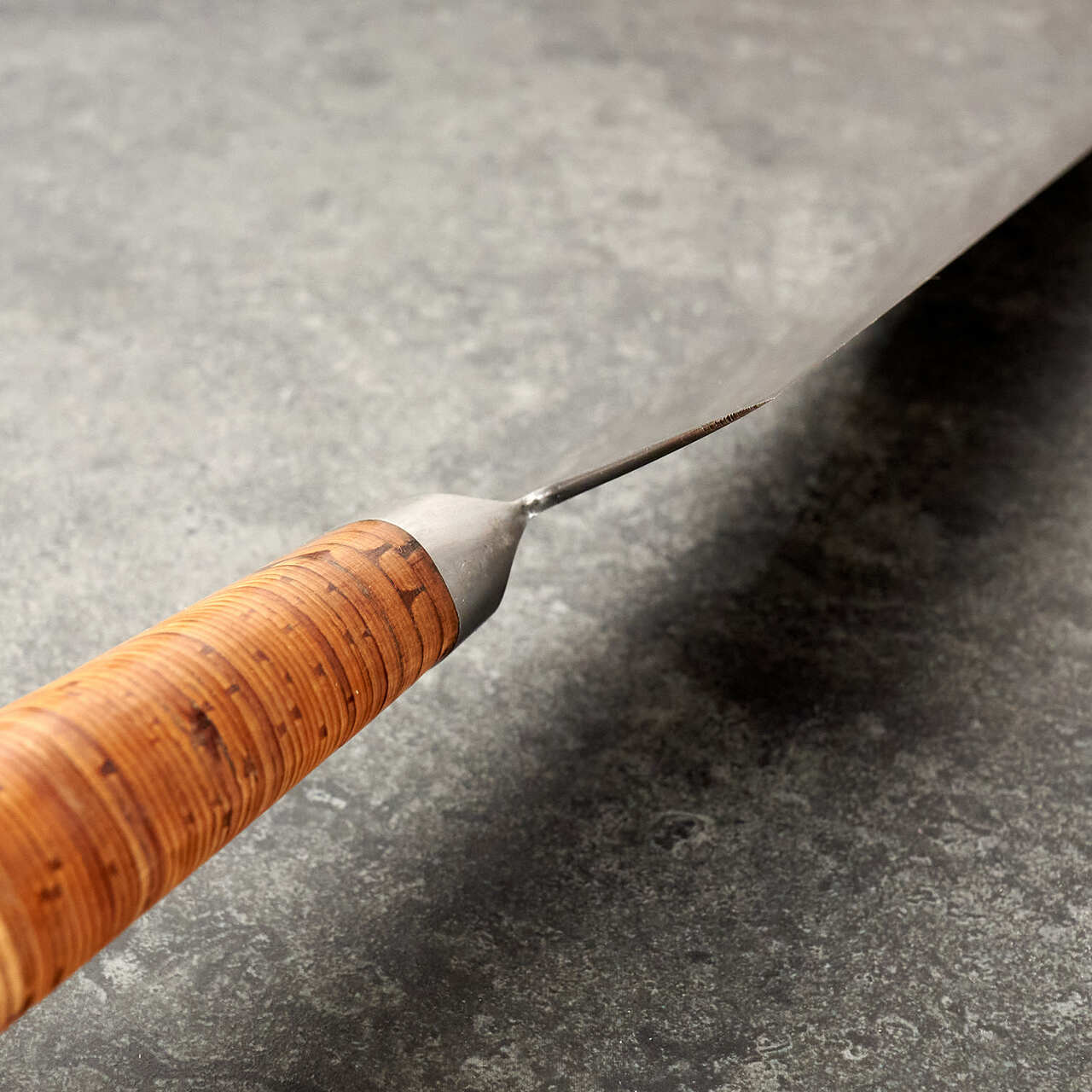
Das ist jedoch nur der Anfang für ein solches Messer. Geschmiedeter San-Mai-Stahl, der für diese Klinge verwendete Stahl wurde zusammengepresst, ein Sandwich aus Schmiedeeisen und hochwertigem deutschem Werkzeugstahl, der zusammengeschweißt und dann Stahl auf Stahl, Hitze für Hitze, in die raue Form einer Klinge geschlagen wurde. Der integrierte Kropf wird mit dem Hammerschlag in Form gebracht. Durch das Schleifen wird die Gesamtform der Klinge verfeinert, bevor stundenlang mit Schleifsteinen poliert wird, um das Kasumi-Finish (Nebel) zu erzeugen. Das ist viel Liebe!

Ein Isasmedjan-Messer wird dir ans Herz wachsen. Rustikal bedeutet sicherlich nicht rau, Passform und Verarbeitung sind hervorragend. Anstatt das Wort rustikal zu verwenden, um diese Messer zu beschreiben, wäre es besser zu sagen, dass sie charaktervoll, charmant, mit liebenswertem Stil und Klasse sind.

Wie beschrieben, verfügt dieses Messer über eine vollständige Kasumi-Politur, eine schmiedeeiserne Ummantelung und einen sehr zähen HRC 64+, 1.2419.05-Stahlkern. Der Griff ist eine handgeerntete Birkenrinde, Rokaku Hanmaru, geschmiedet mit einer schmiedeeisernen Endplatte und einem Messingstift.

Das Profil ist Jonas' klassisches Gyuto mit Santoku-Spitze, mit einem anständigen flachen Abschnitt, der sich allmählich in eine Kurve zur Spitze hin einpendelt. Die Santoku-Spitze verleiht dem Messer Steifigkeit, dies ist keine flexible Klinge. Stabil, zufriedenstellend gewichtet und gut ausbalanciert. Wir sprechen hier jedoch nicht von Arbeitstierschliff, das Messer hat eine dünne, durchschnittliche Klingenstärke von weniger als 2 mm.

Insgesamt ein Vergnügen, mit dem Schneidebrett zu arbeiten.

Zwischen dem schönen Griff aus Birkenrinde und dem geschmiedeten integralen Kropf, der seidig glatten Kasumi-Politur und dem kunstvoll gefertigten Leistungsprofil und Schliff ist es schwer, dieses Stück als etwas anderes als funktionale Kunst zu beschreiben.

Product Specification
  • Blade Type:
  • Edge Length: 240mm
  • Spine Heel: 2.95mm
  • Spine Mid: 1.98mm
  • Spine Tip (20mm before): 1.2mm
  • Blade Height: 52mm
  • Weight: 234g
  • Cutting Edge Steel:
  • Steel class: Carbon
  • HRC: 64+
  • Blade Construction:
  • Blade Finish: Mattpolitur
  • Grind:
  • Handle Construction:
  • Handle Materials: Hand Harvested Birchbark, Wrought Iron and Brass
  • Handedness: Beidhändig

Blade type

Gyuto

牛刀

The Japanese take on the Western chef's knife, and the most versatile blade in a modern kitchen. A gyuto carries a long, gently curved edge — most often 210 to 270 mm — that allows both push cuts and a rocking motion, with a pointed tip for fine work and enough height at the heel to keep knuckles clear of the board. It handles proteins, vegetables, and herbs without complaint, which is why most cooks reach for it first.

Compared with a European chef's knife, the gyuto is usually thinner, harder, and lighter, ground to a finer edge that rewards good board technique and regular honing. That same thinness is the trade-off: the edge is less forgiving of bone, frozen food, and twisting cuts, and it asks for a little more care in maintenance in exchange for its keenness.

View full knife type guide →

Cutting edge steel

1.2419.05

Low-alloy tungsten-chromium oil-hardening tool steel (variant of 1.2419)

Typical HRC
60–63
Corrosion class
Carbon
Production
Conventional
Origin
Germany

1.2419.05 is the leaner, oil-hardening sub-variant of 1.2419, with somewhat reduced carbon and tungsten — closer to a 95WCr5 in spirit. The "0.05" designation signals an oil-quench specification rather than a wholly separate alloy.

For kitchen knife purposes, 1.2419.05 sits between the simple carbons and full 1.2419 in performance: a slightly easier heat treat, slightly less edge retention, similar feel at the stone. It is a sensible "step up from W2" steel for a smith who values forgiving heat treatment and a cook who values an honest, no-drama carbon edge. Toughness is good; patina behaviour is conventional.

It is uncommon enough in finished knives that you will rarely see it called out by name; when you do, treat it as a near-relative of full 1.2419 with marginally different working characteristics. Among the makers Modern Cooking carries, Martin Huber and Adonis Forged Arts work in 1.2419.05.

View full steel guide →

Blade construction

Laminated Steel

A category covering knives built from multiple layers of different steels forge-welded together. The hard cutting steel is sandwiched between softer outer layers (cladding) that protect the core, add toughness, and often contribute visual contrast.

The most common laminated constructions in the Modern Cooking catalogue are:

SanMai (三枚) — three layers: hard cutting steel in the centre, softer cladding on both sides. The traditional and most common form.

GoMai (五枚) — five layers: a hard core, two intermediate layers, and two outer layers. Adds visual depth and structural complexity.

KuMai (九枚) — nine layers: similar logic, with more cladding layers for additional pattern and structural variation.

GoMai and KuMai are often chosen not only for the additional layers and visual depth, but also because the intermediate layers can act as a nickel diffusion barrier — limiting carbon migration out of the core into the cladding during forge welding, and protecting the core's intended carbon content through the heat of the forging process.

In all cases the cutting performance is determined by the core steel; the outer layers are cosmetic and structural. The lamination contributes corrosion protection (when a stainless jacket clads a carbon core), reduced reactivity, and the visible boundary between core and cladding that gives the knife its character.

View full construction guide →

Grind

Convex

A grind whose bevel bulges outward in a gentle curve from spine to edge, rather than running flat. That extra steel directly behind the edge makes a convex grind notably strong and resistant to chipping, while the curved geometry helps food release and lets the blade glide through dense ingredients with less wedging than a flat grind.

The strength comes at the cost of ultimate thinness and ease of maintenance. A convex edge has more metal behind it, so it is not quite as effortlessly keen as a thinly flat-ground edge, and it is harder to sharpen freehand — holding the curve takes a stropping technique or a deliberate hand rather than a single fixed angle. The reward is an exceptionally tough, smooth-cutting edge.

View full grind guide →

Handle construction

Hidden Tang

A construction in which the tang runs into the handle but stays concealed inside it, rather than showing between two scales. A narrower tang — a full-length stick or a shorter projection — is set into a drilled or burned channel in a one-piece handle and secured with adhesive, a friction fit, or a threaded fitting drawn up against the blade. This is the traditional construction of Japanese wa-handles and many European hidden-tang knives.

The design puts the handle material in charge of the look and feel: a single piece of wood, horn, or composite — often with a ferrule or spacers at the front — is shaped into any cross-section the maker wants, from the classic octagonal and D-shaped wa profiles to fully rounded Western forms. With no steel showing along the grip, the handle can be slim and light, and is frequently made to be removed and replaced, with the balance sitting toward the blade.

View full construction guide →

Shipping & Returns

Shipping

We process orders 5 days a week (Monday - Friday) and ship from our shop in Sydney, Australia. We ship with FedEx, UPS and DHL.

We are happy to offer free international shipping on a variety of orders depending on location and order value.

Free Shipping Regions and Minimum Order Values

For Australia and New Zealand the minimum is $500AUD. For the rest of the world it is approximately €1000EUR. The discount is applied automatically when you reach the minimum cart value at checkout.

Returns

If you're not entirely happy with your purchase, you can return it within 14 days of delivery for a refund. The item must be in its original condition with all original packaging.

  • Returns are accepted for 14 days
  • The customer is responsible for return shipping costs
  • A 15% restocking fee may be applied to change-of-mind returns
  • We do not accept returns on second-hand items for change of mind

Faulty or Damaged Items

You must notify us within 5 business days of receiving your order. Photographic evidence of damage is required. Once approved, Modern Cooking will cover return shipping costs.

Product Care

Cleaning: Clean by hand with warm water. Avoid wetting the handle when possible.

Sharpening: We advise using whetstones to sharpen your knives and a honing rod or steel to maintain the burr between sharpening sessions.

Reactive Steels: Reactive steels like Aogami Super, Apex Ultra or premium reactive German and Swedish steels are susceptible to rust if not properly cared for. Keep the knife dry between uses and when storing for longer periods, wiping the blade with Tsubaki oil or another food-safe oil is a wise choice. A patina can be a beautiful personal feature on your knife and helps to stop rust forming.

Handle Care: For non-stabilised wooden handles, apply Tsubaki oil or another food-safe oil from time to time. Food-safe wax can be applied to both stabilised and non-stabilised wooden handles. Never apply hot wax or oil as you risk warping or damaging the handle.

Vollständige Details anzeigen