Zu Produktinformationen springen
1 von 5

Gyuto 250mm „Gleanntán“ KuMai AEB-L, Ni, Spicy White, Ni, RWL34

Gyuto 250mm „Gleanntán“ KuMai AEB-L, Ni, Spicy White, Ni, RWL34

By Erik Gullikson


No longer available

Erik Gullikson

Reserve your place

We'll only email you when there's something to say. Invitations go out in signup order as new work becomes available.

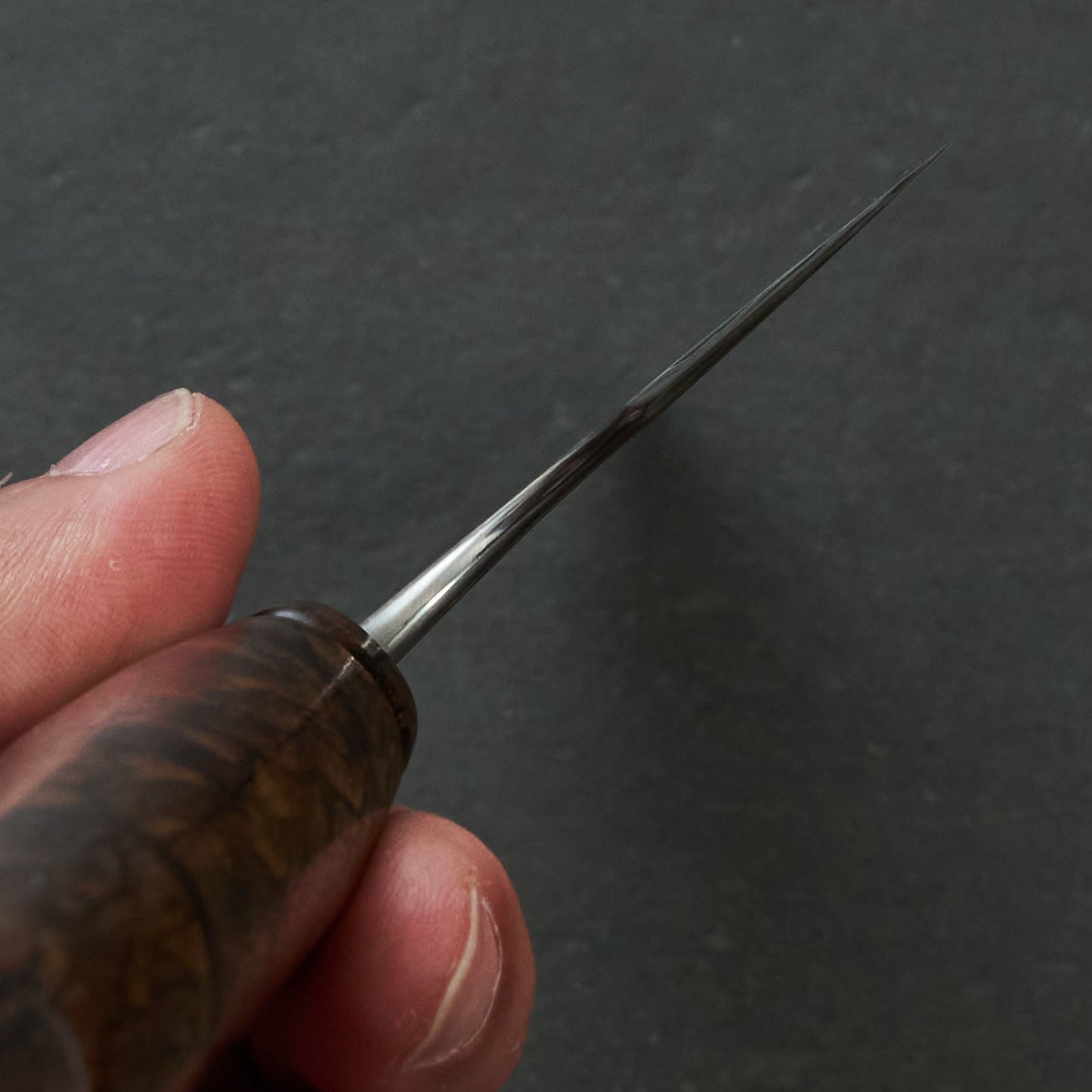
Dieses einzigartige, handgefertigte Küchenmesser ist das Werk des Kunsthandwerkers Erik Gullikson, der für seine Präzisionstechnik und sein skulpturales Design bekannt ist. Als moderne Interpretation des japanischen Gyuto ist diese Klinge auf Vielseitigkeit ausgelegt – vom feinen Schneiden bis hin zu schwereren Zubereitungsarbeiten. Ihre Form wird durch einen stark verjüngten Rücken bestimmt, der die Klinge zur Spitze hin leichter macht und so Kontrolle und Beweglichkeit in der Hand verbessert. Die Gesamtbalance und Spannung des Profils drücken aus jedem Blickwinkel Leistung und Handwerkskunst aus.

Kernstück seiner Funktion ist der raffinierte Walkschliff-Schliff, eine von Solingen inspirierte Geometrie, die hier präzise und zurückhaltend umgesetzt wurde. Anders als bei herkömmlichen Schliffen, bei denen die Klinge am Rücken am dicksten ist, verlagert der Walkschliff die Masse direkt unter den Rücken, sodass die Spitze schlank bleibt und gleichzeitig die Steifigkeit erhalten bleibt. Diese Struktur verjüngt sich nach unten zu einer dünnen, leicht konvexen Schneide, was zu geringerer Reibung, sauberem Ablösen des Schneidguts und hervorragender Stabilität führt. In Kombination mit der markanten Verjüngung der Klinge sorgt diese Geometrie für ein Messer, das sich schnell und sicher anfühlt – es gleitet mühelos und kontrolliert durch das Schneidgut.

Der Stahl ist eine charakteristische Innovation aus Eriks Werkstatt. Die im eigenen Haus geschmiedete neunlagige Patina Vale-Konstruktion besteht aus einem Damasteel RWL34-Kern, durchsetzt mit Nickel, würzigem weißem 26c3-Kohlenstoffstahl und AEB-L. Bemerkenswert ist, dass der Kohlenstoffstahl im äußeren Laminat – nicht im Kern – platziert ist, wo er mit der Zeit patiniert. Mit zunehmendem Alter des Messers entwickelt diese Kohlenstoffschicht einen unverwechselbaren „Fluss“ aus Lila- und Blautönen, umrahmt von der Stabilität und Korrosionsbeständigkeit seiner rostfreien Gegenstücke. Der Griff spiegelt diese Harmonie aus Kontrast und Handwerkskunst wider: Ein geometrischer Kropf in Erbstückform aus burgunderfarbenem Paperstone geht in einen stabilisierten Korpus in Choco Mango über, der durch einen Nickel-Abstandshalter getrennt und mit einer fein geschnitzten runden Rille versehen ist. Kühn, ausgewogen und zutiefst durchdacht, spiegelt dieses Messer einen Hersteller auf dem Höhepunkt seiner Karriere wider – es lädt zum Gebrauch ein, altert mit Würde und erzählt eine Geschichte in Stahl.

Product Specification
  • Blade Type:
  • Overall Length: 360 mm
  • Edge Length: 250mm
  • Spine Heel: 5mm
  • Spine Mid: 1.8mm
  • Spine Tip (20mm before): 1.2mm
  • Blade Height: 68mm
  • Weight: 188g
  • Cutting Edge Steel:
  • Steel class: Stainless
  • HRC: 64
  • Blade Construction:
  • Blade Finish: SatinpoliturSäuregeätzt (erzwungene Patina)
  • Grind:
  • Handle Construction:
  • Handle Materials: Stabilised Choco Mango, Nickel, PapperStone
  • Handedness: Beidhändig

Blade type

Gyuto

牛刀

The Japanese take on the Western chef's knife, and the most versatile blade in a modern kitchen. A gyuto carries a long, gently curved edge — most often 210 to 270 mm — that allows both push cuts and a rocking motion, with a pointed tip for fine work and enough height at the heel to keep knuckles clear of the board. It handles proteins, vegetables, and herbs without complaint, which is why most cooks reach for it first.

Compared with a European chef's knife, the gyuto is usually thinner, harder, and lighter, ground to a finer edge that rewards good board technique and regular honing. That same thinness is the trade-off: the edge is less forgiving of bone, frozen food, and twisting cuts, and it asks for a little more care in maintenance in exchange for its keenness.

View full knife type guide →

Cutting edge steel

RWL34 / RWL

Powder metallurgy martensitic stainless tool steel

Typical HRC
60–63
Corrosion class
Stainless
Production
Powder
Origin
Sweden (Damasteel)

RWL34 — usually shortened to RWL — is Damasteel's powder-route stainless equivalent of ATS-34 / CPM-154, and is the bright-and-hard layer in much of the world's high-end stainless damascus. The composition (1.05 percent carbon, 14 percent chromium, 4 percent molybdenum, 0.2 percent vanadium) is essentially ATS-34 chemistry, but the rapid-solidification powder process produces a finer, cleaner microstructure than the conventional ingot route.

In a kitchen knife — usually a Damasteel-pattern blade — RWL34 runs at 60–62 HRC, sharpens cleanly, and produces a refined edge that holds well for the class. Edge retention is in the same band as SG2 at slightly lower hardness; toughness is good; corrosion resistance is excellent. The named association with Robert W. Loveless, the steel's original collaborator on the design, is half of the steel's mystique.

You see RWL most often as a mono-steel core in high-end custom work and as the contrast layer in Damasteel patterns. Among the makers Modern Cooking carries, Bernhard Noitz, Erik Gullikson, Evan Antzenberger, Jeroen Knippenberg, and Birch & Bevel work in RWL. It is a genuinely nice premium stainless that is somewhat under-discussed compared to the American powder steels.

View full steel guide →

Blade construction

Laminated Steel

A category covering knives built from multiple layers of different steels forge-welded together. The hard cutting steel is sandwiched between softer outer layers (cladding) that protect the core, add toughness, and often contribute visual contrast.

The most common laminated constructions in the Modern Cooking catalogue are:

SanMai (三枚) — three layers: hard cutting steel in the centre, softer cladding on both sides. The traditional and most common form.

GoMai (五枚) — five layers: a hard core, two intermediate layers, and two outer layers. Adds visual depth and structural complexity.

KuMai (九枚) — nine layers: similar logic, with more cladding layers for additional pattern and structural variation.

GoMai and KuMai are often chosen not only for the additional layers and visual depth, but also because the intermediate layers can act as a nickel diffusion barrier — limiting carbon migration out of the core into the cladding during forge welding, and protecting the core's intended carbon content through the heat of the forging process.

In all cases the cutting performance is determined by the core steel; the outer layers are cosmetic and structural. The lamination contributes corrosion protection (when a stainless jacket clads a carbon core), reduced reactivity, and the visible boundary between core and cladding that gives the knife its character.

View full construction guide →

Grind

Walkschliff

A traditional Solingen grind — also called a kettle or kessel bulge grind — in which the blade is hollowed high on the side so its thickest point sits a little below the spine rather than at it. Below that bulge the steel is taken down to an extremely thin, finely convexed cutting edge, combining the rigidity of a thick upper blade with the keenness of a very thin one.

The Walkschliff is among the most demanding grinds to execute, historically reserved for the finest German knives and requiring years of a grinder's experience to do well. For the buyer it is a high-craft European alternative to the thin flat grinds of Japanese knives — strong, stable, and keen — but it is a hand-ground specialism, and a knife that carries it is priced for the skill it took to make.

View full grind guide →

Handle construction

Hidden Tang

A construction in which the tang runs into the handle but stays concealed inside it, rather than showing between two scales. A narrower tang — a full-length stick or a shorter projection — is set into a drilled or burned channel in a one-piece handle and secured with adhesive, a friction fit, or a threaded fitting drawn up against the blade. This is the traditional construction of Japanese wa-handles and many European hidden-tang knives.

The design puts the handle material in charge of the look and feel: a single piece of wood, horn, or composite — often with a ferrule or spacers at the front — is shaped into any cross-section the maker wants, from the classic octagonal and D-shaped wa profiles to fully rounded Western forms. With no steel showing along the grip, the handle can be slim and light, and is frequently made to be removed and replaced, with the balance sitting toward the blade.

View full construction guide →

Shipping & Returns

Shipping

We process orders 5 days a week (Monday - Friday) and ship from our shop in Sydney, Australia. We ship with FedEx, UPS and DHL.

We are happy to offer free international shipping on a variety of orders depending on location and order value.

Free Shipping Regions and Minimum Order Values

For Australia and New Zealand the minimum is $500AUD. For the rest of the world it is approximately €1000EUR. The discount is applied automatically when you reach the minimum cart value at checkout.

Returns

If you're not entirely happy with your purchase, you can return it within 14 days of delivery for a refund. The item must be in its original condition with all original packaging.

  • Returns are accepted for 14 days
  • The customer is responsible for return shipping costs
  • A 15% restocking fee may be applied to change-of-mind returns
  • We do not accept returns on second-hand items for change of mind

Faulty or Damaged Items

You must notify us within 5 business days of receiving your order. Photographic evidence of damage is required. Once approved, Modern Cooking will cover return shipping costs.

Product Care

Cleaning: Clean by hand with warm water. Avoid wetting the handle when possible.

Sharpening: We advise using whetstones to sharpen your knives and a honing rod or steel to maintain the burr between sharpening sessions.

Reactive Steels: Reactive steels like Aogami Super, Apex Ultra or premium reactive German and Swedish steels are susceptible to rust if not properly cared for. Keep the knife dry between uses and when storing for longer periods, wiping the blade with Tsubaki oil or another food-safe oil is a wise choice. A patina can be a beautiful personal feature on your knife and helps to stop rust forming.

Handle Care: For non-stabilised wooden handles, apply Tsubaki oil or another food-safe oil from time to time. Food-safe wax can be applied to both stabilised and non-stabilised wooden handles. Never apply hot wax or oil as you risk warping or damaging the handle.

Vollständige Details anzeigen