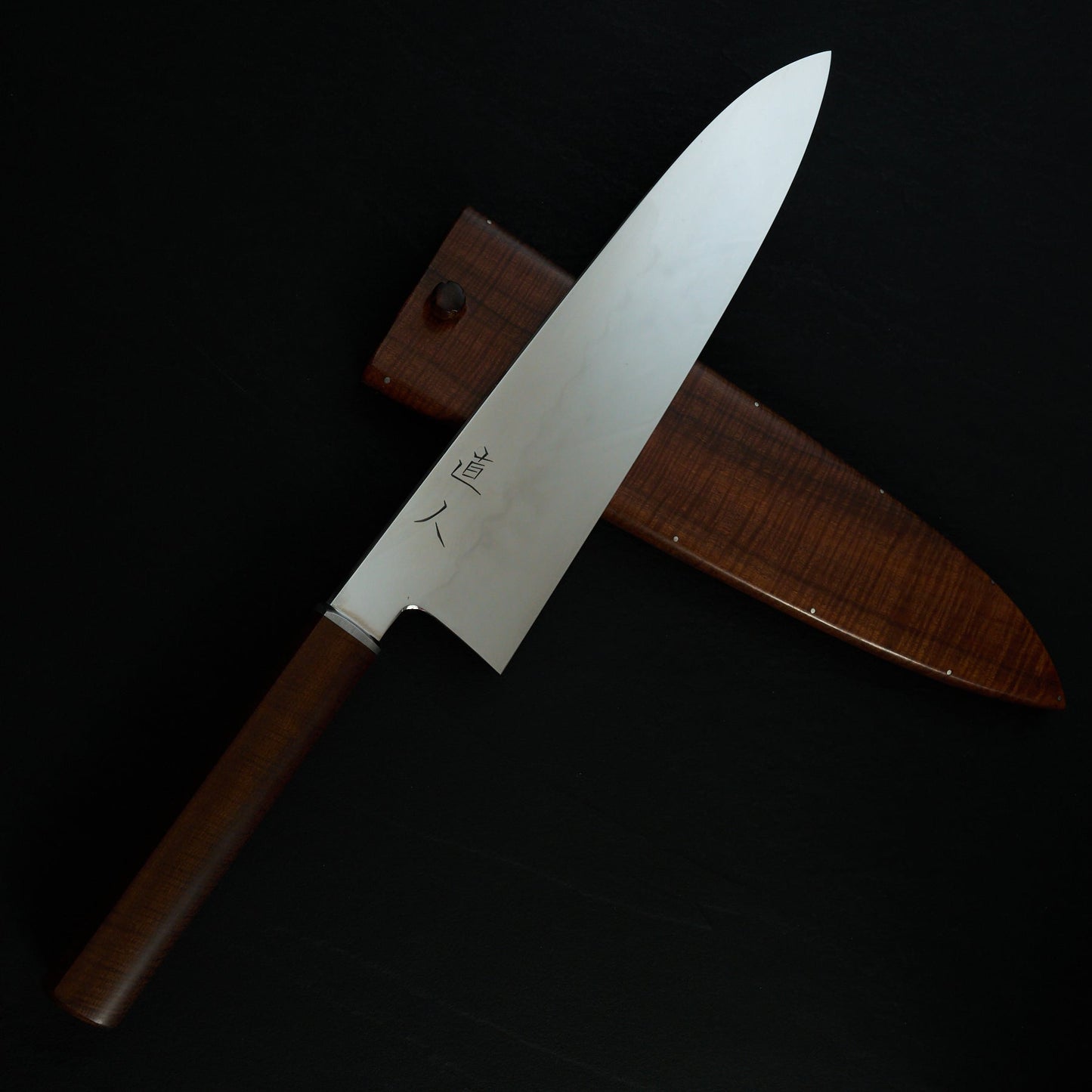
Isa Smedjan X Myojin Gyuto 245 mm Spicy White, Western Myall & Edelstahl
Isa Smedjan X Myojin Gyuto 245 mm Spicy White, Western Myall & Edelstahl
No longer available
Our Sydney workshop is closed until Monday 9 November. Orders placed now are very welcome and will ship in the order received from Tuesday 10 November. Shipping details
Ein einzigartiges Meisterwerk: Honyaki Gyuto von Jonas Johnsson und Naohito Myojin
Dieses einzigartige Honyaki Gyuto ist eine seltene Verschmelzung europäischer Handwerkskunst mit japanischer Präzision und stellt den Gipfel der Schneidleistung, Kunstfertigkeit und Exklusivität dar. Während die ursprüngliche limitierte Serie außergewöhnliche Fertigkeiten demonstrierte, hebt sich dieses Einzelstück von der Masse ab – mit seiner hochwertigen Politur und der Griff-Saya-Kombination, die es auf ein völlig neues Niveau der Verfeinerung hebt.
Die Klinge wurde von Jonas Johnsson von Isa Smedjan, einem der weltbesten Honyaki-Schmiede, handgeschmiedet. Seine tadellose Wärmebehandlung, sein sorgfältiges Schmieden und sein tiefes Stahlverständnis haben ihm einen Ruf bei Spitzenhandwerkern wie Benjamin Kamon und Milan Gravier eingebracht. Das Ergebnis ist eine Klinge mit außergewöhnlicher Schnitthaltigkeit, Widerstandsfähigkeit und einem unübertroffenen Schneidgefühl.
Nach dem Schmieden wird die Klinge von Naohito Myojin bearbeitet, einer Legende im Präzisionsschleifen und -finishen. Myojins Können, das unter anderem mit Konosuke Sakai, Hashimoto Shoichi und Satoshi Nakagawa zusammengearbeitet hat, verwandelt großartige Klingen in wahre Meisterwerke. Dieses einzigartige Stück wurde von ihm noch feiner poliert, vollständig von Hand, was sowohl die optische Brillanz als auch das nahtlose Schneideerlebnis verbessert.
Geschmiedet aus 26C3-Kohlenstoffstahl – oft auch als „Spicy White“ bezeichnet – erreicht dieses Messer eine außergewöhnliche Balance aus Schärfe, Härte und Langlebigkeit. Vergleichbar mit japanischem Weißstahl Nr. 1, bietet er jedoch eine überlegene Schnitthaltigkeit und eine feine Karbidstruktur und ist somit das ideale Material für das Honyaki-Schmieden. Durch Jonas Johnssons sorgfältige Wärmebehandlung erreicht der Stahl eine bemerkenswerte Härte bei gleichzeitiger Beibehaltung seiner Elastizität und sorgt so für lang anhaltende Schärfe mit einer wahrhaft verfeinerten Schneide.
Durch den differentiellen Härtungsprozess entsteht ein markanter Hamon, ein einzigartiges optisches Erkennungszeichen der Klingenkunst. Kein Hamon gleicht dem anderen, was diese Klinge zu einem individuellen Ausdruck von Jonas' Kunstfertigkeit macht.
Ergänzt wird diese atemberaubende Klinge durch eine unglaubliche Griff- und Saya-Kombination, gefertigt aus einem exquisiten und seltenen Stück Western Myall. Western Myall ist bekannt für seine tiefe, faszinierende Maserung und bemerkenswerte Dichte und verbessert sowohl das visuelle als auch das taktile Erlebnis. Edelstahlakzente werten das Design zusätzlich auf und schaffen eine perfekte Balance aus Eleganz, Haltbarkeit und ergonomischer Exzellenz.
Dieses einzigartige Honyaki Gyuto ist mehr als nur ein Messer – es ist ein funktionales Kunstwerk, das europäische und japanische Meisterleistung mit einer seltenen Raffinesse vereint. Ob in den Händen eines Profikochs oder eines passionierten Sammlers – es bietet ein unvergleichliches Erlebnis, sowohl in puncto Leistung als auch Ästhetik.
Eine einmalige Gelegenheit, etwas wirklich Einzigartiges zu besitzen – dieses Meisterwerk ist das einzige seiner Art auf der Welt.
Product Specification
- Blade Type:
- Overall Length: 395 mm
- Edge Length: 245mm
- Spine Heel: 3.39mm
- Spine Mid: 2.34mm
- Spine Tip (20mm before): 1.25mm
- Blade Height: 57.37mm
- Weight: 205g
- Cutting Edge Steel:
- Steel class: Carbon
- HRC: 65
- Blade Construction:
- Blade Finish: Spiegelpolitur
- Grind:
- Handle Construction:
- Handle Materials: Western Myall, Stainless Steel
- Handedness: Beidhändig
- Saya / Storage Included: Yes
Shipping & Returns
Shipping & Returns
Shipping
We process orders Monday to Friday from our Sydney workshop. Australian orders are shipped with Australia Post and international orders with DHL Express. Shipping charges are calculated at checkout based on destination, shipment size and weight, and the carrier service available for the order.
Returns
If you're not entirely happy with your purchase, you can return it within 14 days of delivery for a refund. The item must be in its original condition with all original packaging.
- Returns are accepted for 14 days
- The customer is responsible for return shipping costs
- A 15% restocking fee may be applied to change-of-mind returns
- We do not accept returns on second-hand items for change of mind
Faulty or Damaged Items
You must notify us within 5 business days of receiving your order. Photographic evidence of damage is required. Once approved, Modern Cooking will cover return shipping costs.
Product Care
Product Care
Cleaning: Clean by hand with warm water. Avoid wetting the handle when possible.
Sharpening: We advise using whetstones to sharpen your knives and a honing rod or steel to maintain the burr between sharpening sessions.
Reactive Steels: Reactive steels like Aogami Super, Apex Ultra or premium reactive German and Swedish steels are susceptible to rust if not properly cared for. Keep the knife dry between uses and when storing for longer periods, wiping the blade with Tsubaki oil or another food-safe oil is a wise choice. A patina can be a beautiful personal feature on your knife and helps to stop rust forming.
Handle Care: For non-stabilised wooden handles, apply Tsubaki oil or another food-safe oil from time to time. Food-safe wax can be applied to both stabilised and non-stabilised wooden handles. Never apply hot wax or oil as you risk warping or damaging the handle.