Zu Produktinformationen springen
1 von 5

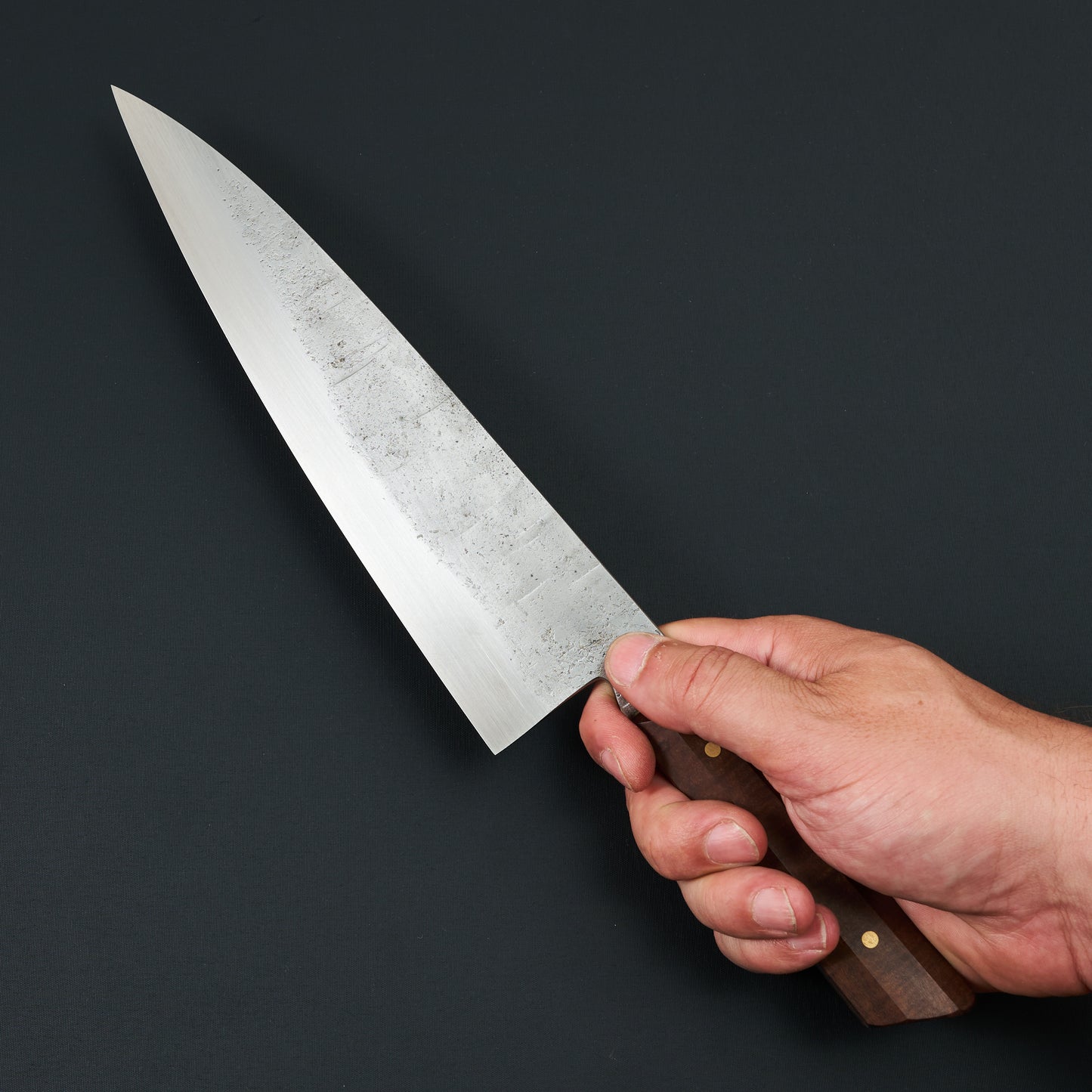
Gyuto 240 mm 1.2419 Mono Full Tang MCX Design Series V2 von Timo Verschuren

Gyuto 240 mm 1.2419 Mono Full Tang MCX Design Series V2 von Timo Verschuren

By MCX


Normaler Preis CHF 378.00
Normaler Preis Verkaufspreis CHF 378.00
Sale Ausverkauft
Inkl. Steuern. Versand wird beim Checkout berechnet

Nicht vorrätig

Anzahl

Dieses bemerkenswerte Messer ist das Ergebnis einer kreativen Zusammenarbeit zwischen Timo Verschuren von Hardent Knives und dem MCX Designstudio. Geschmiedet in Timos Studio im niederländischen Maastricht, stellt das Messer eine harmonische Verbindung aus traditioneller Handwerkskunst und moderner Designästhetik dar. Inspiriert vom renommierten Masamoto KS behält das Klingenprofil die Eleganz seines japanischen Vorbilds bei, weist jedoch einzigartige Modifikationen auf. Mit einer aggressiven distalen Verjüngung und fein gearbeiteten konvexen Fasen sorgt die Geometrie für außergewöhnliche Leistung auf dem Schneidebrett. Die etwas höhere Klingenhöhe erhöht die Vielseitigkeit, ohne die Beweglichkeit zu beeinträchtigen, und macht das Messer zu einem flinken und dennoch leistungsstarken Werkzeug.

Die Klinge aus deutschem 1.2419 Wolfram-legiertem Kohlenstoffstahl ist auf höchste Leistung ausgelegt. Dieser hochwertige Stahl bietet außergewöhnliche Schnitthaltigkeit, Zähigkeit und ermöglicht eine rasiermesserscharfe Schneide, die den Ansprüchen von Profiköchen und Hobbyköchen gleichermaßen gerecht wird. Das Klingendesign wird durch charakteristische Hardent Knives-Elemente ergänzt, darunter eine markante Hohlkehle und ein neu gestalteter ergonomischer Griff. Das überarbeitete Griffdesign bietet verbesserten Griffkomfort und Kontrolle, auch bei längeren Vorbereitungssitzungen, während der vollständig konische Erl für eine hervorragende Balance und Gewichtsverteilung sorgt und so zu einem reaktionsschnellen und agilen Griffgefühl beiträgt.

Modern Cooking wählte für den Griff australisches Ringel-Gidgee-Holz, eine Wahl, die sowohl die Haltbarkeit als auch die Optik verbessert. Das dichte, robuste Holz sorgt nicht nur für eine atemberaubende Ästhetik, sondern stellt auch sicher, dass der Griff den Belastungen des täglichen Küchengebrauchs standhält. Als Allzweckmesser konzipiert, eignet es sich hervorragend für eine Vielzahl von Aufgaben und ist somit die ideale Wahl für Profis und Hobbyköche gleichermaßen. Ob Sie komplizierte Gerichte zubereiten oder alltägliche Schneidearbeiten erledigen, dieses Messer vereint Kunstfertigkeit, Technik und Funktionalität perfekt.

Product Specification
  • Blade Type:
  • Overall Length: 360 mm
  • Edge Length: 240mm
  • Spine Heel: 3.43mm
  • Spine Mid: 1.84mm
  • Spine Tip (20mm before): 0.98mm
  • Blade Height: 55mm
  • Weight: 233g
  • Cutting Edge Steel:
  • Steel class: Carbon
  • HRC: 65
  • Blade Construction:
  • Blade Finish: Schmiedeeisen
  • Grind:
  • Handle Construction:
  • Handle Materials: Australian Ringed Gidgee, Brass
  • Handedness: Beidhändig

Blade type

Gyuto

牛刀

The Japanese take on the Western chef's knife, and the most versatile blade in a modern kitchen. A gyuto carries a long, gently curved edge — most often 210 to 270 mm — that allows both push cuts and a rocking motion, with a pointed tip for fine work and enough height at the heel to keep knuckles clear of the board. It handles proteins, vegetables, and herbs without complaint, which is why most cooks reach for it first.

Compared with a European chef's knife, the gyuto is usually thinner, harder, and lighter, ground to a finer edge that rewards good board technique and regular honing. That same thinness is the trade-off: the edge is less forgiving of bone, frozen food, and twisting cuts, and it asks for a little more care in maintenance in exchange for its keenness.

View full knife type guide →

Cutting edge steel

1.2419

Low-alloy tungsten-chromium tool steel

Typical HRC
62–65
Corrosion class
Carbon
Production
Conventional
Origin
Germany (DIN 105WCr6); approximately the European 125SC family in spirit but more alloyed

1.2419 is the German tungsten-chromium tool steel that sits a clear step above the simple carbons in alloy content, with about 1.05 percent carbon, 1.0 percent chromium, and 1.1 percent tungsten. It is closely related to 1.2519 (which adds vanadium) and to its leaner sub-variant 1.2419.05.

In a kitchen knife it runs at 63–64 HRC, sharpens cleanly, and produces an edge with notably better wear resistance than W2 or 80CrV2. The W- and Cr-rich carbides do real work; toughness is good for the hardness, and patina behaviour is moderate. It is a steel that rewards a maker who can dial in heat treatment and grain control.

European bladesmiths have used 1.2419 for kitchen and outdoor knives for decades. It is well respected in the Solingen tradition and remains a credible choice for a refined carbon-edge knife. Among the makers Modern Cooking carries, Martin Huber, Karol Karyś, Fredrik Spåre, Michał Lipiński, and Birch & Bevel work in this steel. The community sometimes discusses 1.2419 in the same breath as Aogami #1 — not chemically identical, but in a similar performance neighbourhood.

View full steel guide →

Blade construction

Mono Steel

A knife forged from a single piece of steel — no laminations, no clad layers. The simplest and most direct construction. The entire blade is the cutting steel, with no softer outer jacket to protect or contrast it. Most contemporary Western kitchen knives in carbon and stainless steel are mono-steel constructions, as are honyaki and most European bladesmith work.

The trade-off is straightforward: mono-steel knives are easier to forge, sharpen, and reason about, but the entire blade carries the cutting steel's properties — including its reactivity if it's a clean carbon. There is no soft jacket to protect a more brittle core from impact, so the heat treatment and geometry have to do all the work.

View full construction guide →

Grind

Convex

A grind whose bevel bulges outward in a gentle curve from spine to edge, rather than running flat. That extra steel directly behind the edge makes a convex grind notably strong and resistant to chipping, while the curved geometry helps food release and lets the blade glide through dense ingredients with less wedging than a flat grind.

The strength comes at the cost of ultimate thinness and ease of maintenance. A convex edge has more metal behind it, so it is not quite as effortlessly keen as a thinly flat-ground edge, and it is harder to sharpen freehand — holding the curve takes a stropping technique or a deliberate hand rather than a single fixed angle. The reward is an exceptionally tough, smooth-cutting edge.

View full grind guide →

Handle construction

Full Tang

A construction in which the blade steel runs the full length and width of the handle, forming a flat core between two handle scales. The scales are fixed to either face of the tang with pins, rivets, or adhesive, and the tang's outline stays visible as a strip of steel around the top, bottom, and butt of the handle — often with the pin heads showing as a row down each side. It is the dominant construction in Western kitchen and outdoor knives.

Because the steel continues all the way to the butt, the handle is essentially the tang dressed in two scales, and the grip is ground and shaped from that sandwiched assembly as a whole. The extra steel carries weight and balance back toward the hand, giving the solid, blade-and-handle-as-one feel that defines the style, and it leaves the edge of the tang on show as part of the knife's line.

View full construction guide →

Shipping & Returns

Shipping

We process orders 5 days a week (Monday - Friday) and ship from our shop in Sydney, Australia. We ship with FedEx, UPS and DHL.

We are happy to offer free international shipping on a variety of orders depending on location and order value.

Free Shipping Regions and Minimum Order Values

For Australia and New Zealand the minimum is $500AUD. For the rest of the world it is approximately €1000EUR. The discount is applied automatically when you reach the minimum cart value at checkout.

Returns

If you're not entirely happy with your purchase, you can return it within 14 days of delivery for a refund. The item must be in its original condition with all original packaging.

  • Returns are accepted for 14 days
  • The customer is responsible for return shipping costs
  • A 15% restocking fee may be applied to change-of-mind returns
  • We do not accept returns on second-hand items for change of mind

Faulty or Damaged Items

You must notify us within 5 business days of receiving your order. Photographic evidence of damage is required. Once approved, Modern Cooking will cover return shipping costs.

Product Care

Cleaning: Clean by hand with warm water. Avoid wetting the handle when possible.

Sharpening: We advise using whetstones to sharpen your knives and a honing rod or steel to maintain the burr between sharpening sessions.

Reactive Steels: Reactive steels like Aogami Super, Apex Ultra or premium reactive German and Swedish steels are susceptible to rust if not properly cared for. Keep the knife dry between uses and when storing for longer periods, wiping the blade with Tsubaki oil or another food-safe oil is a wise choice. A patina can be a beautiful personal feature on your knife and helps to stop rust forming.

Handle Care: For non-stabilised wooden handles, apply Tsubaki oil or another food-safe oil from time to time. Food-safe wax can be applied to both stabilised and non-stabilised wooden handles. Never apply hot wax or oil as you risk warping or damaging the handle.

Vollständige Details anzeigen