Zu Produktinformationen springen
1 von 1

Gyuto 230 mm GoMai Edelstahl-beschichteter integrierter I-Träger-Rahmengriff, Mamoth Ivory

Gyuto 230 mm GoMai Edelstahl-beschichteter integrierter I-Träger-Rahmengriff, Mamoth Ivory

By Antoine Kniamen


No longer available

Antoine Kniamen

Reserve your place

We'll only email you when there's something to say. Invitations go out in signup order as new work becomes available.

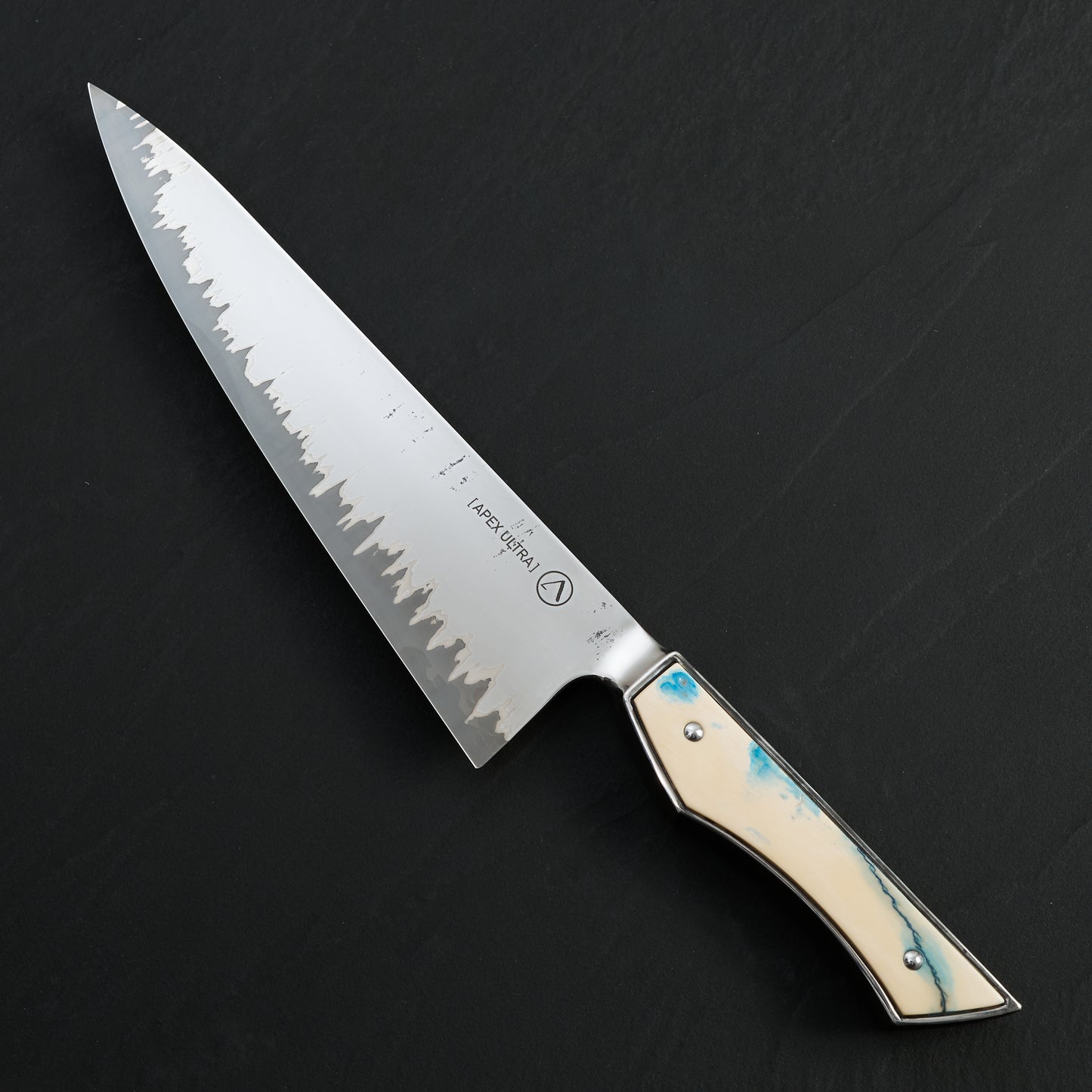
Dieses handgefertigte Küchenmesser ist eine wirklich einzigartige Kreation des renommierten französischen Schmieds Antoine Kniamen. Als atemberaubende Fusion aus westlichem und japanischem Design bietet das hybride Profil des Messers beispiellose Vielseitigkeit für Profiköche und Hobbyköche gleichermaßen. Das Schneidenprofil ist vom japanischen Gyuto übernommen, weist jedoch eine etwas bauchigere Krümmung auf, die flüssige Wiegebewegungen ermöglicht und gleichzeitig präzise Hacktechniken unterstützt. Da es höher als ein traditionelles Gyuto ist, bietet die zusätzliche Höhe mehr Platz für die Fingerknöchel und eine imposantere Präsenz auf dem Schneidebrett. Diese dynamische Mischung aus Designelementen führt zu einem Messer, mit dem Sie ebenso mühelos durch zarte Kräuter schneiden wie größere Fleischstücke zerlegen können. Ob als Ausstellungsstück in einem gehobenen Restaurant oder als Herzstück einer Küchensammlung zu Hause, der Nutzen und die Eleganz dieses Messers sind unverkennbar.

Die Geometrie des Messers ist ein Meisterwerk präziser Handwerkskunst. Der stark konische Rücken sorgt für eine außergewöhnliche Balance und verleiht dem Messer ein agiles und reaktionsschnelles Gefühl in der Hand. Dieses durchdachte Design bietet dem Benutzer unglaubliche Kontrolle bei der Anwendung und bietet die nötige Präzision für feine Arbeiten und das nötige Gewicht für anspruchsvollere Schnitte. Die fein geformten konvexen Fasen verbessern die Schneidleistung zusätzlich, indem sie die Reibung beim Gleiten der Klinge durch die Zutaten reduzieren und so ein sanftes, müheloses Schneiden gewährleisten. Das Schneidgut löst sich hervorragend, wodurch das Anhaften minimiert und die Effizienz bei der Zubereitung verbessert wird. Das Herz der Klinge ist aus Verbundstahl geschmiedet, mit einem Kern aus Apex Ultra – einem für seine Schnitthaltigkeit bekannten Kohlenstoffstahl – umhüllt von Schichten aus Edelstahl und Nickel. Diese Konstruktion bietet nicht nur überragende Schneidkraft, sondern gewährleistet auch Rostbeständigkeit und strukturelle Integrität. Die schwarz geätzte Oberfläche, die einen Kontrast zu den hellen Silberschichten aus Nickel und Edelstahl bildet, schafft ein optisch beeindruckendes und hochfunktionales Kunstwerk.

Der Griff ist eine ebenso beeindruckende Mischung aus Kunstfertigkeit und Ingenieurskunst. Antoines charakteristisches „I-Beam“-Design zeichnet sich durch einen aufwendig WIG-geschweißten und polierten integrierten Kropf aus, der einen nahtlosen Übergang von der Klinge zum Griff bietet. Die Griffschalen sind aus seltenem und begehrtem Mammutelfenbein mit faszinierenden blauen Streifen gefertigt. Diese natürlichen Blautöne sind das Ergebnis jahrtausendealter Mineralisierung, bei der Eisen und andere Mineralien das versteinerte Elfenbein durchdringen und eine lebendige und einzigartige Färbung hinterlassen. Jeder Griff ist daher ein einzigartiges Meisterwerk der Naturkunst. Um diese optische Pracht zu ergänzen, verfügt der Griff außerdem über geschwärzte Stahlakzente, die mit ihrer matten Textur für einen sicheren, rutschfesten Griff sorgen. Die matte Oberfläche ist unempfindlich gegen Fingerabdrücke und behält auch bei häufigem Gebrauch ihr glattes, sauberes Aussehen. Zusammen veranschaulichen diese Elemente Antoine Kniamens meisterhaften Ansatz für funktionales Design und künstlerischen Ausdruck. Die Schönheit, Ausgewogenheit und Leistung dieses Messers machen es zu einer bemerkenswerten Leistung – ein leuchtendes Beispiel für Kniamens Handwerkskunst und ein Vorgeschmack auf weitere aufregende Kreationen, die noch kommen werden.

Product Specification
  • Blade Type:
  • Overall Length: 365 mm
  • Edge Length: 230mm
  • Spine Heel: 3.55mm
  • Spine Mid: 1.91mm
  • Spine Tip (20mm before): 0.84mm
  • Blade Height: 59.5mm
  • Weight: 296g
  • Cutting Edge Steel:
  • Steel class: Carbon
  • HRC: 66
  • Blade Construction:
  • Blade Finish: Satinpolitur, Säuregeätzt (erzwungene Patina)
  • Grind:
  • Handle Construction:
  • Handle Materials: Mammoth Ivory
  • Handedness: Beidhändig

Blade type

Gyuto

牛刀

The Japanese take on the Western chef's knife, and the most versatile blade in a modern kitchen. A gyuto carries a long, gently curved edge — most often 210 to 270 mm — that allows both push cuts and a rocking motion, with a pointed tip for fine work and enough height at the heel to keep knuckles clear of the board. It handles proteins, vegetables, and herbs without complaint, which is why most cooks reach for it first.

Compared with a European chef's knife, the gyuto is usually thinner, harder, and lighter, ground to a finer edge that rewards good board technique and regular honing. That same thinness is the trade-off: the edge is less forgiving of bone, frozen food, and twisting cuts, and it asks for a little more care in maintenance in exchange for its keenness.

View full knife type guide →

Cutting edge steel

Apex Ultra

Low-alloy fine-grain carbon tool steel

Typical HRC
64–68
Corrosion class
Carbon
Production
Conventional
Origin
Austria (ApexUltra project — developed by Larrin Thomas, Marco Guldimann and Tobias Hangler; FFG-funded, associated with Messerschmiede Hangler)

Apex Ultra is one of the most carefully engineered non-stainless kitchen knife steels in modern circulation — a steel designed from the ground up specifically for handmade knives, rather than borrowed from another industry. It was developed by metallurgist Larrin Thomas together with smiths Marco Guldimann and Tobias Hangler. It is a low-alloy carbon steel — roughly 1.25 percent carbon, 2.6 percent tungsten, 1.5 percent chromium and a 0.4 percent vanadium addition, with manganese and silicon kept low. That composition is tuned for high purity and a fine, evenly distributed mix of chromium-enriched iron carbides, tungsten carbides and vanadium carbides — the structure that lets it hold a very hard edge without the coarse carbides or plate martensite that sap toughness in other high-hardness carbon steels.

What this means for a cook is unusual permission. Apex Ultra carries very high toughness in the 66+ HRC range — the highest of any knife steel its developers have tested at that hardness — so you can ask a maker to grind it thin and run the heat treatment hard, and the edge will hold far longer than the carbon steels smiths usually forge, without microchipping. It forges and forge-welds much like 52100 or 1.2562, sharpens cleanly on natural and synthetic stones without needing diamond plates, and its modest chromium slows patina a little — though it is not stainless and should be cared for as a carbon steel.

Apex Ultra has become a signature steel of the European maker community, and the Modern Cooking catalogue carries an unusually deep bench of smiths working in it. Tobias Hangler himself heads that group, alongside Marco Guldimann, Benjamin Kamon, Martin Huber, Jonas Johnsson, Karol Karyś, Birch & Bevel, and MCx. It is genuinely a step forward — one of the relatively few cases where the marketing claims and the underlying metallurgical data are saying the same thing.

View full steel guide →

Blade construction

Laminated Steel

A category covering knives built from multiple layers of different steels forge-welded together. The hard cutting steel is sandwiched between softer outer layers (cladding) that protect the core, add toughness, and often contribute visual contrast.

The most common laminated constructions in the Modern Cooking catalogue are:

SanMai (三枚) — three layers: hard cutting steel in the centre, softer cladding on both sides. The traditional and most common form.

GoMai (五枚) — five layers: a hard core, two intermediate layers, and two outer layers. Adds visual depth and structural complexity.

KuMai (九枚) — nine layers: similar logic, with more cladding layers for additional pattern and structural variation.

GoMai and KuMai are often chosen not only for the additional layers and visual depth, but also because the intermediate layers can act as a nickel diffusion barrier — limiting carbon migration out of the core into the cladding during forge welding, and protecting the core's intended carbon content through the heat of the forging process.

In all cases the cutting performance is determined by the core steel; the outer layers are cosmetic and structural. The lamination contributes corrosion protection (when a stainless jacket clads a carbon core), reduced reactivity, and the visible boundary between core and cladding that gives the knife its character.

View full construction guide →

Grind

Convex

A grind whose bevel bulges outward in a gentle curve from spine to edge, rather than running flat. That extra steel directly behind the edge makes a convex grind notably strong and resistant to chipping, while the curved geometry helps food release and lets the blade glide through dense ingredients with less wedging than a flat grind.

The strength comes at the cost of ultimate thinness and ease of maintenance. A convex edge has more metal behind it, so it is not quite as effortlessly keen as a thinly flat-ground edge, and it is harder to sharpen freehand — holding the curve takes a stropping technique or a deliberate hand rather than a single fixed angle. The reward is an exceptionally tough, smooth-cutting edge.

View full grind guide →

Handle construction

Integral

A construction in which the bolster — and, in a full integral, a frame around the handle as well — is formed from the same single piece of steel as the blade rather than added as a separate part. The bolster and blade are continuous metal, forged or machined from one billet so there is no seam between them, with the tang carrying the handle material behind the integral section.

The design announces itself at the transition from blade to handle: a seamless steel bolster, and on a frame integral a steel surround bordering the handle material on every side. That unbroken metal gives a distinctive, resolved look and a forward, substantial feel, and removes the joint where a fitted bolster would otherwise meet the blade. It is a hallmark of high-end Western knifemaking and a demanding piece of forging or machining to execute cleanly.

View full construction guide →

Shipping & Returns

Shipping

We process orders 5 days a week (Monday - Friday) and ship from our shop in Sydney, Australia. We ship with FedEx, UPS and DHL.

We are happy to offer free international shipping on a variety of orders depending on location and order value.

Free Shipping Regions and Minimum Order Values

For Australia and New Zealand the minimum is $500AUD. For the rest of the world it is approximately €1000EUR. The discount is applied automatically when you reach the minimum cart value at checkout.

Returns

If you're not entirely happy with your purchase, you can return it within 14 days of delivery for a refund. The item must be in its original condition with all original packaging.

  • Returns are accepted for 14 days
  • The customer is responsible for return shipping costs
  • A 15% restocking fee may be applied to change-of-mind returns
  • We do not accept returns on second-hand items for change of mind

Faulty or Damaged Items

You must notify us within 5 business days of receiving your order. Photographic evidence of damage is required. Once approved, Modern Cooking will cover return shipping costs.

Product Care

Cleaning: Clean by hand with warm water. Avoid wetting the handle when possible.

Sharpening: We advise using whetstones to sharpen your knives and a honing rod or steel to maintain the burr between sharpening sessions.

Reactive Steels: Reactive steels like Aogami Super, Apex Ultra or premium reactive German and Swedish steels are susceptible to rust if not properly cared for. Keep the knife dry between uses and when storing for longer periods, wiping the blade with Tsubaki oil or another food-safe oil is a wise choice. A patina can be a beautiful personal feature on your knife and helps to stop rust forming.

Handle Care: For non-stabilised wooden handles, apply Tsubaki oil or another food-safe oil from time to time. Food-safe wax can be applied to both stabilised and non-stabilised wooden handles. Never apply hot wax or oil as you risk warping or damaging the handle.
Vollständige Details anzeigen