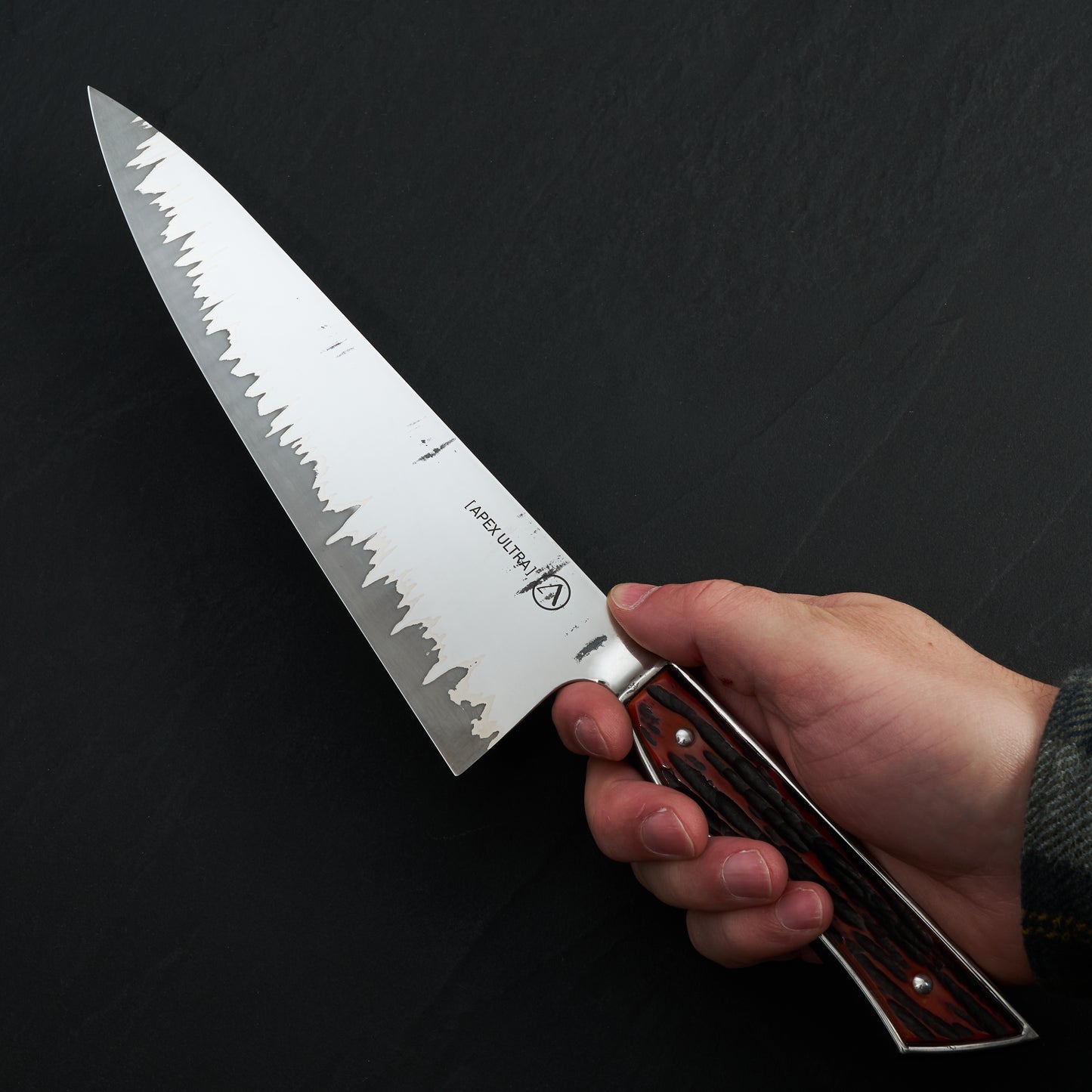
Gyuto 230 mm GoMai Edelstahl-beschichteter integrierter I-Träger-Griff, geschnitzt und strukturiert, Kamelknochen
Gyuto 230 mm GoMai Edelstahl-beschichteter integrierter I-Träger-Griff, geschnitzt und strukturiert, Kamelknochen
No longer available
Our Sydney workshop is closed until Monday 9 November. Orders placed now are very welcome and will ship in the order received from Tuesday 10 November. Shipping details
Das handgefertigte Küchenmesser des renommierten Schmieds Antoine Kniamen ist ein wahres, einzigartiges Meisterwerk, das Form und Funktion neu definiert. Diese außergewöhnliche Klinge vereint das Beste aus zwei Welten: die elegante Effizienz eines japanischen Gyuto mit der robusten Nützlichkeit eines westlichen Kochmessers. Sein Profil schafft eine meisterhafte Balance: Es weist eine etwas bauchigere Schneide als ein traditionelles Gyuto auf und behält gleichzeitig eine subtile Ausweitung am Kantenradius bei. Diese raffinierte Form ist zudem höher als ihr japanisches Gegenstück, bietet mehr Fingerknöchelfreiheit und überlegene Vielseitigkeit für eine Vielzahl von Schneidetechniken. Ob Sie Gemüse würfeln, Fleisch tranchieren oder präzise Schnitte mit Finesse ausführen, dieses Hybriddesign liegt natürlich und intuitiv in der Hand und macht sowohl in der heimischen Küche als auch in professionellen Kochumgebungen Freude.
Neben dem markanten Profil zeugt die Geometrie des Messers von Antoine Kniamens akribischer Liebe zum Detail. Der stark konische Rücken sorgt für ein außergewöhnliches Gleichgewicht und ein agiles, kontrolliertes Gefühl. Dieses Design sorgt für eine optimale Gewichtsverteilung und reduziert die Ermüdung der Hand bei längerem Gebrauch. Die Fasen sind zu fein abgestimmten konvexen Oberflächen geformt, was sowohl die Schneidleistung als auch die Freigabe der Lebensmittel verbessert. Jede Scheibe gleitet mühelos durch Obst und Gemüse, Proteine und andere Küchenutensilien, während die Lebensmittel weniger an der Klingenoberfläche haften bleiben. Diese optimale Geometrie, gepaart mit dem hausgeschmiedeten Verbundstahl, verkörpert Kniamens Engagement für handwerkliches Können. Der Klingenkern besteht aus Apex Ultra-Stahl, der für seine Schnitthaltigkeit und Zähigkeit geschätzt wird, und ist zwischen Nickel- und Edelstahlschichten eingebettet. Diese Konstruktion sorgt nicht nur für einen beeindruckenden optischen Kontrast, sondern stärkt auch die strukturelle Integrität der Klinge und gewährleistet Langlebigkeit und Schutz vor Oxidation.
Der Griff dieses atemberaubenden Messers ist das wahre Meisterwerk von Antoine Kniamen. Der aufgrund seiner einzigartigen Metallkonstruktion „I-Beam“-Griff verfügt über einen aufwendig WIG-geschweißten und polierten integrierten Kropf. Dieses Design bietet unübertroffene Stärke und Stabilität und ermöglicht nahtlose Übergänge zwischen Klinge und Griff. Die ergonomische Form des Griffs sorgt für einen komfortablen und sicheren Halt. Die handgeschnitzten, strukturierten Griffschalen aus stabilisiertem, rot gefärbtem Kamelknochen sorgen für einen angenehmen Griff. Dieses Material verleiht dem Messer nicht nur Farbe und Charakter, sondern verbessert auch die Griffigkeit und Haltbarkeit. Die geschwärzte Stahlbehandlung unterstreicht die Ästhetik des Griffs zusätzlich. Sie erzeugt eine matte, fingerabdruckabweisende und rutschfeste Oberfläche. Die schwarz geätzte Oberfläche der Klinge kontrastiert mit dem polierten Satin der Nickel- und Edelstahlschichten und sorgt für ein optisch beeindruckendes Erscheinungsbild, das ebenso markant wie funktional ist. Dieses Messer ist mehr als nur ein Küchenwerkzeug – es ist ein Kunstwerk, das sich sowohl für den täglichen Gebrauch als auch als Präsentationsstück in der gehobenen Gastronomie perfekt eignet. Mit jedem sorgfältig entworfenen und meisterhaft ausgeführten Element läutet diese Klinge eine neue Ära der Handwerkskunst des französischen Schmieds Antoine Kniamen ein und bietet einen fesselnden Vorgeschmack auf die außergewöhnlichen Kreationen, die noch kommen werden.
Product Specification
- Blade Type:
- Overall Length: 370 mm
- Edge Length: 230mm
- Spine Heel: 3.26mm
- Spine Mid: 2.11mm
- Spine Tip (20mm before): 0.84mm
- Blade Height: 60.78mm
- Weight: 299g
- Cutting Edge Steel:
- Steel class: Carbon
- HRC: 66
- Blade Construction:
- Blade Finish: Satinpolitur, Säuregeätzt (erzwungene Patina)
- Grind:
- Handle Construction:
- Handle Materials: Carved, Textured Camel Bone
- Handedness: Beidhändig
Shipping & Returns
Shipping & Returns
Shipping
We process orders Monday to Friday from our Sydney workshop. Australian orders are shipped with Australia Post and international orders with DHL Express. Shipping charges are calculated at checkout based on destination, shipment size and weight, and the carrier service available for the order.
Returns
If you're not entirely happy with your purchase, you can return it within 14 days of delivery for a refund. The item must be in its original condition with all original packaging.
- Returns are accepted for 14 days
- The customer is responsible for return shipping costs
- A 15% restocking fee may be applied to change-of-mind returns
- We do not accept returns on second-hand items for change of mind
Faulty or Damaged Items
You must notify us within 5 business days of receiving your order. Photographic evidence of damage is required. Once approved, Modern Cooking will cover return shipping costs.
Product Care
Product Care
Cleaning: Clean by hand with warm water. Avoid wetting the handle when possible.
Sharpening: We advise using whetstones to sharpen your knives and a honing rod or steel to maintain the burr between sharpening sessions.
Reactive Steels: Reactive steels like Aogami Super, Apex Ultra or premium reactive German and Swedish steels are susceptible to rust if not properly cared for. Keep the knife dry between uses and when storing for longer periods, wiping the blade with Tsubaki oil or another food-safe oil is a wise choice. A patina can be a beautiful personal feature on your knife and helps to stop rust forming.
Handle Care: For non-stabilised wooden handles, apply Tsubaki oil or another food-safe oil from time to time. Food-safe wax can be applied to both stabilised and non-stabilised wooden handles. Never apply hot wax or oil as you risk warping or damaging the handle.