Zu Produktinformationen springen
1 von 5

Gyuto 230 mm Apex Ultra TakeDown Bronze, Micarta und Black Juma

Gyuto 230 mm Apex Ultra TakeDown Bronze, Micarta und Black Juma

By Oliver Märtens


No longer available

Oliver Märtens

Reserve your place

We'll only email you when there's something to say. Invitations go out in signup order as new work becomes available.

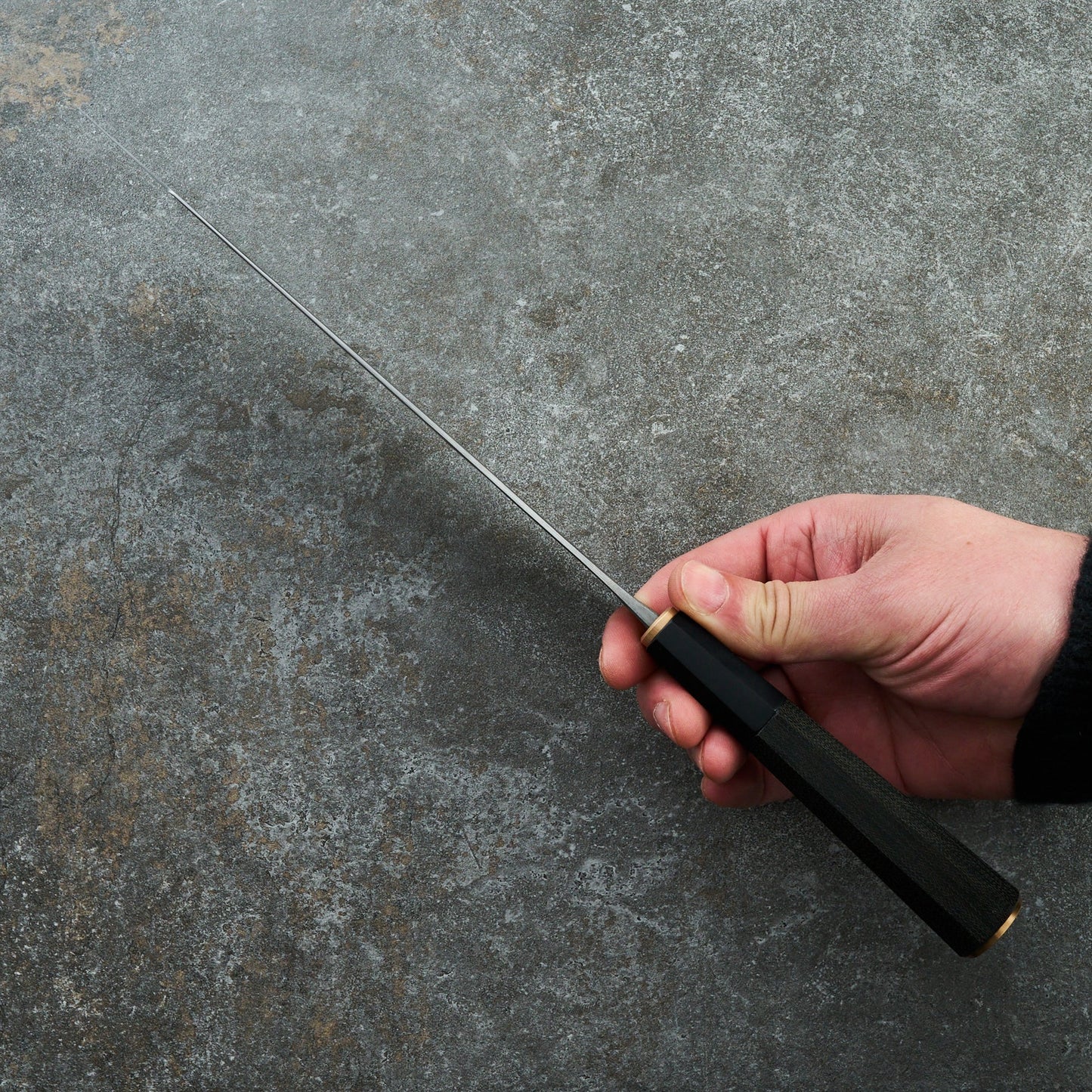
Das Gyuto von Oliver Märtens ist eine meisterhafte Verschmelzung von Präzision, Handwerkskunst und Spitzenleistung. Dieses außergewöhnliche Messer, das in Kassel, Deutschland, von den geschickten Händen des Schmieds Oliver Märtens geschmiedet wurde, verkörpert die Essenz eines leistungsstarken Küchenwerkzeugs. Die 230 mm lange Klinge aus ApexUltra-Kohlenstoffstahl sorgt für überragende Schärfe, Haltbarkeit und müheloses Schneiden. Mit einem 57 mm hohen Profil ist dieses Gyuto auf optimale Balance ausgelegt und ermöglicht eine flüssige Bewegung durch die Zutaten mit minimalem Widerstand. Die dünne, gehärtete Schneide garantiert ein unvergleichliches Schneideerlebnis, während die nadelartige Spitze perfekt für Detailarbeiten ist und feinste Schnitte mit absoluter Präzision gewährleistet. Ob Sie empfindliche Proteine schneiden oder Kräuter fein hacken, dieses Messer ist für herausragende Leistung in der Küche konzipiert.

Neben der Klinge verfügt dieses Gyuto über einen innovativen, zerlegbaren Griff – ein Beweis für Märtens‘ Engagement für Funktionalität und Handwerkskunst. Der aus Micarta, schwarzem Juma und bronzenen Endkappen gefertigte Griff präsentiert eine minimalistische und dennoch markante Ästhetik. Die verdeckte Erlkonstruktion erhöht nicht nur die Haltbarkeit, sondern bietet auch einen nahtlosen, komfortablen Griff, der sich natürlich an die Hand anpasst. Märtens‘ Konstruktionsweise bietet eine raffinierte Interpretation handwerklicher Qualität und macht den Griff nicht nur zu einem Bestandteil, sondern zu einem prägenden Merkmal dieses Messers. Die Ergonomie des für den Dauereinsatz konzipierten Griffs gewährleistet eine ermüdungsfreie Handhabung, sodass Köche selbst bei kompliziertesten Aufgaben Kontrolle und Präzision behalten.

Dieses leistungsstarke Gyuto ist mehr als nur ein Küchenwerkzeug – es ist ein Statement, das die Kunstfertigkeit und Innovationskraft seines Herstellers widerspiegelt. Die Kombination aus modernsten Materialien, raffiniertem Design und unvergleichlicher Schärfe macht es zu einem unverzichtbaren Begleiter für Profiköche und Hobbyköche gleichermaßen. Die Verschmelzung von deutscher Ingenieurskunst, handwerklicher Perfektion und minimalistischer Eleganz macht dieses Messer nicht nur zum Vergnügen, sondern auch zu einem wertvollen Bestandteil jeder Küche. Ob Sie Präzision beim Schneiden verlangen oder ein Messer suchen, das Form und Funktion vereint – Oliver Märtens' Gyuto bietet ein unvergleichliches Erlebnis – eines, das neu definiert, was ein leistungsstarkes Messer sein sollte.

Product Specification
  • Blade Type:
  • Overall Length: 365 mm
  • Edge Length: 230mm
  • Spine Heel: 3.36mm
  • Spine Mid: 2.04mm
  • Spine Tip (20mm before): 0.88mm
  • Blade Height: 57mm
  • Weight: 210g
  • Cutting Edge Steel:
  • Steel class: Carbon
  • HRC: 66
  • Blade Construction:
  • Blade Finish: StrukturiertMattpolitur
  • Grind:
  • Handle Construction:
  • Handle Materials: Bronze, Micarta, Black Juma
  • Handedness: Beidhändig

Blade type

Gyuto

牛刀

The Japanese take on the Western chef's knife, and the most versatile blade in a modern kitchen. A gyuto carries a long, gently curved edge — most often 210 to 270 mm — that allows both push cuts and a rocking motion, with a pointed tip for fine work and enough height at the heel to keep knuckles clear of the board. It handles proteins, vegetables, and herbs without complaint, which is why most cooks reach for it first.

Compared with a European chef's knife, the gyuto is usually thinner, harder, and lighter, ground to a finer edge that rewards good board technique and regular honing. That same thinness is the trade-off: the edge is less forgiving of bone, frozen food, and twisting cuts, and it asks for a little more care in maintenance in exchange for its keenness.

View full knife type guide →

Cutting edge steel

Apex Ultra

Low-alloy fine-grain carbon tool steel

Typical HRC
64–68
Corrosion class
Carbon
Production
Conventional
Origin
Austria (developed by Tobias Hangler and Marco Guldimann; project led by Hangler at Messerschmiede Hangler)

Apex Ultra is one of the most carefully engineered non-stainless kitchen knife steels in modern circulation, and the project of an Austrian smith — Tobias Hangler — who set out, with Marco Guldimann, to design a steel for the kitchen rather than borrow one from another industry. It carries roughly 1.25 percent carbon, around four percent chromium, modest tungsten and molybdenum, and a small vanadium addition. The composition is tuned to produce a fine, evenly distributed carbide structure that supports hardness up to 67 HRC while delivering toughness comparable to 52100 at the same hardness — a combination that is the entire point of the steel.

What this means for a cook is unusual permission. You can ask a maker to grind an Apex Ultra knife thin enough that a White #1 owner would call you brave, then ask for the heat treatment to land at 65 HRC, and the resulting edge will hold for longer than Aogami Super without microchipping. It sharpens cleanly on natural and synthetic stones alike and patinas slowly because of the chromium content, though it is not stainless and should be treated as a carbon steel.

Apex Ultra has become a signature steel of the European maker community, and the Modern Cooking catalogue carries an unusually deep bench of smiths working in it. Tobias Hangler himself heads that group, alongside Marco Guldimann, Benjamin Kamon, Martin Huber, Jonas Johnsson, Karol Karyś, Birch & Bevel, and MCx. It is genuinely a step forward — one of the relatively few cases where the marketing claims and the underlying metallurgical data are saying the same thing.

View full steel guide →

Blade construction

Mono Steel

A knife forged from a single piece of steel — no laminations, no clad layers. The simplest and most direct construction. The entire blade is the cutting steel, with no softer outer jacket to protect or contrast it. Most contemporary Western kitchen knives in carbon and stainless steel are mono-steel constructions, as are honyaki and most European bladesmith work.

The trade-off is straightforward: mono-steel knives are easier to forge, sharpen, and reason about, but the entire blade carries the cutting steel's properties — including its reactivity if it's a clean carbon. There is no soft jacket to protect a more brittle core from impact, so the heat treatment and geometry have to do all the work.

View full construction guide →

Grind

Convex

A grind whose bevel bulges outward in a gentle curve from spine to edge, rather than running flat. That extra steel directly behind the edge makes a convex grind notably strong and resistant to chipping, while the curved geometry helps food release and lets the blade glide through dense ingredients with less wedging than a flat grind.

The strength comes at the cost of ultimate thinness and ease of maintenance. A convex edge has more metal behind it, so it is not quite as effortlessly keen as a thinly flat-ground edge, and it is harder to sharpen freehand — holding the curve takes a stropping technique or a deliberate hand rather than a single fixed angle. The reward is an exceptionally tough, smooth-cutting edge.

View full grind guide →

Handle construction

Takedown

A takedown is a hidden-tang construction built to come apart. The tang passes through the handle and is drawn up by a threaded fitting — a nut at the butt, or a pommel that screws down — so the handle can be dismantled and re-fitted rather than being permanently bonded in place. Everything else follows the hidden-tang pattern: a concealed tang inside a one-piece handle, with no steel showing along the grip.

The point of the design is serviceability. Because the handle is mechanical rather than glued, it can be taken off for thorough cleaning and drying, swapped for a different material or profile, or replaced entirely if it is ever damaged — all without destroying the original fittings. It is the construction to choose for a knife meant to be maintained and kept for the long term, and for owners who like the option of changing a handle later.

View full construction guide →

Shipping & Returns

Shipping

We process orders 5 days a week (Monday - Friday) and ship from our shop in Sydney, Australia. We ship with FedEx, UPS and DHL.

We are happy to offer free international shipping on a variety of orders depending on location and order value.

Free Shipping Regions and Minimum Order Values

For Australia and New Zealand the minimum is $500AUD. For the rest of the world it is approximately €1000EUR. The discount is applied automatically when you reach the minimum cart value at checkout.

Returns

If you're not entirely happy with your purchase, you can return it within 14 days of delivery for a refund. The item must be in its original condition with all original packaging.

  • Returns are accepted for 14 days
  • The customer is responsible for return shipping costs
  • A 15% restocking fee may be applied to change-of-mind returns
  • We do not accept returns on second-hand items for change of mind

Faulty or Damaged Items

You must notify us within 5 business days of receiving your order. Photographic evidence of damage is required. Once approved, Modern Cooking will cover return shipping costs.

Product Care

Cleaning: Clean by hand with warm water. Avoid wetting the handle when possible.

Sharpening: We advise using whetstones to sharpen your knives and a honing rod or steel to maintain the burr between sharpening sessions.

Reactive Steels: Reactive steels like Aogami Super, Apex Ultra or premium reactive German and Swedish steels are susceptible to rust if not properly cared for. Keep the knife dry between uses and when storing for longer periods, wiping the blade with Tsubaki oil or another food-safe oil is a wise choice. A patina can be a beautiful personal feature on your knife and helps to stop rust forming.

Handle Care: For non-stabilised wooden handles, apply Tsubaki oil or another food-safe oil from time to time. Food-safe wax can be applied to both stabilised and non-stabilised wooden handles. Never apply hot wax or oil as you risk warping or damaging the handle.

Vollständige Details anzeigen