Gyuto 230mm AEB-L Gidgee MCx Fredrik Spåre
Gyuto 230mm AEB-L Gidgee MCx Fredrik Spåre
By MCx
No longer available
Our Sydney workshop is closed until Monday 9 November. Orders placed now are very welcome and will ship in the order received from Tuesday 10 November. Shipping details
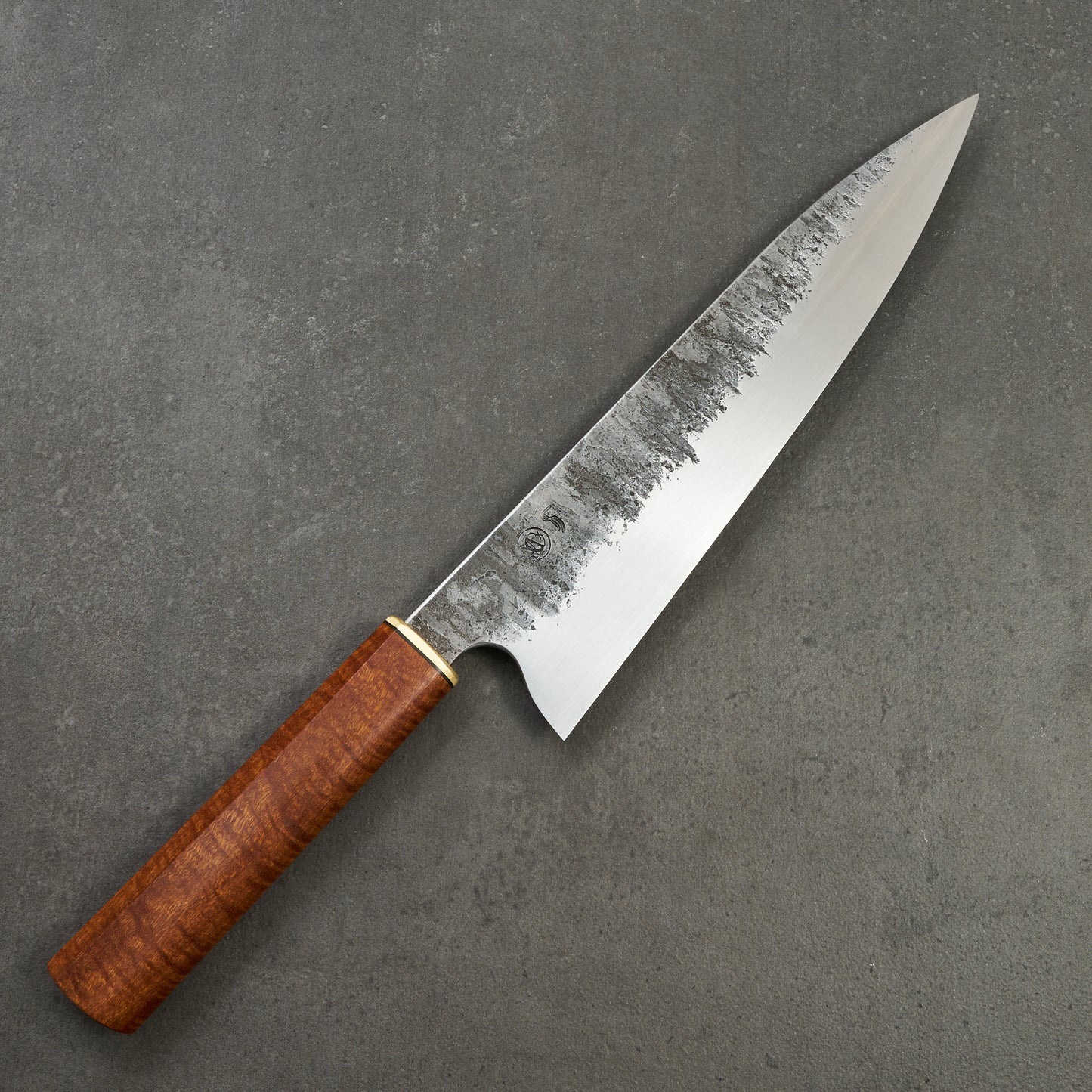
Wir präsentieren das neueste Küchenmesser des MCX Design Studios, das in Zusammenarbeit mit dem renommierten schwedischen Schmied und Birch & Bevel-Absolventen Fredrik Spåre gefertigt wurde. Diese außergewöhnliche Klinge verkörpert die perfekte Mischung aus ästhetischer Eleganz und Spitzenleistung. Das vollständig von Spåre selbst geschmiedete Messer verfügt über das charakteristische spitze Profil von MCX, das durch Iterationen der MCX-Küchenmesserkollektion und der Birch & Bevel-Reihe verfeinert und verfeinert wurde. Das Ergebnis ist eine Klinge mit einer schmiedekonischen konvexen Geometrie, ultradünnen konvexen Fasen und einer rasiermesserscharfen Schneide. Das Kantenprofil umfasst einen subtilen Radius, der sanft von der Ferse zur Spitze übergeht und so ein außergewöhnliches Schneidebrett-Erlebnis gewährleistet. Dieses Design verbessert nicht nur Präzision und Kontrolle, sondern reduziert auch die Belastung des Handgelenks, sodass die Verwendung über längere Zeiträume der kulinarischen Zubereitung eine Freude ist.
Das Herzstück dieses Meisterwerks ist AEB-L-Edelstahl, ein hochwertiges Material, das für seine bemerkenswerte Balance aus Zähigkeit, Schnitthaltigkeit und Korrosionsbeständigkeit geschätzt wird. AEB-L gilt dank seiner feinkörnigen Struktur, die eine schärfere, feinere Schneide ermöglicht, oft als einer der edelsten Stähle für Küchenmesser. Im Gegensatz zu vielen anderen Edelstählen bietet AEB-L eine hohe Absplitterfestigkeit und sorgt so für eine robuste, langlebige Schneide. Die Klinge ist auf 63 HRC gehärtet – ein Wert, der die perfekte Harmonie zwischen Härte und Flexibilität schafft. Dieser hohe Rockwell-Wert verleiht dem Messer eine scharfe, langlebige Schneide, die Schnitt für Schnitt ihre Präzision behält. Die Wahl von AEB-L zeugt von unserem Engagement für Handwerkskunst und Leistung, denn es bietet Köchen und Kochbegeisterten ein Werkzeug, das sowohl pflegeleicht als auch beeindruckend widerstandsfähig ist.
Nicht weniger Aufmerksamkeit wird dem Griff gewidmet, der MCXs Engagement für ergonomisches Design und luxuriöse Materialien widerspiegelt. Der Griff zeichnet sich durch MCXs klassische konische Rokkaku Hanmaru-Form aus, auch bekannt als „Sechsrund“-Form, die Anwendern aller Könnerstufen einen komfortablen und sicheren Halt bietet. Gefertigt aus atemberaubendem australischem Ringed Gidgee-Holz, einem Material, das für seine tiefen, satten Farbtöne und seine natürliche Härte bekannt ist, ist der Griff ebenso langlebig wie schön. Akzentuiert durch einen Messing-Kropf und einen eleganten schwarzen G10-Abstandshalter, schafft diese Materialkombination eine harmonische Balance aus Textur, Farbe und Funktionalität. Das Design ist zeitlos und modern zugleich und bereitet Köchen bei jedem Gebrauch Freude und Stolz. Dieses handgefertigte Messer ist ideal für Profiküchen und Hobbyköche und zeugt von der Kunstfertigkeit von Fredrik Spåre und der Design-Exzellenz von MCX. Ob Sie zarte Garnituren zubereiten oder herzhafte Zutaten zerkleinern – mit diesem Messer erledigen Sie jede Aufgabe mit Präzision, Stil und Komfort.
Product Specification
- Blade Type:
- Overall Length: 375 mm
- Edge Length: 230mm
- Spine Heel: 3.03mm
- Spine Mid: 1.87mm
- Spine Tip (20mm before): 0.95mm
- Blade Height: 54mm
- Weight: 188g
- Cutting Edge Steel:
- Steel class: Stainless
- HRC: 63
- Blade Construction:
- Blade Finish: Schmiedeeisen, Satinpolitur
- Grind:
- Handle Construction:
- Handle Materials: Australian Ringed Gidgee, G10, Brass
- Handedness: Beidhändig
Shipping & Returns
Shipping & Returns
Shipping
We process orders Monday to Friday from our Sydney workshop. Australian orders are shipped with Australia Post and international orders with DHL Express. Shipping charges are calculated at checkout based on destination, shipment size and weight, and the carrier service available for the order.
Returns
If you're not entirely happy with your purchase, you can return it within 14 days of delivery for a refund. The item must be in its original condition with all original packaging.
- Returns are accepted for 14 days
- The customer is responsible for return shipping costs
- A 15% restocking fee may be applied to change-of-mind returns
- We do not accept returns on second-hand items for change of mind
Faulty or Damaged Items
You must notify us within 5 business days of receiving your order. Photographic evidence of damage is required. Once approved, Modern Cooking will cover return shipping costs.
Product Care
Product Care
Cleaning: Clean by hand with warm water. Avoid wetting the handle when possible.
Sharpening: We advise using whetstones to sharpen your knives and a honing rod or steel to maintain the burr between sharpening sessions.
Reactive Steels: Reactive steels like Aogami Super, Apex Ultra or premium reactive German and Swedish steels are susceptible to rust if not properly cared for. Keep the knife dry between uses and when storing for longer periods, wiping the blade with Tsubaki oil or another food-safe oil is a wise choice. A patina can be a beautiful personal feature on your knife and helps to stop rust forming.
Handle Care: For non-stabilised wooden handles, apply Tsubaki oil or another food-safe oil from time to time. Food-safe wax can be applied to both stabilised and non-stabilised wooden handles. Never apply hot wax or oil as you risk warping or damaging the handle.