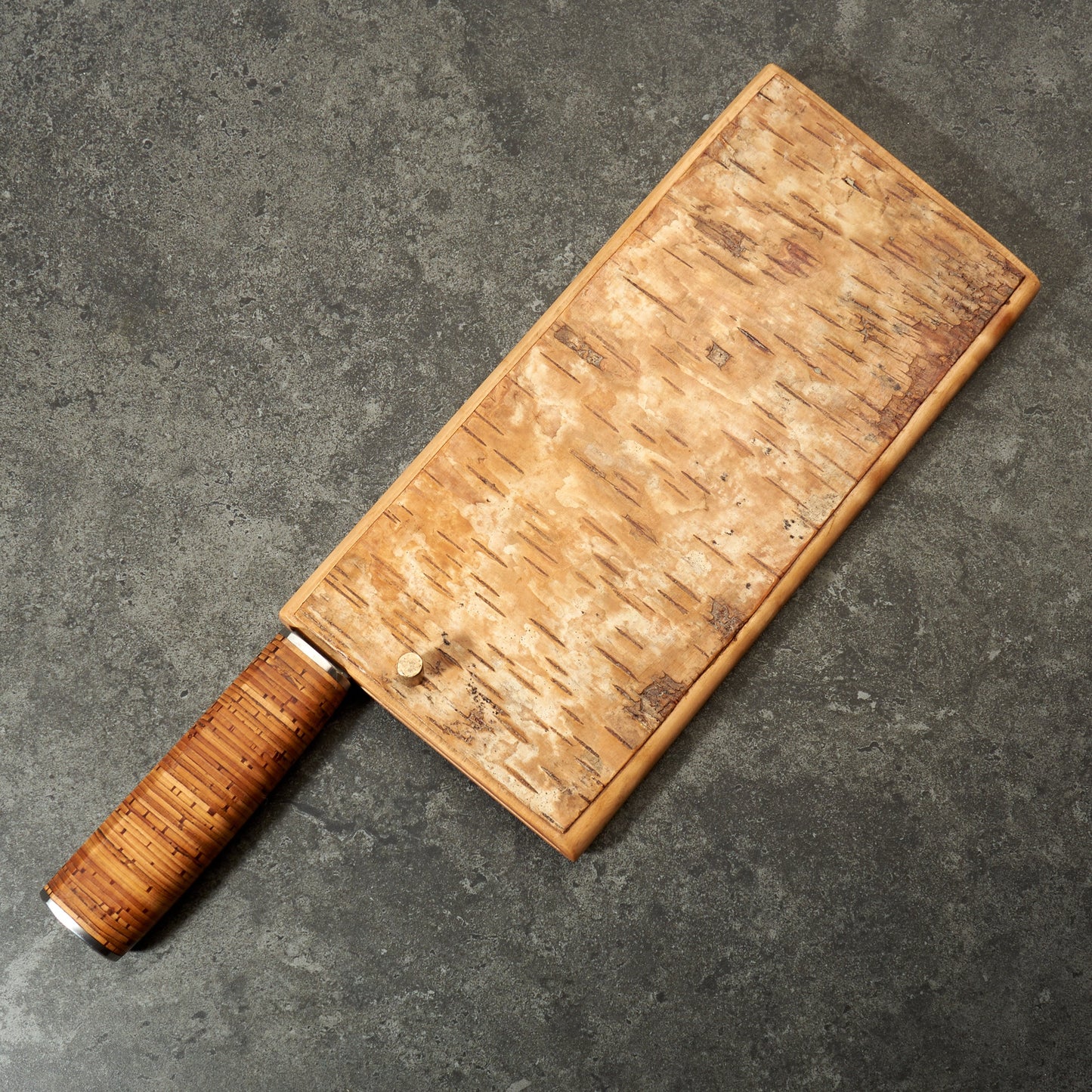
Chinesisches Kochmesser 225 × 105 mm Honyaki „S“-Schliff, Birkenrinde & Edelstahl
Chinesisches Kochmesser 225 × 105 mm Honyaki „S“-Schliff, Birkenrinde & Edelstahl
No longer available
Das Schmieden von Spaltern, insbesondere chinesischen Spaltern, ist eine große Herausforderung. Bei einem so großen Stück Metall ist die Gefahr des Verziehens ziemlich hoch. Oft muss der Klingenschmied Zeit aufwenden, um die Klinge zu glätten und zu glätten. Bei Honyaki, die auch von Natur aus schwierig zu schmieden sind, ist dies sogar noch schwieriger. Es genügt also zu sagen, dass es für Jonas sehr beeindruckend ist, einen Clever dieser Größe mit einer so dünnen, flachen und geraden Klinge herzustellen.
Ebenso beeindruckend ist die Geometrie der Klinge, die einen sehr dünnen, leistungsstarken „S“-Schliff und eine unglaubliche distale Verjüngung aufweist. Da es sich um ein Hackmesser handelt, ist das Profil überwiegend flach, weist jedoch eine leichte Krümmung zur Nase hin auf, die dem Messer eine gewisse Rock-Fähigkeit verleiht. Mit etwa 425 g ist das Messer auch relativ leicht, liegt aber dennoch solide und angenehm in der Hand.
Wenden wir uns dem Aussehen zu und was für eine erstaunliche Arbeit Jonas geleistet hat. Der Rokkaku-Hanmaru-Griff aus Birkenrinde ist zu einem charakteristischen Merkmal von Jonas' Arbeit geworden, und zum ersten Mal hat Jonas diese Klinge mit einer maßgeschneiderten Saya mit Reibungspassung und wunderschönen Birkenrindeneinlagen kombiniert, die zum Griff passen. Die rustikale Schönheit der Birkenrinde hat etwas, das sich so richtig anfühlt, wenn sie mit Jonas' unglaublichen Honyaki-Klingen kombiniert wird.
Insgesamt ist dies eine beeindruckende Arbeit von Jonas Johnsson alias isasmedjan. Die Klinge fühlt sich unglaublich in der Hand und auf dem Brett an, ein erstaunliches Erbstück von unserem schwedischen Honyaki-Meister.
Product Specification
- Blade Type:
- Edge Length: 225mm
- Spine Heel: 2.8mm
- Spine Mid: 2.2mm
- Spine Tip (20mm before): 2mm
- Blade Height: 105mm
- Weight: 425g
- Cutting Edge Steel:
- Steel class: Carbon
- HRC: 64
- Blade Construction:
- Blade Finish: Mattpolitur
- Handle Construction:
- Handle Materials: Birch Bark, Stainless Steel
- Handedness: Beidhändig
- Saya / Storage Included: Yes
Shipping & Returns
Shipping & Returns
Shipping
We process orders Monday to Friday from our Sydney workshop. Australian orders are shipped with Australia Post and international orders with DHL Express. Shipping charges are calculated at checkout based on destination, shipment size and weight, and the carrier service available for the order.
Returns
If you're not entirely happy with your purchase, you can return it within 14 days of delivery for a refund. The item must be in its original condition with all original packaging.
- Returns are accepted for 14 days
- The customer is responsible for return shipping costs
- A 15% restocking fee may be applied to change-of-mind returns
- We do not accept returns on second-hand items for change of mind
Faulty or Damaged Items
You must notify us within 5 business days of receiving your order. Photographic evidence of damage is required. Once approved, Modern Cooking will cover return shipping costs.
Product Care
Product Care
Cleaning: Clean by hand with warm water. Avoid wetting the handle when possible.
Sharpening: We advise using whetstones to sharpen your knives and a honing rod or steel to maintain the burr between sharpening sessions.
Reactive Steels: Reactive steels like Aogami Super, Apex Ultra or premium reactive German and Swedish steels are susceptible to rust if not properly cared for. Keep the knife dry between uses and when storing for longer periods, wiping the blade with Tsubaki oil or another food-safe oil is a wise choice. A patina can be a beautiful personal feature on your knife and helps to stop rust forming.
Handle Care: For non-stabilised wooden handles, apply Tsubaki oil or another food-safe oil from time to time. Food-safe wax can be applied to both stabilised and non-stabilised wooden handles. Never apply hot wax or oil as you risk warping or damaging the handle.