Zu Produktinformationen springen
1 von 5

Chinesisches Kochmesser 208 mm „Denty“ Short Neck, Black Out

Chinesisches Kochmesser 208 mm „Denty“ Short Neck, Black Out

By Benjamin Kamon


No longer available

Benjamin Kamon

Reserve your place

We'll only email you when there's something to say. Invitations go out in signup order as new work becomes available.

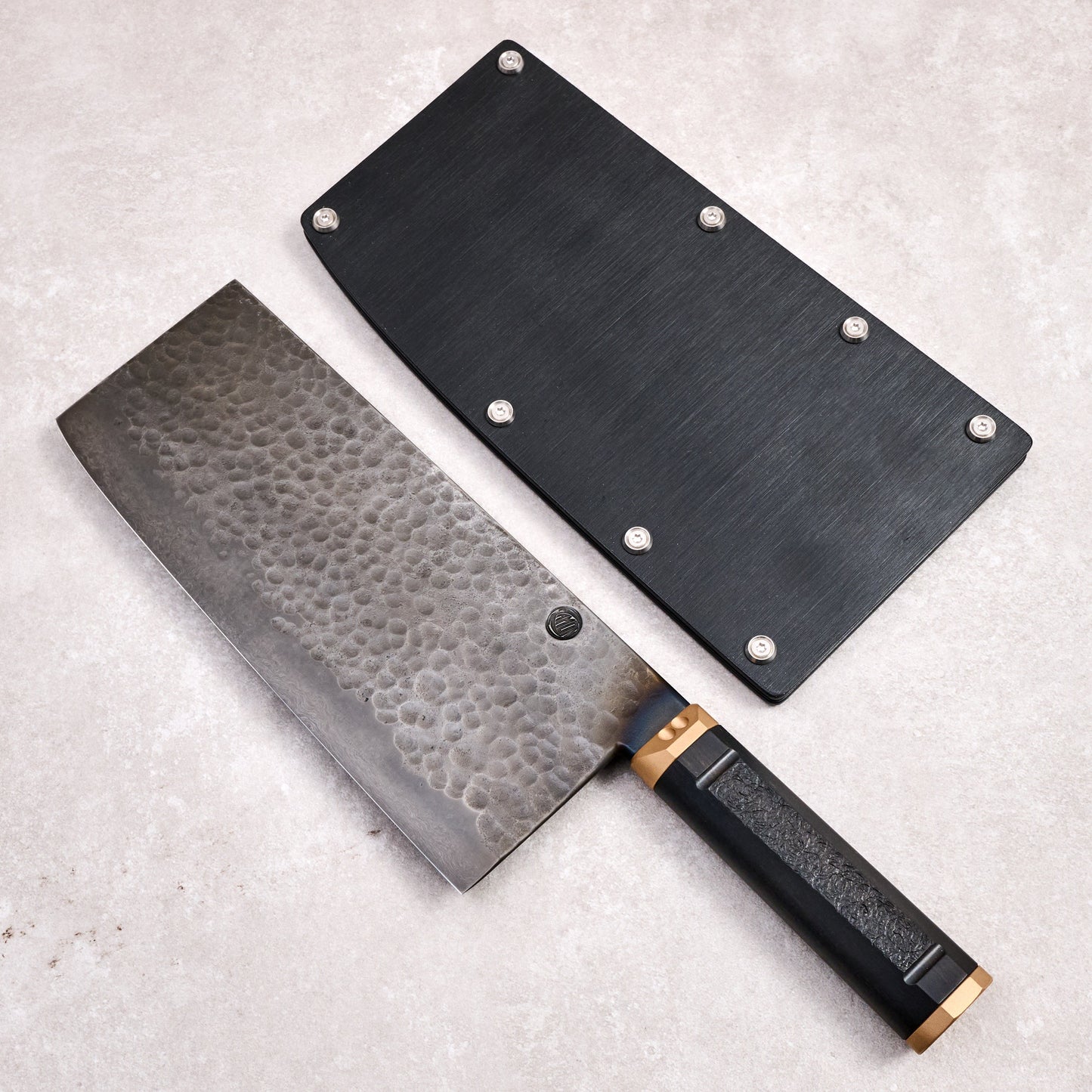
Hacken, schneiden, schöpfen – so gut kann ein Hackmesser nur sein. Präzisionsgeschmiedet und geschliffen in Benjamin Kamons Wiener Atelier. Dieses chinesische Hackmesser besticht durch eine schöne distale Verjüngung und außergewöhnlich konvex geschliffene Fasen. Mit einer Klingenlänge von 208 mm und einer Klingenhöhe von 85 mm ist dieses Hackmesser ein Präzisionskunstwerk, konzipiert als Allrounder in der Küche, mit dem Sie mühelos hacken und schneiden können. Dank Benjamins neuem Kurzhals-Design fühlt sich die Klinge außergewöhnlich ausgewogen und ergonomisch an und wird zu einer Verlängerung Ihres Körpers, während Sie Ihre Zeit in der Küche genießen.

Der präzisionsgehärtete deutsche Werkzeugstahl 1.2519 ist für eine dunkle, geschwärzte Optik säuregeätzt und weist natürlich geformte Wirbel und Linien auf, die die Hauptfase durchziehen. Dieses natürliche Muster, bekannt als Legierungsbänderung, ist ein markantes und schönes Bild. Oberhalb der Hauptfase bedeckt die für Kamon-Messer typische gehämmerte „Denty“-Struktur die Klinge bis zum Rücken und rundet den Look auf atemberaubende Weise ab. Ein pechschwarzer Griff aus Ebenholz „Rokkaku Hanmaru“ ragt aus der Kurzhalsklinge heraus. Der Griff ist an den Seiten mit einer rustizierten Struktur und perlgestrahlten bronzenen Torpedo-Endkappen akzentuiert.

Benjamins Messer zeichnen sich durch beste Passform und Verarbeitung aus und sein Design ist eines der anspruchsvollsten überhaupt. Dies ist ein unglaubliches Erbstück dieses österreichischen Kunstschmiedes.

Das Messer wird mit einer handgefertigten Saya zur sicheren Aufbewahrung und zum Transport geliefert.

Product Specification
  • Blade Type:
  • Edge Length: 208mm
  • Spine Heel: 5.8mm
  • Spine Mid: 2.06mm
  • Spine Tip (20mm before): 1.47mm
  • Blade Height: 85mm
  • Weight: 378g
  • Cutting Edge Steel:
  • Steel class: Carbon
  • HRC: 65
  • Blade Construction:
  • Blade Finish: Säuregeätzt (erzwungene Patina), Strukturiert, Satinpolitur
  • Grind:
  • Handle Construction:
  • Handle Materials: Ebony, Bronze
  • Handedness: Beidhändig
  • Saya / Storage Included: Yes

Blade type

Chinesisches Kochmesser

Ein hohes, dünn ausgeschliffenes Allzweckmesser — trotz seiner Silhouette kein Knochenhacker. Die breite, rechteckige Klinge ist dünn und rasiermesserscharf ausgeschliffen, gemacht für Schnitte im Druckschnitt und feine Gemüsearbeit; die hohe Klingenfläche dient zugleich als Schaufel, um Geschnittenes vom Brett in die Pfanne zu tragen. In geübten Händen deckt es den Großteil der Küchenarbeit ab.

Der Kompromiss liegt in der Form: Weil es die Silhouette mit dem westlichen Hackbeil teilt, wird es oft für einen schweren Hacker gehalten — die Schneide ist jedoch fein, hart und dünn, Knochen oder Gefrorenes beschädigen sie. Aus der Schulter im kontrollierten Druckschnitt geführt statt aus dem Handgelenk geschwungen, ist es eines der vielseitigsten und angenehmsten Messer auf dem Brett.

View full knife type guide →

Cutting edge steel

1.2519

Low-alloy tungsten-chromium tool steel

Typical HRC
62–65
Corrosion class
Carbon
Production
Conventional
Origin
Germany (DIN 110WCrV5)

1.2519 is the classic German oil-hardening Cr-W-V tool steel — close kin to AISI O7 and a sister to 1.2419, with a touch more vanadium for finer carbides. The tungsten and chromium combine to produce hard, finely dispersed carbides that allow a thin geometry to hold an edge longer than the simple carbons, while the vanadium keeps grain size tidy through the heat treat.

In a kitchen knife, it lands comfortably between 62 and 64 HRC and behaves like a slightly more wear-resistant W2 — that is, it sharpens with little fuss on most stones, takes a fine edge, and rewards a deliberate heat treatment more than it punishes a casual one. It will patina, sometimes attractively, sometimes alarmingly to a first-time carbon owner; either way, a wipe-and-dry habit is enough to keep it civil.

You will find 1.2519 in the work of European bladesmiths who want a step up in edge retention from white-paper carbons without losing the easy stone feel. Among the makers Modern Cooking carries, Benjamin Kamon, Martin Huber, Tobias Heldqvist, Jonas Johnsson, and MCx work in 1.2519. It is one of the more honest "European answers to Aogami" — not the same metallurgy, but a similar relationship between feel at the stone and edge longevity.

View full steel guide →

Blade construction

Mono Steel

A knife forged from a single piece of steel — no laminations, no clad layers. The simplest and most direct construction. The entire blade is the cutting steel, with no softer outer jacket to protect or contrast it. Most contemporary Western kitchen knives in carbon and stainless steel are mono-steel constructions, as are honyaki and most European bladesmith work.

The trade-off is straightforward: mono-steel knives are easier to forge, sharpen, and reason about, but the entire blade carries the cutting steel's properties — including its reactivity if it's a clean carbon. There is no soft jacket to protect a more brittle core from impact, so the heat treatment and geometry have to do all the work.

View full construction guide →

Grind

Convex

A grind whose bevel bulges outward in a gentle curve from spine to edge, rather than running flat. That extra steel directly behind the edge makes a convex grind notably strong and resistant to chipping, while the curved geometry helps food release and lets the blade glide through dense ingredients with less wedging than a flat grind.

The strength comes at the cost of ultimate thinness and ease of maintenance. A convex edge has more metal behind it, so it is not quite as effortlessly keen as a thinly flat-ground edge, and it is harder to sharpen freehand — holding the curve takes a stropping technique or a deliberate hand rather than a single fixed angle. The reward is an exceptionally tough, smooth-cutting edge.

View full grind guide →

Handle construction

Takedown

A takedown is a hidden-tang construction built to come apart. The tang passes through the handle and is drawn up by a threaded fitting — a nut at the butt, or a pommel that screws down — so the handle can be dismantled and re-fitted rather than being permanently bonded in place. Everything else follows the hidden-tang pattern: a concealed tang inside a one-piece handle, with no steel showing along the grip.

The point of the design is serviceability. Because the handle is mechanical rather than glued, it can be taken off for thorough cleaning and drying, swapped for a different material or profile, or replaced entirely if it is ever damaged — all without destroying the original fittings. It is the construction to choose for a knife meant to be maintained and kept for the long term, and for owners who like the option of changing a handle later.

View full construction guide →

Shipping & Returns

Shipping

We process orders 5 days a week (Monday - Friday) and ship from our shop in Sydney, Australia. We ship with FedEx, UPS and DHL.

We are happy to offer free international shipping on a variety of orders depending on location and order value.

Free Shipping Regions and Minimum Order Values

For Australia and New Zealand the minimum is $500AUD. For the rest of the world it is approximately €1000EUR. The discount is applied automatically when you reach the minimum cart value at checkout.

Returns

If you're not entirely happy with your purchase, you can return it within 14 days of delivery for a refund. The item must be in its original condition with all original packaging.

  • Returns are accepted for 14 days
  • The customer is responsible for return shipping costs
  • A 15% restocking fee may be applied to change-of-mind returns
  • We do not accept returns on second-hand items for change of mind

Faulty or Damaged Items

You must notify us within 5 business days of receiving your order. Photographic evidence of damage is required. Once approved, Modern Cooking will cover return shipping costs.

Product Care

Cleaning: Clean by hand with warm water. Avoid wetting the handle when possible.

Sharpening: We advise using whetstones to sharpen your knives and a honing rod or steel to maintain the burr between sharpening sessions.

Reactive Steels: Reactive steels like Aogami Super, Apex Ultra or premium reactive German and Swedish steels are susceptible to rust if not properly cared for. Keep the knife dry between uses and when storing for longer periods, wiping the blade with Tsubaki oil or another food-safe oil is a wise choice. A patina can be a beautiful personal feature on your knife and helps to stop rust forming.

Handle Care: For non-stabilised wooden handles, apply Tsubaki oil or another food-safe oil from time to time. Food-safe wax can be applied to both stabilised and non-stabilised wooden handles. Never apply hot wax or oil as you risk warping or damaging the handle.

Vollständige Details anzeigen