Zu Produktinformationen springen
1 von 7

Cleaver 180 mm Apex Ultra mit Kupfer- und Schmiedeeisenverkleidung

Cleaver 180 mm Apex Ultra mit Kupfer- und Schmiedeeisenverkleidung

By Karol Karyś


No longer available

Karol Karyś

Reserve your place

We'll only email you when there's something to say. Invitations go out in signup order as new work becomes available.

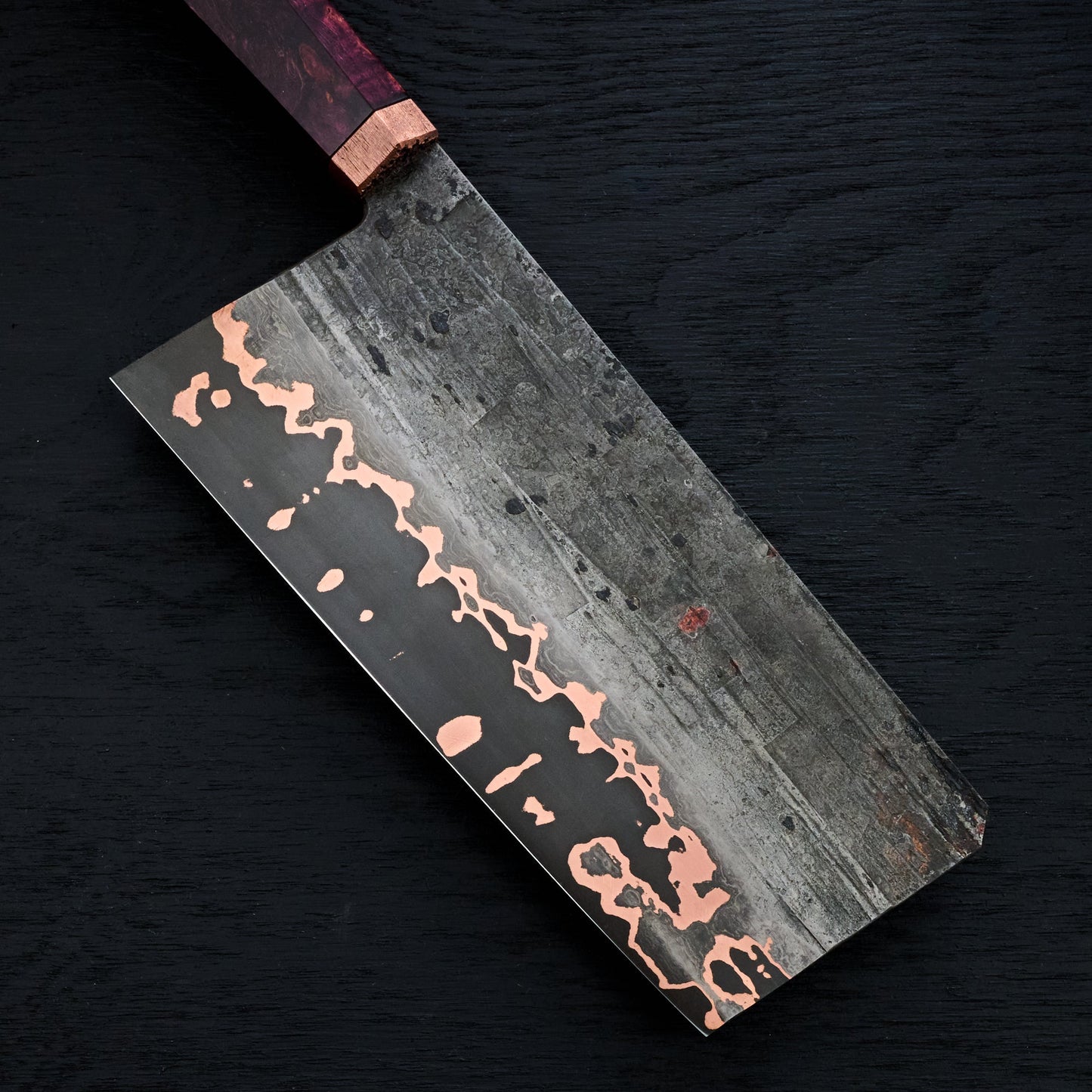
Ein meisterhaft gefertigtes Werkzeug für Köche und kulinarische Enthusiasten, die nach dem Höchstmaß an Leistung und Ästhetik suchen. Dieses Hackmesser mit seiner beachtlichen Kantenlänge von 180 mm ist für eine Vielzahl von Küchenaufgaben konzipiert, vom Hacken großer Fleischstücke bis zum feinen Würfeln von Gemüse. Die Klinge, gefertigt in 5-Lagen-Technik (Go Mai), besticht durch Kupferwellen, Karols brutalistisch inspirierte Texturen, die auf antikes Schmiedeeisen geprägt wurden, und eine moderne, leistungsstarke S-Schliff-Geometrie. Der geschwärzte Stahl, der einen starken Kontrast zur Kupferverkleidung bildet, ist ein beeindruckendes Meisterwerk.

Dieses Hackmesser aus Apex Ultra-Stahl besticht durch beeindruckende Robustheit, hervorragende Schnitthaltigkeit und Schärfe. Der Rücken, der sich von 3,6 mm an der Ferse auf 1,6 mm zur Spitze verjüngt, bildet ein robustes Rückgrat und bietet gleichzeitig eine fein geschliffene Schneide für präzise Schnitte. Der S-Schliff verbessert die Schneidgutfreigabe und ermöglicht müheloses Schneiden durch verschiedene Lebensmitteltexturen mit minimalem Widerstand. Beim Schneiden von Produkten bewahrt dieses Hochleistungs-Küchenmesser die Integrität der Lebensmittel und verbessert so deren Geschmack.

Trotz seiner massiven Bauweise wiegt das Hackmesser nur 293 g. Dies ist Karols außergewöhnlicher Arbeit zu verdanken, die eine feine Verjüngung der Klinge und den S-Schliff zur Gewichtsreduzierung ermöglicht. Dies reduziert die Ermüdung der Hand bei längerem Gebrauch. Der Griff ist ein Kunstwerk mit einer verdeckten Erlkonstruktion aus stabilisierter karelischer Birke und Karols charakteristischem strukturierten Kupferkropf. Die Ästhetik basiert auf perfekter Balance, Gewicht und Ergonomie. Wir freuen uns immer über Aufträge von Karol; seine Handwerkskunst ist außergewöhnlich und beeindruckt immer wieder mit diesem leistungsstarken Küchenhackmesser.

Product Specification
  • Blade Type:
  • Edge Length: 180mm X 80mm
  • Spine Heel: 3.6mm
  • Spine Mid: 2.2mm
  • Spine Tip (20mm before): 1.6mm
  • Blade Height: 80mm
  • Weight: 293
  • Cutting Edge Steel:
  • Steel class: Carbon
  • HRC: 66+
  • Blade Construction:
  • Blade Finish: StrukturiertSäuregeätzt (erzwungene Patina)Mattlack
  • Grind:
  • Handle Construction:
  • Handle Materials: Karelian Birch, Copper
  • Handedness: Beidhändig

Blade type

Cleaver

A broad, heavy, rectangular blade — and a term that covers two very different tools. The heavy Western butcher's cleaver is built with a thick spine and robust edge to chop through bone and joints; the lighter Chinese vegetable cleaver (càidāo) has a tall, thin blade that is a surprisingly nimble all-purpose knife, with a wide face useful for scooping. Knowing which one is meant matters.

A true butcher's cleaver trades all finesse for the mass and durability needed to split bone, and it has little place in delicate work. The Chinese vegetable version is far more versatile than its size suggests but is not built for bone at all, despite the shared silhouette. The shape promises power; the specific knife determines whether that power comes with any subtlety.

View full knife type guide →

Cutting edge steel

Apex Ultra

Low-alloy fine-grain carbon tool steel

Typical HRC
64–68
Corrosion class
Carbon
Production
Conventional
Origin
Austria (developed by Tobias Hangler and Marco Guldimann; project led by Hangler at Messerschmiede Hangler)

Apex Ultra is one of the most carefully engineered non-stainless kitchen knife steels in modern circulation, and the project of an Austrian smith — Tobias Hangler — who set out, with Marco Guldimann, to design a steel for the kitchen rather than borrow one from another industry. It carries roughly 1.25 percent carbon, around four percent chromium, modest tungsten and molybdenum, and a small vanadium addition. The composition is tuned to produce a fine, evenly distributed carbide structure that supports hardness up to 67 HRC while delivering toughness comparable to 52100 at the same hardness — a combination that is the entire point of the steel.

What this means for a cook is unusual permission. You can ask a maker to grind an Apex Ultra knife thin enough that a White #1 owner would call you brave, then ask for the heat treatment to land at 65 HRC, and the resulting edge will hold for longer than Aogami Super without microchipping. It sharpens cleanly on natural and synthetic stones alike and patinas slowly because of the chromium content, though it is not stainless and should be treated as a carbon steel.

Apex Ultra has become a signature steel of the European maker community, and the Modern Cooking catalogue carries an unusually deep bench of smiths working in it. Tobias Hangler himself heads that group, alongside Marco Guldimann, Benjamin Kamon, Martin Huber, Jonas Johnsson, Karol Karyś, Birch & Bevel, and MCx. It is genuinely a step forward — one of the relatively few cases where the marketing claims and the underlying metallurgical data are saying the same thing.

View full steel guide →

Blade construction

Laminated Steel

A category covering knives built from multiple layers of different steels forge-welded together. The hard cutting steel is sandwiched between softer outer layers (cladding) that protect the core, add toughness, and often contribute visual contrast.

The most common laminated constructions in the Modern Cooking catalogue are:

SanMai (三枚) — three layers: hard cutting steel in the centre, softer cladding on both sides. The traditional and most common form.

GoMai (五枚) — five layers: a hard core, two intermediate layers, and two outer layers. Adds visual depth and structural complexity.

KuMai (九枚) — nine layers: similar logic, with more cladding layers for additional pattern and structural variation.

GoMai and KuMai are often chosen not only for the additional layers and visual depth, but also because the intermediate layers can act as a nickel diffusion barrier — limiting carbon migration out of the core into the cladding during forge welding, and protecting the core's intended carbon content through the heat of the forging process.

In all cases the cutting performance is determined by the core steel; the outer layers are cosmetic and structural. The lamination contributes corrosion protection (when a stainless jacket clads a carbon core), reduced reactivity, and the visible boundary between core and cladding that gives the knife its character.

View full construction guide →

Grind

Compound Grind

A category covering blades ground with more than one geometry stacked into a single cross-section — typically a convex (or flat) primary bevel at the very edge, with one or more hollows ground higher up the blade face to relieve material behind it. The aim is food release and reduced wedging: the hollow opens an air gap so dense produce breaks away from the blade instead of clinging to it, while the convex steel at the edge keeps the apex strong and the knife driving through the cut.

The named variations in the Modern Cooking catalogue differ in where the hollows sit, how many there are, and whether the two faces are ground alike:

S-Grind — a convex primary bevel at the edge with a hollow ground into both faces just above it. The symmetrical "S"-shaped cross-section is the classic food-release grind: relief above the edge, strength at the edge.

C-Grind — an asymmetric S-grind. Both faces keep the convex primary bevel, but only one face carries the hollow above it. The single-sided relief biases food release to one side, and is simpler to grind and to maintain than a full S.

B-Grind — a stacked twin-hollow grind: a tight, narrow hollow immediately above the edge, with a second, broader and wider hollow above that. The staged relief gives especially strong food release across the height of the blade.

S-Hook Grind — also called a hook, harpoon, or J grind. An S-grind taken to an extreme, with the hollow placed very close to the cutting edge. The aggressive near-edge relief gives outstanding food release, at the price of being the most maintenance-sensitive of the family.

Asymmetrical-B Grind — a B-grind in which the twin-hollow structure is carried on one face while the other is ground differently (or left without the upper hollow), off-setting the edge. It combines the staged food release of a B-grind with the handed, steering character of an asymmetric grind.

In every case the gain is food release and reduced drag, and the shared cost is sharpening: as the edge is thinned over the knife's life, maintenance eventually reaches the hollowed steel, which cannot be flattened on a stone the way a convex or flat bevel can. How soon that happens depends on how deeply the hollows are cut and how close to the edge they sit — exactly what separates a gentle S-grind from an aggressive S-hook. These are high-craft geometries, prized by makers and experienced users for their cutting feel, and best appreciated by a cook who maintains their own edges.

View full grind guide →

Handle construction

Hidden Tang

A construction in which the tang runs into the handle but stays concealed inside it, rather than showing between two scales. A narrower tang — a full-length stick or a shorter projection — is set into a drilled or burned channel in a one-piece handle and secured with adhesive, a friction fit, or a threaded fitting drawn up against the blade. This is the traditional construction of Japanese wa-handles and many European hidden-tang knives.

The design puts the handle material in charge of the look and feel: a single piece of wood, horn, or composite — often with a ferrule or spacers at the front — is shaped into any cross-section the maker wants, from the classic octagonal and D-shaped wa profiles to fully rounded Western forms. With no steel showing along the grip, the handle can be slim and light, and is frequently made to be removed and replaced, with the balance sitting toward the blade.

View full construction guide →

Shipping & Returns

Shipping

We process orders 5 days a week (Monday - Friday) and ship from our shop in Sydney, Australia. We ship with FedEx, UPS and DHL.

We are happy to offer free international shipping on a variety of orders depending on location and order value.

Free Shipping Regions and Minimum Order Values

For Australia and New Zealand the minimum is $500AUD. For the rest of the world it is approximately €1000EUR. The discount is applied automatically when you reach the minimum cart value at checkout.

Returns

If you're not entirely happy with your purchase, you can return it within 14 days of delivery for a refund. The item must be in its original condition with all original packaging.

  • Returns are accepted for 14 days
  • The customer is responsible for return shipping costs
  • A 15% restocking fee may be applied to change-of-mind returns
  • We do not accept returns on second-hand items for change of mind

Faulty or Damaged Items

You must notify us within 5 business days of receiving your order. Photographic evidence of damage is required. Once approved, Modern Cooking will cover return shipping costs.

Product Care

Cleaning: Clean by hand with warm water. Avoid wetting the handle when possible.

Sharpening: We advise using whetstones to sharpen your knives and a honing rod or steel to maintain the burr between sharpening sessions.

Reactive Steels: Reactive steels like Aogami Super, Apex Ultra or premium reactive German and Swedish steels are susceptible to rust if not properly cared for. Keep the knife dry between uses and when storing for longer periods, wiping the blade with Tsubaki oil or another food-safe oil is a wise choice. A patina can be a beautiful personal feature on your knife and helps to stop rust forming.

Handle Care: For non-stabilised wooden handles, apply Tsubaki oil or another food-safe oil from time to time. Food-safe wax can be applied to both stabilised and non-stabilised wooden handles. Never apply hot wax or oil as you risk warping or damaging the handle.

Vollständige Details anzeigen