Zu Produktinformationen springen
1 von 4

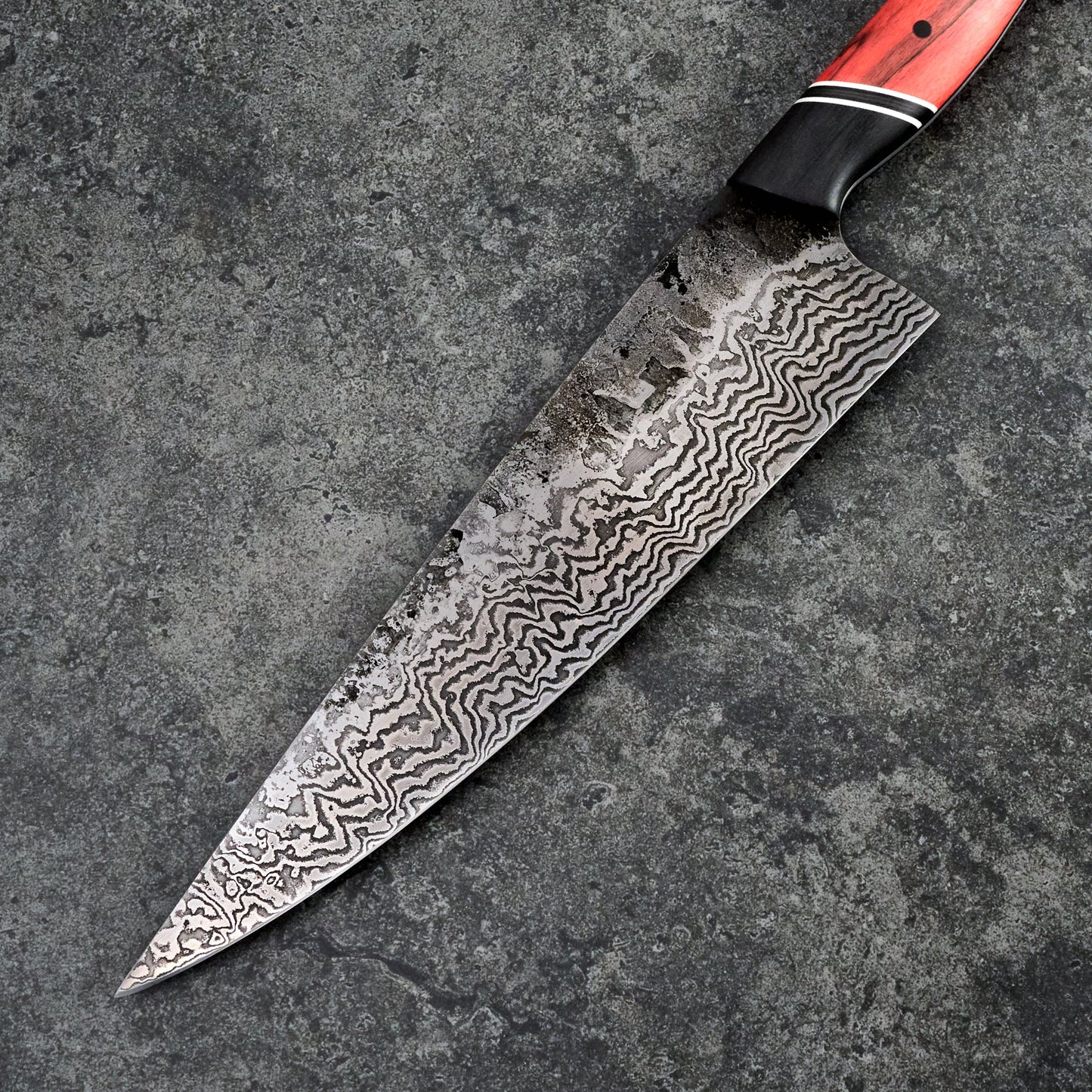
Kochmesser 220mm 50 Lagen Full Tang Spalted Beach

Kochmesser 220mm 50 Lagen Full Tang Spalted Beach

By Martin Huber


No longer available

Martin Huber

Reserve your place

We'll only email you when there's something to say. Invitations go out in signup order as new work becomes available.

Ein elegantes 50-lagiges Damaszener-Kochmesser. Mit 220 mm ist dies ein praktisches und vielseitiges Küchenmesser für den täglichen Gebrauch. Eine ausgewogene Vollerl-Konstruktion sorgt für ein flinkes Gefühl in der Hand und das spitze, klassische Kochprofil eignet sich hervorragend für alltägliche Aufgaben.

Ein robuster, im Haus geschmiedeter Damast mit einem bemerkenswerten, kontrastreichen Muster. Auffällig, rasiermesserscharf und pflegeleicht. Der Stahl lässt sich wunderbar scharf schneiden und weist eine gute Schnitthaltigkeit auf.

Martins durchgehende Griffe bestehen aus lebendigen, aber dennoch edlen Premiummaterialien. Dies ist ein sehr hochwertiges Messer, das für den täglichen Gebrauch geeignet ist und ein Leben lang hält.

Product Specification
  • Blade Type:
  • Edge Length: 220mm
  • Spine Heel: 2.61mm
  • Spine Mid: 2.01mm
  • Spine Tip (20mm before): 0.91mm
  • Blade Height: 55mm
  • Weight: 187g
  • Cutting Edge Steel:
  • Steel class: Carbon
  • HRC: 62
  • Blade Construction:
  • Blade Finish: Säuregeätzt (erzwungene Patina)Schmiedeeisen
  • Grind:
  • Handle Construction:
  • Handle Materials: Spalted Beech, Bog Oak, G10, Carbon Fibre
  • Handedness: Beidhändig

Blade type

Chef Knife

The Western chef's knife — the traditional European all-purpose blade, typically 200 to 250 mm, with a curved belly built to rock against the board. The pronounced curve from heel to tip suits a continuous rocking motion for mincing herbs and aromatics, and the blade is generally thicker, heavier, and softer than its Japanese counterpart, made to absorb hard and varied use.

That robustness is the trade-off. A Western chef's knife is forgiving, durable, and happy with bones, hard squash, and rough handling, but its softer steel and thicker grind mean it is rarely as keen as a comparable gyuto and needs more frequent honing to stay sharp. It is the dependable generalist of the kitchen — what it gives up in refinement it returns in resilience.

View full knife type guide →

Cutting edge steel

Damascus

Pattern-welded composite construction (term, not an alloy)

Typical HRC
Determined by core / outer steel
Corrosion class
Varies
Production
Pattern-welded
Origin
Global

"Damascus" is a construction technique, not a steel. Modern damascus billets are made by forge-welding alternating layers of two or more steels — typically a higher- and a lower-carbon partner, or a contrasting-nickel pair — and then folding, twisting, ladder-cutting, or otherwise manipulating the billet to expose the layer interfaces in a pattern. The visual interest comes from the etch, which preferentially attacks one of the two steels.

For a kitchen knife the relevant question is always: what is the cutting steel? Many premium Japanese damascus knives are *clad* damascus — a VG-10, SG2 or carbon core inside a multi-layer damascus jacket — in which case the patterning is decorative and the cutting metallurgy is the core. In *full* damascus knives (more common in custom Western work) the entire blade is pattern-welded, and the cutting steel is the harder of the two laminate components.

This is one of the points where a customer-facing entry needs to be honest: a beautiful damascus pattern is a craft achievement, but it does not on its own tell the buyer how the knife will cut. The core steel does that, and a good maker will list both.

View full steel guide →

Blade construction

Damascus

Pattern-welded steel — multiple layers of different alloys forge-welded, then folded, twisted, ladder-cut, or otherwise manipulated to expose the layer interfaces in a visible pattern. The pattern is revealed by acid etching, which preferentially attacks one of the two steels in the laminate.

Damascus is a construction technique rather than a single steel. The cutting performance is determined by which steel forms the cutting edge — often a clad core in Japanese damascus knives, occasionally the harder of the two laminate steels in full-damascus Western work. A beautiful damascus pattern is a craft achievement; it does not on its own tell the buyer how the knife will cut. A good maker lists both the pattern and the core steel.

View full construction guide →

Grind

Convex

A grind whose bevel bulges outward in a gentle curve from spine to edge, rather than running flat. That extra steel directly behind the edge makes a convex grind notably strong and resistant to chipping, while the curved geometry helps food release and lets the blade glide through dense ingredients with less wedging than a flat grind.

The strength comes at the cost of ultimate thinness and ease of maintenance. A convex edge has more metal behind it, so it is not quite as effortlessly keen as a thinly flat-ground edge, and it is harder to sharpen freehand — holding the curve takes a stropping technique or a deliberate hand rather than a single fixed angle. The reward is an exceptionally tough, smooth-cutting edge.

View full grind guide →

Handle construction

Full Tang

A construction in which the blade steel runs the full length and width of the handle, forming a flat core between two handle scales. The scales are fixed to either face of the tang with pins, rivets, or adhesive, and the tang's outline stays visible as a strip of steel around the top, bottom, and butt of the handle — often with the pin heads showing as a row down each side. It is the dominant construction in Western kitchen and outdoor knives.

Because the steel continues all the way to the butt, the handle is essentially the tang dressed in two scales, and the grip is ground and shaped from that sandwiched assembly as a whole. The extra steel carries weight and balance back toward the hand, giving the solid, blade-and-handle-as-one feel that defines the style, and it leaves the edge of the tang on show as part of the knife's line.

View full construction guide →

Shipping & Returns

Shipping

We process orders 5 days a week (Monday - Friday) and ship from our shop in Sydney, Australia. We ship with FedEx, UPS and DHL.

We are happy to offer free international shipping on a variety of orders depending on location and order value.

Free Shipping Regions and Minimum Order Values

For Australia and New Zealand the minimum is $500AUD. For the rest of the world it is approximately €1000EUR. The discount is applied automatically when you reach the minimum cart value at checkout.

Returns

If you're not entirely happy with your purchase, you can return it within 14 days of delivery for a refund. The item must be in its original condition with all original packaging.

  • Returns are accepted for 14 days
  • The customer is responsible for return shipping costs
  • A 15% restocking fee may be applied to change-of-mind returns
  • We do not accept returns on second-hand items for change of mind

Faulty or Damaged Items

You must notify us within 5 business days of receiving your order. Photographic evidence of damage is required. Once approved, Modern Cooking will cover return shipping costs.

Product Care

Cleaning: Clean by hand with warm water. Avoid wetting the handle when possible.

Sharpening: We advise using whetstones to sharpen your knives and a honing rod or steel to maintain the burr between sharpening sessions.

Reactive Steels: Reactive steels like Aogami Super, Apex Ultra or premium reactive German and Swedish steels are susceptible to rust if not properly cared for. Keep the knife dry between uses and when storing for longer periods, wiping the blade with Tsubaki oil or another food-safe oil is a wise choice. A patina can be a beautiful personal feature on your knife and helps to stop rust forming.

Handle Care: For non-stabilised wooden handles, apply Tsubaki oil or another food-safe oil from time to time. Food-safe wax can be applied to both stabilised and non-stabilised wooden handles. Never apply hot wax or oil as you risk warping or damaging the handle.

Vollständige Details anzeigen