Zu Produktinformationen springen
1 von 9

Ausbeinmesser 160 mm AEB-L Orbital Double Black Canvas Micarta & Edelstahl

Ausbeinmesser 160 mm AEB-L Orbital Double Black Canvas Micarta & Edelstahl

By Dan Bidinger


No longer available

Dan Bidinger

Reserve your place

We'll only email you when there's something to say. Invitations go out in signup order as new work becomes available.

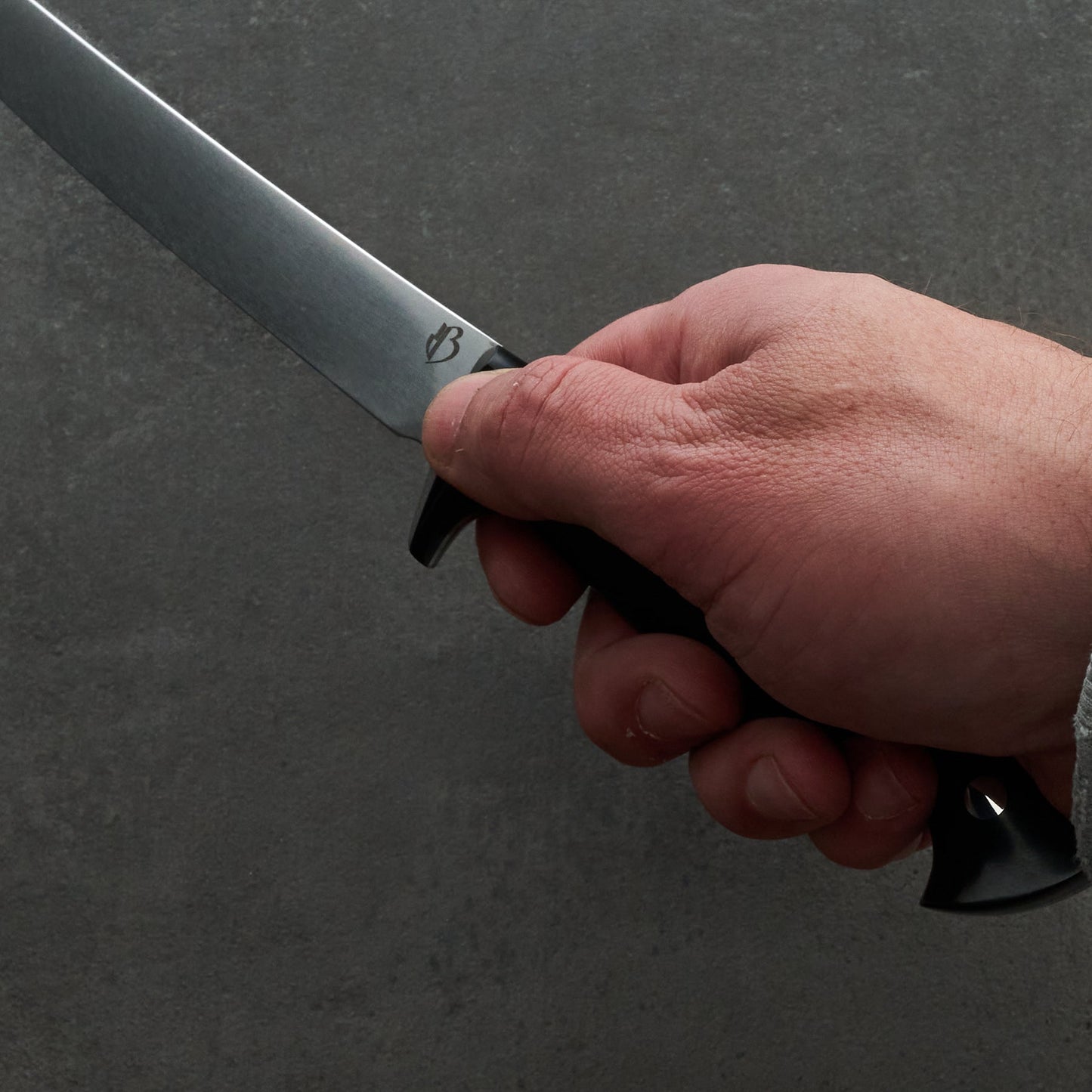
Wir präsentieren ein einzigartiges Küchenmesser, sorgfältig handgefertigt vom Messermacher Dan Bidinger. Inspiriert von klassischen französischen Ausbeinmessern ist dieses außergewöhnliche Werkzeug auf Präzision und Kontrolle ausgelegt. Die dünnen konvexen Fasen und die sanfte Verjüngung sorgen für ein gleichmäßiges Schneideverhalten und machen es zur ausgezeichneten Wahl für detaillierte und komplizierte Aufgaben. Ob Sie Fleisch zuschneiden oder um ein Gelenk herum arbeiten, die raffinierte Geometrie dieses Messers ermöglicht mühelose Handhabung und saubere, präzise Schnitte.

Das Herzstück dieses Messers ist AEB-L Premium-Edelstahl, eines von Dan Bidingers Lieblingsmaterialien. Bekannt für seine feinkörnige Struktur bietet dieser Stahl hervorragende Schärfe und außergewöhnliche Schnitthaltigkeit. Ursprünglich für Rasierklingen entwickelt, wird AEB-L von Messermachern und Köchen gleichermaßen für seine rasiermesserscharfe Schneide geschätzt, die gleichzeitig langlebig und pflegeleicht ist. Das bedeutet, dass das Messer nicht nur eine hervorragende Schneidleistung bietet, sondern auch lange scharf bleibt, sodass häufiges Schärfen reduziert wird.

Der Griff ist in klassischer Full-Tang-Konstruktion gefertigt und verfügt über doppelte schwarze Canvas-Micarta-Schalen und Edelstahlstifte für eine sichere und robuste Konstruktion. Der ergonomisch geformte Griff in Colaflaschenform liegt angenehm in der Hand und ermöglicht so eine einfache Handhabung auch bei längeren Küchenarbeiten. Dan hat außerdem dezente Fingerkerben auf beiden Seiten des Klemmpunkts integriert, die Komfort und Kontrolle verbessern. Einzigartige und seltene Merkmale wie das Orbital-Finish der Klingenfläche tragen zum markanten Erscheinungsbild des Messers und seiner geschmeidigen Schneidefähigkeit bei. Mit seiner außergewöhnlichen Schärfe, dem ausgewogenen Design und der handwerklichen Verarbeitung ist dieses Messer ein echter Hingucker in jeder Küche.

Product Specification
  • Blade Type:
  • Overall Length: 285 mm
  • Edge Length: 160mm
  • Spine Heel: 1.64mm
  • Spine Mid: 1.50mm
  • Spine Tip (20mm before): 1.11mm
  • Blade Height: 20mm
  • Weight: 114g
  • Cutting Edge Steel:
  • Steel class: Stainless
  • HRC: 65
  • Blade Construction:
  • Blade Finish: Gebürstet
  • Grind:
  • Handle Construction:
  • Handle Materials: Double Black Canvas Micarta
  • Handedness: Beidhändig

Blade type

Boning Knife

A narrow knife built to separate meat from bone, with a thin blade and a fine point for working into joints and along the skeleton. Boning knives come in stiff and flexible versions: a stiffer blade gives control and power on beef and pork, while a more flexible one follows the contours of poultry and smaller cuts. The narrow profile keeps waste low by hugging the bone closely.

This is a specialist's knife, and the right degree of flex depends on the work. It excels at its single task and is largely wasted on general prep, where its narrow blade and pointed tip offer no advantage. For anyone who breaks down primal cuts or whole animals, though, it removes meat with a cleanliness no general-purpose knife can match.

View full knife type guide →

Cutting edge steel

AEB-L

Fine-grain martensitic stainless steel

Typical HRC
60–63
Corrosion class
Stainless
Production
Conventional
Origin
Sweden (Uddeholm)

AEB-L is the original fine-grain razor stainless — a steel developed for safety razor blades and rediscovered by knifemakers as one of the most refined stainless choices available. About 0.67 percent carbon and 13 percent chromium, with very low impurity content, allow the steel to take a near-carbon-grade edge while remaining genuinely stainless.

In a custom or boutique kitchen knife AEB-L typically lands at 60–62 HRC, sharpens with the easy feel of a clean carbon, and produces a polished apex that holds an edge longer than its modest carbide content might suggest. Toughness is exceptional: at 62 HRC, AEB-L compares well to 52100 at the same hardness in published toughness data, which is the point that contemporary metallurgical writing on the steel has emphasised. It is the steel that taught a generation of makers that stainless need not feel coarse.

AEB-L is heavily used in the modern American custom scene and is an honest answer to the cook who wants the feel of a clean carbon without the maintenance burden. Among the makers Modern Cooking carries, Lew Griffin and Oliver Märtens work in AEB-L. It is closely related to Sandvik 13C26 and a direct ancestor of 14C28N.

View full steel guide →

Blade construction

Mono Steel

A knife forged from a single piece of steel — no laminations, no clad layers. The simplest and most direct construction. The entire blade is the cutting steel, with no softer outer jacket to protect or contrast it. Most contemporary Western kitchen knives in carbon and stainless steel are mono-steel constructions, as are honyaki and most European bladesmith work.

The trade-off is straightforward: mono-steel knives are easier to forge, sharpen, and reason about, but the entire blade carries the cutting steel's properties — including its reactivity if it's a clean carbon. There is no soft jacket to protect a more brittle core from impact, so the heat treatment and geometry have to do all the work.

View full construction guide →

Grind

Convex

A grind whose bevel bulges outward in a gentle curve from spine to edge, rather than running flat. That extra steel directly behind the edge makes a convex grind notably strong and resistant to chipping, while the curved geometry helps food release and lets the blade glide through dense ingredients with less wedging than a flat grind.

The strength comes at the cost of ultimate thinness and ease of maintenance. A convex edge has more metal behind it, so it is not quite as effortlessly keen as a thinly flat-ground edge, and it is harder to sharpen freehand — holding the curve takes a stropping technique or a deliberate hand rather than a single fixed angle. The reward is an exceptionally tough, smooth-cutting edge.

View full grind guide →

Handle construction

Full Tang

A construction in which the blade steel runs the full length and width of the handle, forming a flat core between two handle scales. The scales are fixed to either face of the tang with pins, rivets, or adhesive, and the tang's outline stays visible as a strip of steel around the top, bottom, and butt of the handle — often with the pin heads showing as a row down each side. It is the dominant construction in Western kitchen and outdoor knives.

Because the steel continues all the way to the butt, the handle is essentially the tang dressed in two scales, and the grip is ground and shaped from that sandwiched assembly as a whole. The extra steel carries weight and balance back toward the hand, giving the solid, blade-and-handle-as-one feel that defines the style, and it leaves the edge of the tang on show as part of the knife's line.

View full construction guide →

Shipping & Returns

Shipping

We process orders 5 days a week (Monday - Friday) and ship from our shop in Sydney, Australia. We ship with FedEx, UPS and DHL.

We are happy to offer free international shipping on a variety of orders depending on location and order value.

Free Shipping Regions and Minimum Order Values

For Australia and New Zealand the minimum is $500AUD. For the rest of the world it is approximately €1000EUR. The discount is applied automatically when you reach the minimum cart value at checkout.

Returns

If you're not entirely happy with your purchase, you can return it within 14 days of delivery for a refund. The item must be in its original condition with all original packaging.

  • Returns are accepted for 14 days
  • The customer is responsible for return shipping costs
  • A 15% restocking fee may be applied to change-of-mind returns
  • We do not accept returns on second-hand items for change of mind

Faulty or Damaged Items

You must notify us within 5 business days of receiving your order. Photographic evidence of damage is required. Once approved, Modern Cooking will cover return shipping costs.

Product Care

Cleaning: Clean by hand with warm water. Avoid wetting the handle when possible.

Sharpening: We advise using whetstones to sharpen your knives and a honing rod or steel to maintain the burr between sharpening sessions.

Reactive Steels: Reactive steels like Aogami Super, Apex Ultra or premium reactive German and Swedish steels are susceptible to rust if not properly cared for. Keep the knife dry between uses and when storing for longer periods, wiping the blade with Tsubaki oil or another food-safe oil is a wise choice. A patina can be a beautiful personal feature on your knife and helps to stop rust forming.

Handle Care: For non-stabilised wooden handles, apply Tsubaki oil or another food-safe oil from time to time. Food-safe wax can be applied to both stabilised and non-stabilised wooden handles. Never apply hot wax or oil as you risk warping or damaging the handle.

Vollständige Details anzeigen