Zu Produktinformationen springen
1 von 7

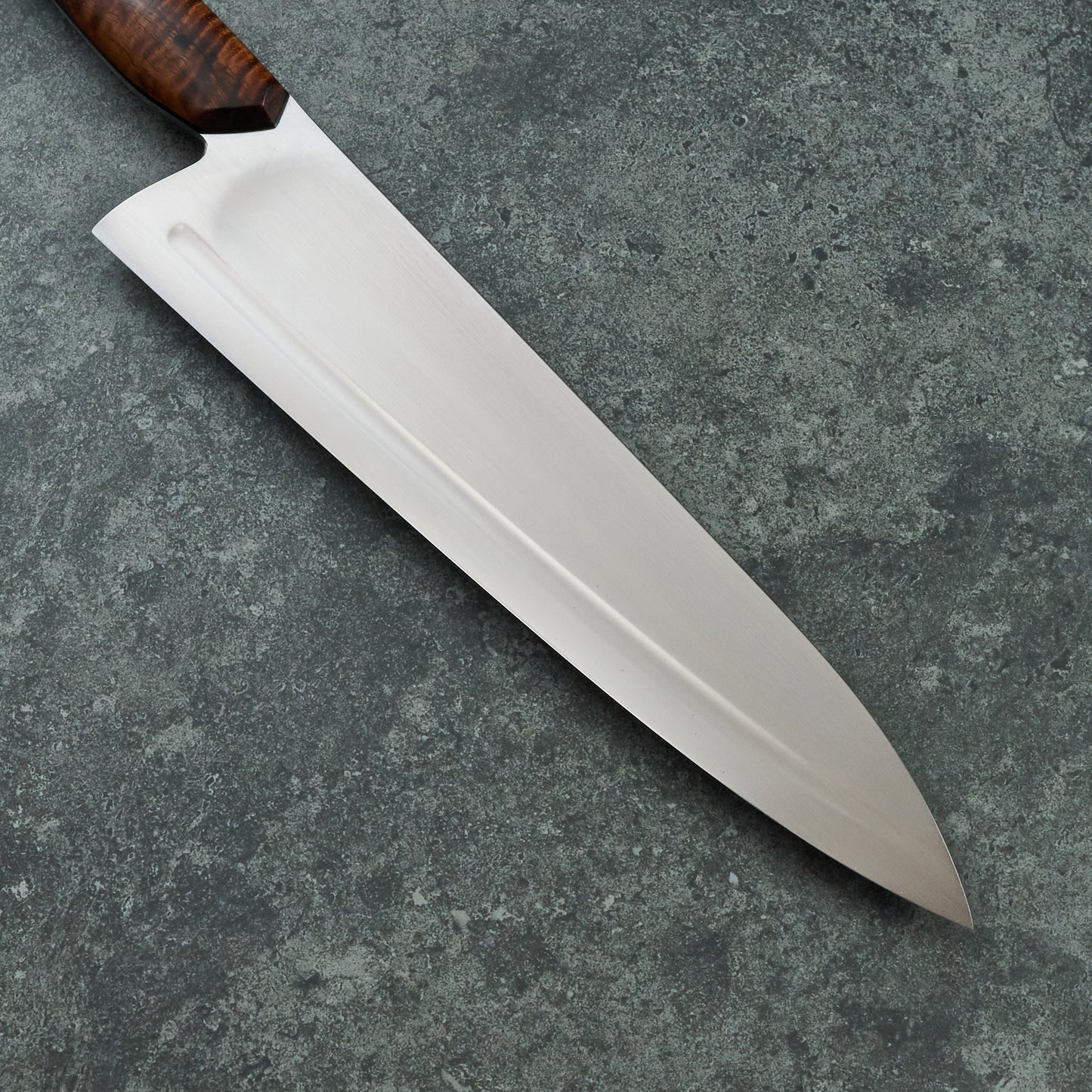
250 mm Gyuto Asymmetrisches B-Grind Koa

250 mm Gyuto Asymmetrisches B-Grind Koa

By PRE-OWNED


No longer available

Dan Bidinger

Reserve your place

We'll only email you when there's something to say. Invitations go out in signup order as new work becomes available.

Dieses handgefertigte Küchenmesser ist ein echtes Unikat. Es wurde vom Messermacher Dan Bidinger sorgfältig gefertigt und besticht durch Form und Funktion. Inspiriert vom klassischen japanischen Gyuto bietet das Klingenprofil hervorragende Vielseitigkeit beim Schneiden, Würfeln und Hacken. Jeder Winkel, jede Rundung und jede Oberfläche ist bewusst auf Komfort, Effizienz und Präzision für Köche jeden Könnensniveaus ausgelegt. Der von Dan entwickelte asymmetrische B-Schliff unterscheidet dieses Messer von typischen westlichen oder japanischen Klingen. Er umfasst sowohl eine breite Hohlkehle an der Oberseite der Klinge als auch eine zweite schmale Hohlkehle entlang der rechten Seite. Diese Hohlkehlen reduzieren das Gewicht deutlich und minimieren gleichzeitig den Luftwiderstand. So gleiten die Scheiben sanft und die Zutaten lassen sich schnell lösen. Hergestellt aus CPM 3V-Stahl – einem von Dans persönlichen Favoriten – zeichnet sich diese Klinge durch außergewöhnliche Schärfe und bemerkenswerte Schnitthaltigkeit aus und ist damit ein hervorragendes Werkzeug für den anspruchsvollen Koch. Das Ergebnis ist ein Messer, dessen Geometrie und Stahlzusammensetzung von sorgfältiger Handwerkskunst und einem tiefen Verständnis für kulinarische Bedürfnisse zeugen.

Dans patentierter asymmetrischer B-Schliff gilt als eine der besten Geometrien für Profi- und Hobbyküchen und macht die Essenszubereitung zu einer Kunstform. Die breite Hohlkehle reduziert nicht nur die Gesamtmasse der Klinge, sondern hilft auch, Zutaten abzuleiten und ein Anhaften zu verhindern. Die zweite schmale Hohlkehle auf der rechten Seite optimiert diese Effekte und ermöglicht müheloses Schneiden beim Schieben oder Ziehen durch verschiedene Texturen. Diese sorgfältige Konstruktion harmoniert perfekt mit den widerstandsfähigen Eigenschaften von CPM 3V und bietet Stabilität ohne Kompromisse bei Leichtigkeit oder Kantenstabilität. Wiederholtes Schärfen wird auf ein Minimum reduziert, da der Stahl dank seiner hohen Verschleißfestigkeit deutlich länger scharf bleibt als viele andere Legierungen. Wer mehr über die besonderen Eigenschaften von CPM 3V erfahren möchte, findet im Internet seinen guten Ruf unter Messerliebhabern. Diese Kombination aus Geometrie und Stahl schafft in jeder Hinsicht eine agile, präzise und langlebige Klinge, die marktüblichen Serienmessern weit überlegen ist.

Die exquisite Klinge wird durch einen klassischen, konisch zulaufenden Vollerlgriff in der Form einer zeitlosen Colaflaschenform ergänzt, die sich luxuriös ergonomisch anfühlt. Der mit atemberaubend gemusterten Koa-Schalen gefertigte Griff verleiht dem Messer Wärme und optische Attraktivität und gibt einem einzigartigen Stück einen Hauch einzigartiger natürlicher Schönheit. Der ultrafeine, konische Erl verbessert nicht nur die Balance, sondern trägt auch zur eleganten Silhouette des Messers bei und sorgt dafür, dass es natürlich in der Hand liegt, ohne bei längeren Vorbereitungsarbeiten zu ermüden. Diese durchdachte Verbindung von Materialien, Geometrie und Design führt zu einem seltenen Meisterwerk, das sowohl Sammler als auch Profiköche jahrelang schätzen werden. Vom asymmetrischen B-Schliff über den hochwertigen CPM 3V-Stahl bis hin zum atemberaubenden Koa-Griff veranschaulicht jedes Element dieser einzigartigen Kreation Dan Bidingers Engagement, die Grenzen von Kunstfertigkeit und Leistung bei Küchenbestecken zu erweitern.

Product Specification
  • Blade Type:
  • Overall Length: 370 mm
  • Edge Length: 250mm
  • Spine Heel: 3.83mm
  • Spine Mid: 2.07mm
  • Spine Tip (20mm before): 1.59mm
  • Blade Height: 51mm
  • Weight: 173g
  • Cutting Edge Steel:
  • Steel class: Carbon
  • HRC: 66
  • Blade Construction:
  • Blade Finish: Satinpolitur
  • Grind:
  • Handle Construction:
  • Handle Materials: Koa
  • Handedness: Beidhändig

Blade type

Gyuto

牛刀

The Japanese take on the Western chef's knife, and the most versatile blade in a modern kitchen. A gyuto carries a long, gently curved edge — most often 210 to 270 mm — that allows both push cuts and a rocking motion, with a pointed tip for fine work and enough height at the heel to keep knuckles clear of the board. It handles proteins, vegetables, and herbs without complaint, which is why most cooks reach for it first.

Compared with a European chef's knife, the gyuto is usually thinner, harder, and lighter, ground to a finer edge that rewards good board technique and regular honing. That same thinness is the trade-off: the edge is less forgiving of bone, frozen food, and twisting cuts, and it asks for a little more care in maintenance in exchange for its keenness.

View full knife type guide →

Cutting edge steel

CPM 3V

Powder metallurgy chromium-vanadium tool steel

Typical HRC
58–62
Corrosion class
Carbon
Production
Powder
Origin
United States (Crucible)

CPM 3V is the toughness specialist of the powder-metallurgy world: about 0.80 percent carbon, 7.5 percent chromium, 2.75 percent vanadium, 1.3 percent molybdenum, and 1 percent tungsten produce a steel with toughness that is, in most published comparisons, the highest of any non-PM3V variant tool steel in commercial production.

For a kitchen knife — which is generally not a knife asked to chop bones — 3V's toughness is somewhat over-specified. Where the steel earns its place is in heavy chef's knives, large cleavers, and crossover camp/kitchen blades. At 60 HRC it offers respectable edge retention (better than 80CrV2, short of 52100 on a clean cut), and it is genuinely difficult to chip. It is not stainless, despite its moderate chromium, and will patina politely.

You will see 3V most often in the work of American forging custom shops that want a "do not worry about it" carbon steel. As a kitchen-only choice it is somewhat overbuilt, but for a one-knife-fits-all enthusiast it is an honest and very durable answer.

View full steel guide →

Blade construction

Mono Steel

A knife forged from a single piece of steel — no laminations, no clad layers. The simplest and most direct construction. The entire blade is the cutting steel, with no softer outer jacket to protect or contrast it. Most contemporary Western kitchen knives in carbon and stainless steel are mono-steel constructions, as are honyaki and most European bladesmith work.

The trade-off is straightforward: mono-steel knives are easier to forge, sharpen, and reason about, but the entire blade carries the cutting steel's properties — including its reactivity if it's a clean carbon. There is no soft jacket to protect a more brittle core from impact, so the heat treatment and geometry have to do all the work.

View full construction guide →

Grind

Compound Grind

A category covering blades ground with more than one geometry stacked into a single cross-section — typically a convex (or flat) primary bevel at the very edge, with one or more hollows ground higher up the blade face to relieve material behind it. The aim is food release and reduced wedging: the hollow opens an air gap so dense produce breaks away from the blade instead of clinging to it, while the convex steel at the edge keeps the apex strong and the knife driving through the cut.

The named variations in the Modern Cooking catalogue differ in where the hollows sit, how many there are, and whether the two faces are ground alike:

S-Grind — a convex primary bevel at the edge with a hollow ground into both faces just above it. The symmetrical "S"-shaped cross-section is the classic food-release grind: relief above the edge, strength at the edge.

C-Grind — an asymmetric S-grind. Both faces keep the convex primary bevel, but only one face carries the hollow above it. The single-sided relief biases food release to one side, and is simpler to grind and to maintain than a full S.

B-Grind — a stacked twin-hollow grind: a tight, narrow hollow immediately above the edge, with a second, broader and wider hollow above that. The staged relief gives especially strong food release across the height of the blade.

S-Hook Grind — also called a hook, harpoon, or J grind. An S-grind taken to an extreme, with the hollow placed very close to the cutting edge. The aggressive near-edge relief gives outstanding food release, at the price of being the most maintenance-sensitive of the family.

Asymmetrical-B Grind — a B-grind in which the twin-hollow structure is carried on one face while the other is ground differently (or left without the upper hollow), off-setting the edge. It combines the staged food release of a B-grind with the handed, steering character of an asymmetric grind.

In every case the gain is food release and reduced drag, and the shared cost is sharpening: as the edge is thinned over the knife's life, maintenance eventually reaches the hollowed steel, which cannot be flattened on a stone the way a convex or flat bevel can. How soon that happens depends on how deeply the hollows are cut and how close to the edge they sit — exactly what separates a gentle S-grind from an aggressive S-hook. These are high-craft geometries, prized by makers and experienced users for their cutting feel, and best appreciated by a cook who maintains their own edges.

View full grind guide →

Handle construction

Half Tang

A construction in which the tang extends partway into the handle rather than running its full length. The tang is forged or cut as a partial projection from the blade — often a stub or tapered stick — and seated into the handle material, set into a drilled or slotted channel and fixed with adhesive, a pin, or a friction fit. Because the steel stops short of the butt, the body of the handle is built from the handle material itself, and the weight sits forward toward the blade.

Visually and in the hand it reads as a one-piece handle: a grip of wood, horn, or composite shaped, rounded, and finished without a strip of steel running through it, much like a hidden tang but with a shorter internal anchor. It is a light, blade-forward construction, and in a kitchen knife the tang's role is to hold the blade securely in a comfortable handle rather than to carry the prying and impact loads a hard-use outdoor tool is built around.

View full construction guide →

Shipping & Returns

Shipping

We process orders 5 days a week (Monday - Friday) and ship from our shop in Sydney, Australia. We ship with FedEx, UPS and DHL.

We are happy to offer free international shipping on a variety of orders depending on location and order value.

Free Shipping Regions and Minimum Order Values

For Australia and New Zealand the minimum is $500AUD. For the rest of the world it is approximately €1000EUR. The discount is applied automatically when you reach the minimum cart value at checkout.

Returns

If you're not entirely happy with your purchase, you can return it within 14 days of delivery for a refund. The item must be in its original condition with all original packaging.

  • Returns are accepted for 14 days
  • The customer is responsible for return shipping costs
  • A 15% restocking fee may be applied to change-of-mind returns
  • We do not accept returns on second-hand items for change of mind

Faulty or Damaged Items

You must notify us within 5 business days of receiving your order. Photographic evidence of damage is required. Once approved, Modern Cooking will cover return shipping costs.

Product Care

Cleaning: Clean by hand with warm water. Avoid wetting the handle when possible.

Sharpening: We advise using whetstones to sharpen your knives and a honing rod or steel to maintain the burr between sharpening sessions.

Reactive Steels: Reactive steels like Aogami Super, Apex Ultra or premium reactive German and Swedish steels are susceptible to rust if not properly cared for. Keep the knife dry between uses and when storing for longer periods, wiping the blade with Tsubaki oil or another food-safe oil is a wise choice. A patina can be a beautiful personal feature on your knife and helps to stop rust forming.

Handle Care: For non-stabilised wooden handles, apply Tsubaki oil or another food-safe oil from time to time. Food-safe wax can be applied to both stabilised and non-stabilised wooden handles. Never apply hot wax or oil as you risk warping or damaging the handle.

Vollständige Details anzeigen