Skip to product information
1 of 7

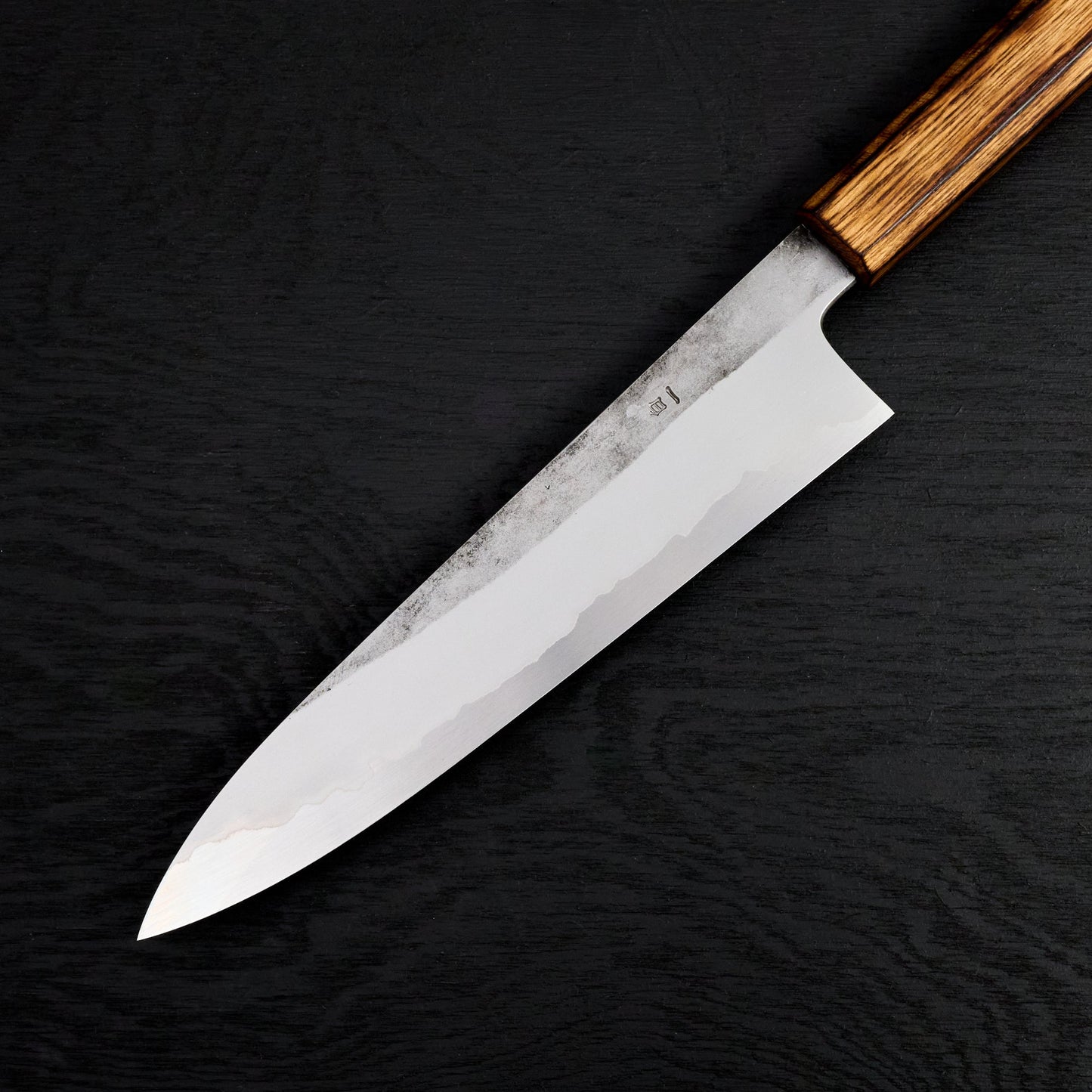
Gyuto 210mm Kirisame Series Shirogami #1 Stainless Clad Scorched Oak

Gyuto 210mm Kirisame Series Shirogami #1 Stainless Clad Scorched Oak

By Hado Knives


Regular price $458.00 USD
Regular price Sale price $458.00 USD
Sale Sold out
Shipping calculated at checkout.

Out of stock

Quantity

Forged in Sakai, Japan by master blacksmith Yoshikazu Tanaka of Tanaka Uchihamono. At the core we find one of the most pure and traditional of the Japanese knife making steels, Shirogami One. The steel takes an exceptionally sharp edge and is like butter on a whetstone, making it easy to maintain. Clad in a protective jacket of stainless steel the knife is designed for performance and maintainability.

A classic Hado Gyuto profile on this series, perfect for fine, detailed slicing. The super fine edge ground and sharpened by HADO knives’ Tadataka Maruyama. The geometry features a consistent spine thickness, which is beautifully polished up until the primary bevel, which then tapers very quickly towards the tip giving the knife a very stable feel. A wide bevel, flat ground knife, these blades are super sharp and thin behind the edge. Pressing your fingernail against the edge you will notice a little flex, demonstrating just how thin and sharp these knives are. 

The knife is beautifully finished and will perform exceptionally well in a variety of tasks, but with such a thin and fine edge these knives truly excel at fine detail work. 

Hado design lead Yoshio Ichikawa continues to show a skill for contemporary knife design while pridefully acknowledging Sakai's traditional aesthetics. A brushed (Nashiji) brute de forge (Ku) is a subtle and classy combination that transitions beautifully into the hazy textured bevels. This combination of textures and light grey hues pairs beautifully with the modest yet beautiful scorched oak handle.

A beautiful example of the culinary classic, carbon clad in stainless steel.

Product Specification
  • Blade Type:
  • Edge Length: 210mm
  • Spine Heel: 3.24mm
  • Spine Mid: 3.02mm
  • Spine Tip (20mm before): 1.29mm
  • Blade Height: 46.45mm
  • Weight: 184g
  • Cutting Edge Steel:
  • Steel class: Carbon
  • HRC: 65
  • Blade Construction:
  • Blade Finish: KurouchiTexturedSatin Polish
  • Grind:
  • Handle Construction:
  • Handle Materials: Oak
  • Handedness: Ambidextrous

Blade type

Gyuto

牛刀

The Japanese take on the Western chef's knife, and the most versatile blade in a modern kitchen. A gyuto carries a long, gently curved edge — most often 210 to 270 mm — that allows both push cuts and a rocking motion, with a pointed tip for fine work and enough height at the heel to keep knuckles clear of the board. It handles proteins, vegetables, and herbs without complaint, which is why most cooks reach for it first.

Compared with a European chef's knife, the gyuto is usually thinner, harder, and lighter, ground to a finer edge that rewards good board technique and regular honing. That same thinness is the trade-off: the edge is less forgiving of bone, frozen food, and twisting cuts, and it asks for a little more care in maintenance in exchange for its keenness.

View full knife type guide →

Cutting edge steel

Shirogami #1

Ultra-pure plain carbon steel

Typical HRC
64–67
Corrosion class
Carbon
Production
Conventional
Origin
Japan (Hitachi YSS / Proterial)

Shirogami #1 — White Paper #1 — is the highest-carbon, highest-purity entry in Hitachi's white-paper family, with approximately 1.30 to 1.40 percent carbon and impurities (P, S, Mn, Si) held to extremely low levels. Without chromium, tungsten, or vanadium, it is the closest thing the modern industrial world has to a continuation of the traditional Japanese tamahagane lineage in commercial form.

In a finished kitchen knife it can run at 64–66 HRC, sharpens to an extraordinary apex on natural and fine synthetic stones, and gives a feel at the cutting board that aficionados describe as glassy. Edge retention is modest — the absence of carbide-forming alloys means the steel is wear-limited — and toughness at this hardness is genuinely low; a thin Shirogami #1 edge will chip on bone or on a poor cutting board. The patina is energetic.

It is the steel of choice for honyaki and high-end clad single-bevels, and it remains the touchstone against which other ultra-clean carbons like 125SC and C130 are judged. Among the makers Modern Cooking carries, Hado Knives and Simon Maillet work in Shirogami #1. Recommend it only to a cook who understands what it is asking of them.

View full steel guide →

Blade construction

Laminated Steel

A category covering knives built from multiple layers of different steels forge-welded together. The hard cutting steel is sandwiched between softer outer layers (cladding) that protect the core, add toughness, and often contribute visual contrast.

The most common laminated constructions in the Modern Cooking catalogue are:

SanMai (三枚) — three layers: hard cutting steel in the centre, softer cladding on both sides. The traditional and most common form.

GoMai (五枚) — five layers: a hard core, two intermediate layers, and two outer layers. Adds visual depth and structural complexity.

KuMai (九枚) — nine layers: similar logic, with more cladding layers for additional pattern and structural variation.

GoMai and KuMai are often chosen not only for the additional layers and visual depth, but also because the intermediate layers can act as a nickel diffusion barrier — limiting carbon migration out of the core into the cladding during forge welding, and protecting the core's intended carbon content through the heat of the forging process.

In all cases the cutting performance is determined by the core steel; the outer layers are cosmetic and structural. The lamination contributes corrosion protection (when a stainless jacket clads a carbon core), reduced reactivity, and the visible boundary between core and cladding that gives the knife its character.

View full construction guide →

Grind

Flat

A grind in which the blade tapers in a straight line from the spine down toward the edge, with no curve or hollow in the bevel. The flat grind is the most common geometry on modern double-bevel kitchen knives because it balances cutting performance and durability: thin enough behind the edge to slice well, with enough steel behind it to stay strong.

A true full flat grind, running from spine to edge, is keen but can wedge in dense produce as the food meets the widening blade; many kitchen knives use a partial flat grind that begins lower on the blade to manage that. The flat grind's appeal is its predictability — it sharpens straightforwardly, behaves consistently, and asks nothing unusual of the user.

View full grind guide →

Handle construction

Hidden Tang

A construction in which the tang runs into the handle but stays concealed inside it, rather than showing between two scales. A narrower tang — a full-length stick or a shorter projection — is set into a drilled or burned channel in a one-piece handle and secured with adhesive, a friction fit, or a threaded fitting drawn up against the blade. This is the traditional construction of Japanese wa-handles and many European hidden-tang knives.

The design puts the handle material in charge of the look and feel: a single piece of wood, horn, or composite — often with a ferrule or spacers at the front — is shaped into any cross-section the maker wants, from the classic octagonal and D-shaped wa profiles to fully rounded Western forms. With no steel showing along the grip, the handle can be slim and light, and is frequently made to be removed and replaced, with the balance sitting toward the blade.

View full construction guide →

Shipping & Returns

Shipping

We process orders 5 days a week (Monday - Friday) and ship from our shop in Sydney, Australia. We ship with FedEx, UPS and DHL.

We are happy to offer free international shipping on a variety of orders depending on location and order value.

Free Shipping Regions and Minimum Order Values

For Australia and New Zealand the minimum is $500AUD. For the rest of the world it is approximately €1000EUR. The discount is applied automatically when you reach the minimum cart value at checkout.

Returns

If you're not entirely happy with your purchase, you can return it within 14 days of delivery for a refund. The item must be in its original condition with all original packaging.

  • Returns are accepted for 14 days
  • The customer is responsible for return shipping costs
  • A 15% restocking fee may be applied to change-of-mind returns
  • We do not accept returns on second-hand items for change of mind

Faulty or Damaged Items

You must notify us within 5 business days of receiving your order. Photographic evidence of damage is required. Once approved, Modern Cooking will cover return shipping costs.

Product Care

Cleaning: Clean by hand with warm water. Avoid wetting the handle when possible.

Sharpening: We advise using whetstones to sharpen your knives and a honing rod or steel to maintain the burr between sharpening sessions.

Reactive Steels: Reactive steels like Aogami Super, Apex Ultra or premium reactive German and Swedish steels are susceptible to rust if not properly cared for. Keep the knife dry between uses and when storing for longer periods, wiping the blade with Tsubaki oil or another food-safe oil is a wise choice. A patina can be a beautiful personal feature on your knife and helps to stop rust forming.

Handle Care: For non-stabilised wooden handles, apply Tsubaki oil or another food-safe oil from time to time. Food-safe wax can be applied to both stabilised and non-stabilised wooden handles. Never apply hot wax or oil as you risk warping or damaging the handle.

View full details