170mm Nakiri OB Wootz with Composite Handle
170mm Nakiri OB Wootz with Composite Handle
No longer available
Our Sydney workshop is closed until Monday 9 November. Orders placed now are very welcome and will ship in the order received from Tuesday 10 November. Shipping details
A combination of elements makes Wootz steel interesting when it comes to knife making. Firstly, is its association with the origins of Damascus steel. The truth is that nobody really knows where Damascus steel came from or how it was originally produced. Today when we refer to Damascus, we are most commonly referring to pattern wielded steel, the layered steel produced by wielding various soft and hard steels together.
Wootz steel refers to crucible steel. It is made by melting a combination of elements in a crucible to form a small ingot of high carbon steel that is then forged and thermal cycled in a specific manner that leads to highly refined carbide bands that produce the final pattern when the steel is etched.
The high carbon content and the refined carbides can produce extremely tough steels that take very fine edges. The problem is that in most cases it is truly difficult to know the final content of a crucible steel and it is possible that the carbon content is much lower than often predicted.
Jezz at Oblivion Blades has each of his ingots tested to know precisely how much of each element is contained within. This blade contains a very reasonable 1.6C 0.4W 0.35Cr, it’s a very decent piece of Wootz.
So, with the technical stuff out of the way, a little about the blade itself.
Firstly, for a Nakiri you might see the angled handle as a little unorthodox, but the angle is perfectly suited to the profile of the blade which tapers towards the nose of the knife. In use this geometry actually relieves tension in the wrist, and I believe would reduce fatigue over time.
If you know the origins of the Nakiri, it was first developed as an easy-to-use vegetable knife, mainly for the home. The knife was modelled on the Japanese Usuba, which is used for a particular cutting style called Katsuramuki or Rotary Pealing a technique that involves holding a piece of vegetable in one hand and peeling away a thin layer by rotating the vegetable against the blade while moving the knife in a subtle, up and down motion. In my limited experience with this technique I believe the angled design would make this process a little easier.
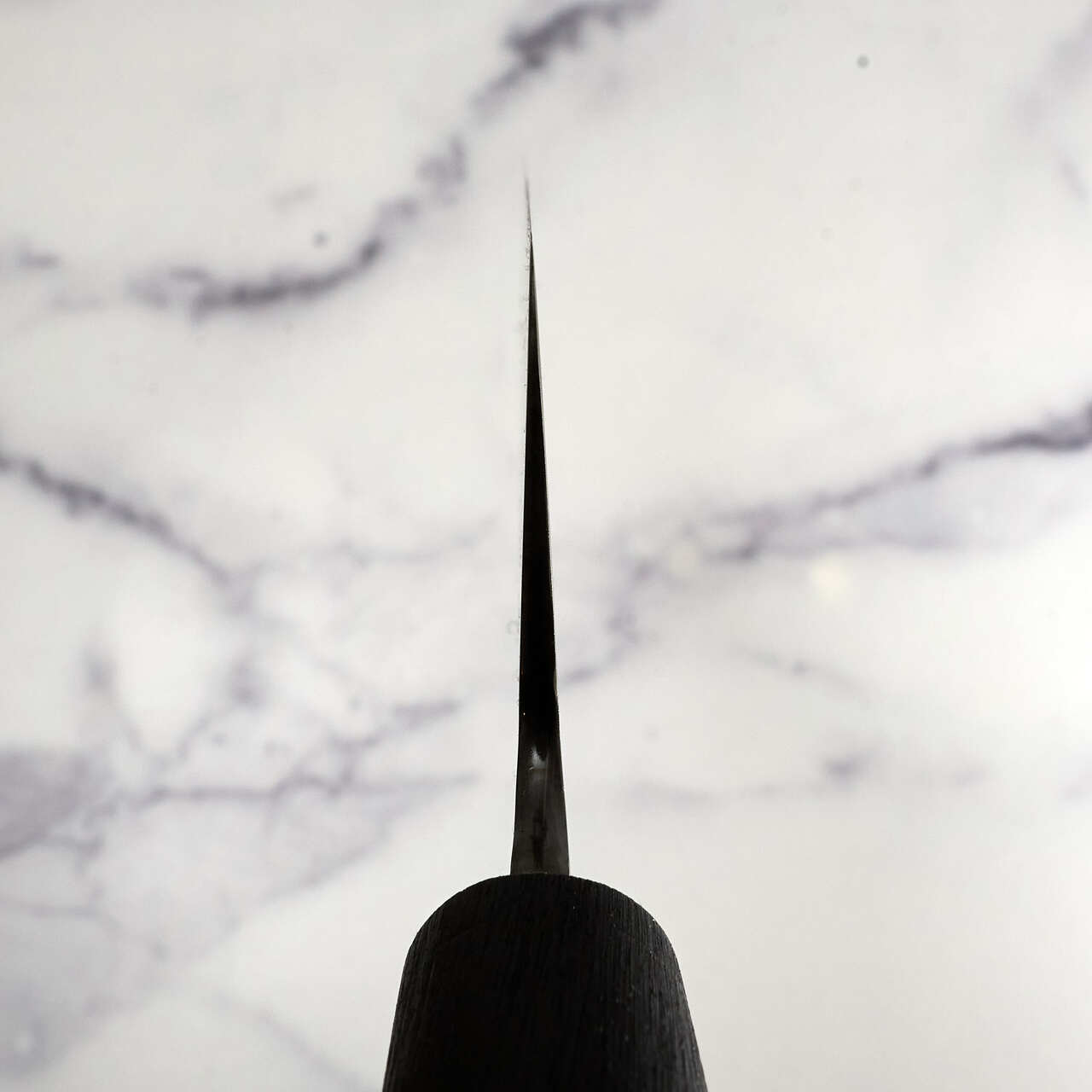
The blade is very thin at the edge, about 0.2mm, and remains fairly thin for about 1cm above the edge, giving the knife a razor like property that is perfect for vegetable prep. The knife is nicely balance for a pinch grip and the balance point sits precisely on the Oblivion Blades, makers mark.
Crucible steel or Wootz is a very labour-intensive steel to produce and to find a premium kitchen knife of this standard in such a unique high carbon steel is an absolute rarity. Jezz is a very talented knife maker and steel producer, and the combination is proving to result in some amazing kitchen knives. This is absolutely no exception. A great 170mm Nakiri, in an amazing, tough steel and with a tonne of style!
Product Specification
- Blade Type:
- Edge Length: 170mm
- Spine Heel: 3.55mm
- Spine Mid: 3.05mm
- Spine Tip (20mm before): 2.2mm
- Blade Height: 59mm
- Weight: 272g
- Cutting Edge Steel:
- Steel class: Carbon
- HRC: 63
- Blade Construction:
- Blade Finish: Matte Polish
- Grind:
- Handle Construction:
- Handle Materials: OB Composite, Brass Pin, Tasmanian Oak dowel
- Handedness: Ambidextrous
Shipping & Returns
Shipping & Returns
Shipping
We process orders Monday to Friday from our Sydney workshop. Australian orders are shipped with Australia Post and international orders with DHL Express. Shipping charges are calculated at checkout based on destination, shipment size and weight, and the carrier service available for the order.
Returns
If you're not entirely happy with your purchase, you can return it within 14 days of delivery for a refund. The item must be in its original condition with all original packaging.
- Returns are accepted for 14 days
- The customer is responsible for return shipping costs
- A 15% restocking fee may be applied to change-of-mind returns
- We do not accept returns on second-hand items for change of mind
Faulty or Damaged Items
You must notify us within 5 business days of receiving your order. Photographic evidence of damage is required. Once approved, Modern Cooking will cover return shipping costs.
Product Care
Product Care
Cleaning: Clean by hand with warm water. Avoid wetting the handle when possible.
Sharpening: We advise using whetstones to sharpen your knives and a honing rod or steel to maintain the burr between sharpening sessions.
Reactive Steels: Reactive steels like Aogami Super, Apex Ultra or premium reactive German and Swedish steels are susceptible to rust if not properly cared for. Keep the knife dry between uses and when storing for longer periods, wiping the blade with Tsubaki oil or another food-safe oil is a wise choice. A patina can be a beautiful personal feature on your knife and helps to stop rust forming.
Handle Care: For non-stabilised wooden handles, apply Tsubaki oil or another food-safe oil from time to time. Food-safe wax can be applied to both stabilised and non-stabilised wooden handles. Never apply hot wax or oil as you risk warping or damaging the handle.