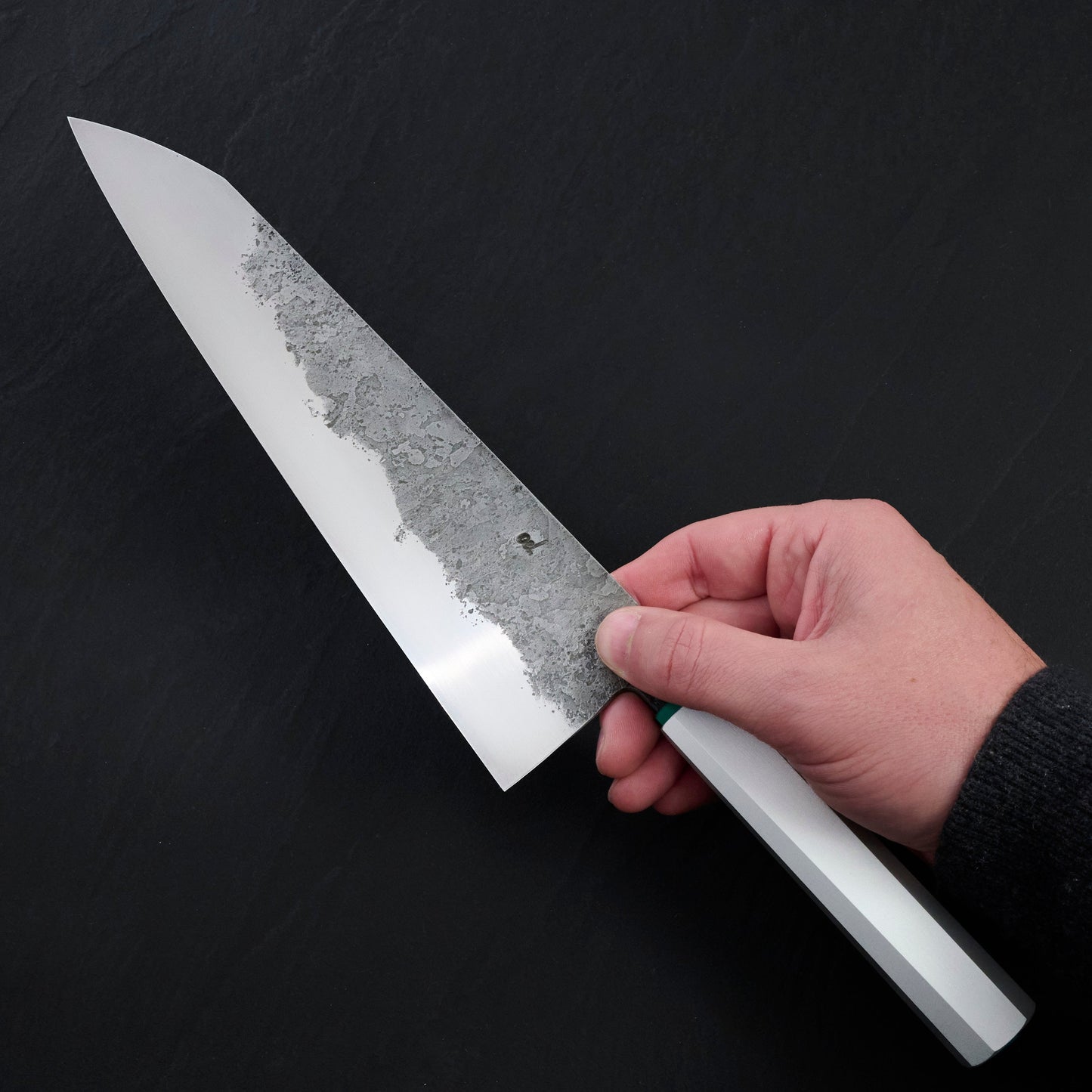
Gyuto 240mm Petrol Mono Take Down
Gyuto 240mm Petrol Mono Take Down
No longer available
Our Sydney workshop is closed until Monday 9 November. Orders placed now are very welcome and will ship in the order received from Tuesday 10 November. Shipping details
This 240mm Gyuto knife is forged from 1.3505 German tool steel, a material known for its exceptional durability and edge retention. It is the creation of renowned German blacksmith Oliver Märtens, whose workshop in Kassel, Germany, is synonymous with innovative craftsmanship and cutting-edge design. The blade showcases Oliver's distinctive design ethos, deeply inspired by the Bauhaus movement, which prioritizes simplicity, functionality, and the seamless integration of form and utility. This design philosophy is evident in the knife's clean lines and purposeful aesthetic, making it a highly refined tool crafted for superior performance.
The knife features a bold gyuto profile with wide convex bevels that ensure efficient cutting performance and minimal drag. Its tapered spine adds to its nimble, balanced feel, providing excellent control and precision in every cut. The ergonomic handle enhances comfort during extended use, demonstrating a meticulous focus on user experience. Notably, this knife incorporates Oliver’s innovative takedown handle design, which allows the knife to be disassembled and reassembled with ease, ensuring straightforward cleaning, maintenance, and even customization. For a detailed explanation of takedown handles, you can watch this video. The handle is made from anodized aluminum, paired with custom petrol-colored front and rear end caps, and fastened with a titanium locking screw, delivering durability alongside a sleek, contemporary appearance.
Oliver Märtens’ knives are celebrated for their world-class design, offering exceptional cutting performance, unparalleled ergonomics, and a bold yet functional aesthetic. Every detail of this gyuto reflects Oliver's expertise in combining high-performance engineering with visually striking elements that prioritize utility. His designs stand out in the world of cutlery, emphasizing not just craftsmanship but also thoughtful innovation that caters to the needs of professional and amateur chefs alike. This gyuto is a prime example of how purposeful design can elevate a kitchen tool to a new standard of usability and elegance.
Product Specification
- Blade Type:
- Overall Length: 380mm
- Edge Length: 240mm
- Spine Heel: 3.48mm
- Spine Mid: 1.81mm
- Spine Tip (20mm before): 0.85mm
- Blade Height: 64mm
- Weight: 241g
- Cutting Edge Steel:
- Steel class: Carbon
- HRC: 65
- Blade Construction:
- Blade Finish: Textured, Satin Polish
- Grind:
- Handle Construction:
- Handle Materials: Anodised Aluminium
- Handedness: Ambidextrous
Shipping & Returns
Shipping & Returns
Shipping
We process orders Monday to Friday from our Sydney workshop. Australian orders are shipped with Australia Post and international orders with DHL Express. Shipping charges are calculated at checkout based on destination, shipment size and weight, and the carrier service available for the order.
Returns
If you're not entirely happy with your purchase, you can return it within 14 days of delivery for a refund. The item must be in its original condition with all original packaging.
- Returns are accepted for 14 days
- The customer is responsible for return shipping costs
- A 15% restocking fee may be applied to change-of-mind returns
- We do not accept returns on second-hand items for change of mind
Faulty or Damaged Items
You must notify us within 5 business days of receiving your order. Photographic evidence of damage is required. Once approved, Modern Cooking will cover return shipping costs.
Product Care
Product Care
Cleaning: Clean by hand with warm water. Avoid wetting the handle when possible.
Sharpening: We advise using whetstones to sharpen your knives and a honing rod or steel to maintain the burr between sharpening sessions.
Reactive Steels: Reactive steels like Aogami Super, Apex Ultra or premium reactive German and Swedish steels are susceptible to rust if not properly cared for. Keep the knife dry between uses and when storing for longer periods, wiping the blade with Tsubaki oil or another food-safe oil is a wise choice. A patina can be a beautiful personal feature on your knife and helps to stop rust forming.
Handle Care: For non-stabilised wooden handles, apply Tsubaki oil or another food-safe oil from time to time. Food-safe wax can be applied to both stabilised and non-stabilised wooden handles. Never apply hot wax or oil as you risk warping or damaging the handle.