Skip to product information
1 of 16

Gyuto 230mm & Pizza Cutter 90mm Honyaki "Float Grip" Set

Gyuto 230mm & Pizza Cutter 90mm Honyaki "Float Grip" Set

By Toma Fenes


No longer available

Toma Fenes

Reserve your place

We'll only email you when there's something to say. Invitations go out in signup order as new work becomes available.

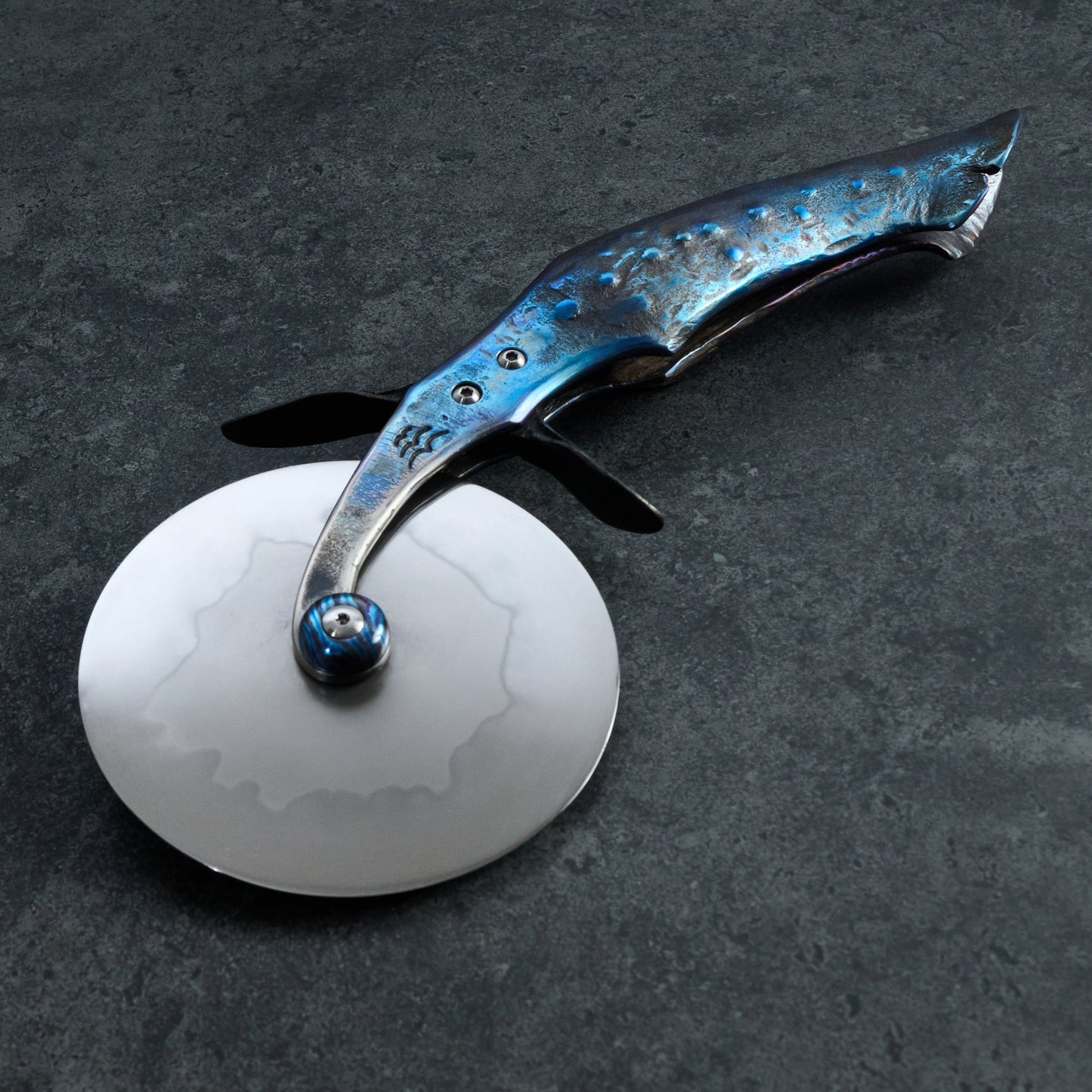
This exquisite set, crafted by Romanian artisan Toma Fenes, is a one-of-a-kind masterpiece that merges functional utility with a sense of mystique and elegance. The set includes two distinct pieces: a Gyuto, known for its versatility in slicing, dicing, and chopping, and an intricately designed pizza cutter. Both blades are forged from premium Swedish 26c3 carbon steel, selected for its purity, exceptional sharpness and durability. Adding to their allure, each blade has been forged honyaki and boasts a hamon, highlighting the meticulous forging process and adding a visual element typically admired in traditional Japanese blades. The hamon not only enhances the aesthetic of each tool but also symbolizes their strength and durability, making this set as functional as it is visually striking.

The handles on both pieces use Toma's proprietary "Float Grip" design, crafted from lightweight titanium to ensure a comfortable yet robust grip. The "Float Grip" effect creates the illusion that the handles are hovering or detached from the blades, a feat achieved through Toma's unique riveted and split design. This floating aspect is further enhanced by the ergonomic, smooth-to-the-touch contours, allowing for prolonged use without discomfort. The innovative handle design draws inspiration from elven weaponry, specifically influenced by J.R.R. Tolkien's Lord of the Rings, embodying a mystical elegance that adds to their allure.

Adding to the sophistication, the Gyuto knife features studs made from 999 silver, strategically placed across the handle and the textured area of the blade. These silver accents add a touch of luxury and refinement, elevating the visual appeal. Meanwhile, the pizza cutter includes titanium Damascus, or "Timascus," washers that secure the wheel, showcasing Toma's dedication to detail and material quality. The cutter’s wheel is approximately 90mm in diameter, providing ample coverage for slicing, while a thoughtfully designed finger guard supports the thumb during use, ensuring comfort and control. This set, with its blend of timeless aesthetic and functional craftsmanship, exemplifies Toma Fenes' mastery and imagination in artisanal cutlery.

Product Specification
  • Blade Type:
  • Overall Length: 360mm
  • Edge Length: 230mm
  • Spine Heel: 4.98mm
  • Spine Mid: 2.4mm
  • Spine Tip (20mm before): 0.99mm
  • Blade Height: 62mm
  • Weight: 212g
  • Cutting Edge Steel:
  • Steel class: Carbon
  • HRC: 65
  • Blade Construction:
  • Blade Finish: Acid Etched (Forced Patina), Satin Polish
  • Grind:
  • Handle Construction:
  • Handle Materials: Titanium
  • Handedness: Ambidextrous

Blade type

Gyuto

牛刀

The gyuto is the Japanese interpretation of the western chef knife, and the most versatile blade in a modern kitchen. It carries a long edge, most often 210 to 270 mm, that runs flatter through the heel than its western counterpart before rising in a gentle, late curve to a fine point — a line that favours push- and pull-cutting while still allowing a rocking motion when the work calls for it. There is enough height at the heel to keep knuckles clear of the board, and the tip is fine enough for detail work, which is why most cooks reach for it first.

The flatter edge is the defining characteristic and the trade-off both. More of the blade lands on the board at once, which suits push cutting and gives clean, decisive contact through an ingredient, but a cook who works primarily by rocking will find less curve to work with than a western profile offers. Modern makers increasingly blur the line between the two, drawing a profile that rocks and push-cuts equally well — Birch & Bevel's Modern Gyuto profile, Antoine Kniamen's Western Gyuto, and Benjamin Kamon's own gyuto profile are all examples of that hybrid thinking.

View full knife type guide →

Cutting edge steel

26C3

High-carbon, low-alloy fine-grain steel

Typical HRC
63–67
Corrosion class
Carbon
Production
Conventional
Origin
Sweden (Sandvik / Alleima)

26C3 is one of the most quietly important kitchen knife steels of the past decade. Originally engineered by Sandvik as a razor steel — its lineage runs straight to UHB-20C — it carries about 1.25 to 1.30 percent carbon, very low manganese and sulphur, and a small chromium addition to control grain size. The result is a steel that hardens cleanly into the mid-sixties HRC while retaining genuinely useful toughness for its hardness, an unusual combination outside the powder-metallurgy world.

For the cook, 26C3 sharpens the way the best Japanese white papers sharpen — a quick burr that wipes off cleanly, and a polished edge that holds a screaming apex without microchipping. Toughness at 64 HRC is comparable to or better than 52100 at the same hardness in published testing, which is part of why the Larrin-Thomas-and-friends generation of makers gravitated to it; it lets you grind thinner without paying for it later. Like all clean carbons, it patinas willingly and benefits from a wipe between tasks.

26C3 has become something of a default among UK and European bladesmiths who want a no-compromise carbon edge, and it is the chemical parent of SheffCut, which adds a sliver of niobium to refine grain further. Among the makers Modern Cooking carries, Birch & Bevel, Karol Karyś, Jonas Johnsson, Tobias Heldqvist, Brook Turner, and Fredrik Spåre work in 26C3. It is one of the few non-stainless steels you can recommend to a cook coming from VG-10 without apology.

View full steel guide →

Blade construction

Honyaki

The traditional Japanese single-steel forging technique, in which a high-carbon mono-steel blade is differentially hardened — clay is applied to the spine before quench, leaving only the edge to fully harden. The result is a hard cutting edge and a softer spine that improves toughness, plus the hamon (temper line) that defines the visual signature of the technique.

Honyaki is the high-water mark of Japanese knifemaking. The technique is unforgiving; a failed differential quench cracks the blade. Honyaki knives are almost always from a single high-purity carbon steel — Shirogami #1 is the canonical choice — and are priced and treated accordingly.

View full construction guide →

Grind

Convex

A grind whose faces curve outward in a continuous arc rather than falling in a straight line. The practical consequence is that it has no shoulder — no abrupt step where a bevel meets the blade face. Food release improves for the same reason: a curved face touches the cut surface along a narrow band instead of a full flat plane, so slices break away rather than clinging. Drag behaves differently too. A convex blade carries more steel than a flat grind of the same spine thickness, so it is not the lowest-drag geometry available, but the resistance it does create builds smoothly through the cut instead of arriving all at once as the food meets a bevel transition. The feel is progressive rather than sudden.

The curve also supports the edge. Steel thickens quickly behind the apex, which raises edge stability at a given sharpening angle — the apex is less prone to rolling or chipping under lateral load. How much of that you get depends on where the convexity sits. A face can be curved the whole way from spine to edge, or the curve can be confined to the last millimetre or two as a convex "appleseed" edge on an otherwise flat blade. The first shapes how the knife moves through food; the second is felt almost entirely at the edge.

View full grind guide →

Handle construction

Half Tang

A construction in which the tang extends partway into the handle rather than running its full length. The tang is forged or cut as a partial projection from the blade — often a stub or tapered stick — and seated into the handle material, set into a drilled or slotted channel and fixed with adhesive, a pin, or a friction fit. Because the steel stops short of the butt, the body of the handle is built from the handle material itself, and the weight sits forward toward the blade.

Visually and in the hand it reads as a one-piece handle: a grip of wood, horn, or composite shaped, rounded, and finished without a strip of steel running through it, much like a hidden tang but with a shorter internal anchor. It is a light, blade-forward construction, and in a kitchen knife the tang's role is to hold the blade securely in a comfortable handle rather than to carry the prying and impact loads a hard-use outdoor tool is built around.

View full construction guide →

Shipping & Returns

Shipping

We process orders 5 days a week (Monday - Friday) and ship from our shop in Sydney, Australia. We ship with FedEx, UPS and DHL.

We are happy to offer free international shipping on a variety of orders depending on location and order value.

Free Shipping Regions and Minimum Order Values

For Australia and New Zealand the minimum is $500AUD. For the rest of the world it is approximately €1000EUR. The discount is applied automatically when you reach the minimum cart value at checkout.

Returns

If you're not entirely happy with your purchase, you can return it within 14 days of delivery for a refund. The item must be in its original condition with all original packaging.

  • Returns are accepted for 14 days
  • The customer is responsible for return shipping costs
  • A 15% restocking fee may be applied to change-of-mind returns
  • We do not accept returns on second-hand items for change of mind

Faulty or Damaged Items

You must notify us within 5 business days of receiving your order. Photographic evidence of damage is required. Once approved, Modern Cooking will cover return shipping costs.

Product Care

Cleaning: Clean by hand with warm water. Avoid wetting the handle when possible.

Sharpening: We advise using whetstones to sharpen your knives and a honing rod or steel to maintain the burr between sharpening sessions.

Reactive Steels: Reactive steels like Aogami Super, Apex Ultra or premium reactive German and Swedish steels are susceptible to rust if not properly cared for. Keep the knife dry between uses and when storing for longer periods, wiping the blade with Tsubaki oil or another food-safe oil is a wise choice. A patina can be a beautiful personal feature on your knife and helps to stop rust forming.

Handle Care: For non-stabilised wooden handles, apply Tsubaki oil or another food-safe oil from time to time. Food-safe wax can be applied to both stabilised and non-stabilised wooden handles. Never apply hot wax or oil as you risk warping or damaging the handle.

View full details