Zu Produktinformationen springen
1 von 4

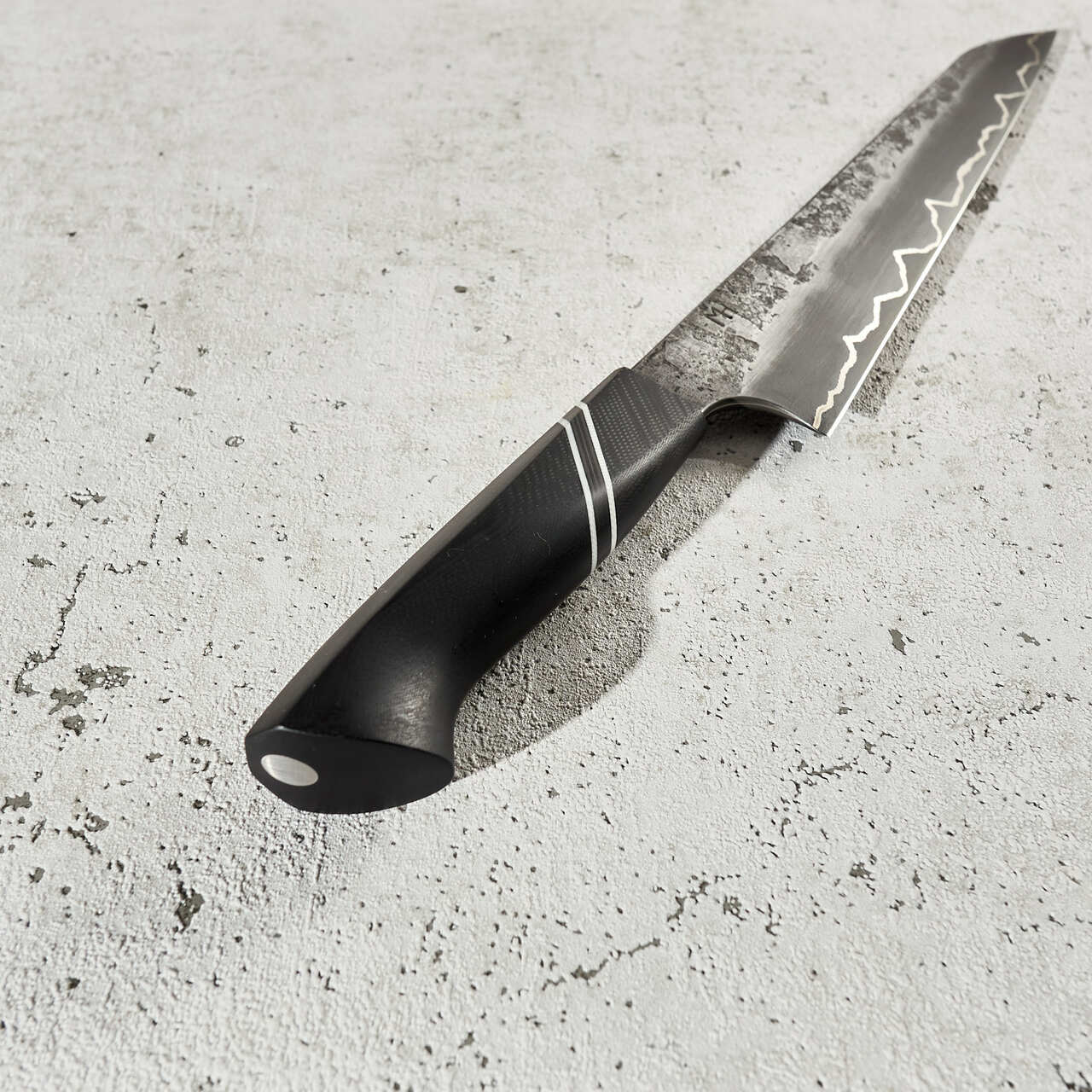
Allesschneider 200mm 1.2842 San Mai mit G10 & Carbon Griff

Allesschneider 200mm 1.2842 San Mai mit G10 & Carbon Griff

By Martin Huber


No longer available

Martin Huber

Reserve your place

We'll only email you when there's something to say. Invitations go out in signup order as new work becomes available.

Sie denken vielleicht, dass 200 mm für eine Aufschnittmaschine kurz erscheinen, aber haben Sie sich schon einmal an einem Wochenendnachmittag mit einer schönen Flasche Wein und etwas getrockneter Wurst oder vielleicht einer Terrine oder sogar dem klassischen Bier, Käse und Keksen hingesetzt? Ich sage nicht, dass dieses Messer in der Küche nicht nützlich sein wird, aber ich denke, es ist ein großartiger kleiner Allesschneider für Küche und Tisch.

Die Klinge verfügt über einen perfekten konvexen Schliff, ein zufriedenstellendes Gleichgewicht und Gewicht sowie eine unglaublich scharfe Schneidkante aus 1.2842. Diese kleine Schneidemaschine gleitet sehr schön durch die Produkte.

Die Klinge ist auch sehr auffällig mit dem auffälligen Blitz aus Nickel, der zwischen den Lagen aus deutschem Premium-Werkzeugstahl 1.2842 schneidet. Das forcierte Schwarz, die Patina und das Brute de Forge sorgen für Farb- und Texturkontrast, eine Ästhetik, die für den erstklassigen Griff im westlichen Stil beibehalten wird.

Eine Kombination aus schwarzem und weißem G10 und Kohlefaser ergibt eine sehr edle und robuste Kombination mit dem elektrisierenden Aussehen der Klinge. Ein sehr cooler, kompakter Hochleistungs-Allesschneider von Martin Huber.

Product Specification
  • Blade Type:
  • Edge Length: 200mm
  • Spine Heel: 3.9mm
  • Spine Mid: 3.5mm
  • Spine Tip (20mm before): 2.6mm
  • Blade Height: 40mm
  • Weight: 209g
  • Cutting Edge Steel:
  • Steel class: Carbon
  • HRC: 63
  • Blade Construction:
  • Blade Finish: Schmiedeeisen, Säuregeätzt (erzwungene Patina)
  • Grind:
  • Handle Construction:
  • Handle Materials: Black, White G10, Carbon Fibre
  • Handedness: Beidhändig

Blade type

Utility Slicer

A mid-length knife that fills the space between a paring knife and a chef's knife — generally 130 to 160 mm — for the everyday tasks too large for one and too small to justify the other. Sandwiches, tomatoes, citrus, small roasts, and general prep all fall comfortably within its range, which makes it one of the most-reached-for blades in a busy kitchen.

The utility knife is a generalist, and that is both its strength and its limit. It does many jobs acceptably and none with the dedicated efficiency of a purpose-built blade, so a cook who does a lot of one task is better served by the specialist for it. As a convenient middle option, though, it earns its keep.

View full knife type guide →

Cutting edge steel

1.2842

Low-alloy manganese-vanadium oil-hardening tool steel

Typical HRC
60–63
Corrosion class
Carbon
Production
Conventional
Origin
Germany (DIN 90MnCrV8)

1.2842 is the European workhorse oil-hardening carbon, identical to AISI O2. About 0.90 percent carbon, two percent manganese, half a percent of chromium and a small vanadium addition give it deep oil hardenability and predictable behaviour in the workshop.

For the cook it is a familiar "everyday carbon" — the steel behind a great many German and Austrian Solingen working knives, including a substantial portion of the post-war production tradition. It sharpens easily, takes a competent edge, holds it modestly, patinas politely. Toughness at hardness is good; the manganese-induced inclusions can mean the apex is a little less perfectly clean than a Hitachi white paper, but the difference is noticeable mostly to those who go looking for it.

Among the makers Modern Cooking carries, Martin Huber works in 1.2842. See O2 for the same alloy under its AISI name; see O1 for the closely related lower-Mn cousin.

Also known as:O2

View full steel guide →

Blade construction

Laminated Steel

A category covering knives built from multiple layers of different steels forge-welded together. The hard cutting steel is sandwiched between softer outer layers (cladding) that protect the core, add toughness, and often contribute visual contrast.

The most common laminated constructions in the Modern Cooking catalogue are:

SanMai (三枚) — three layers: hard cutting steel in the centre, softer cladding on both sides. The traditional and most common form.

GoMai (五枚) — five layers: a hard core, two intermediate layers, and two outer layers. Adds visual depth and structural complexity.

KuMai (九枚) — nine layers: similar logic, with more cladding layers for additional pattern and structural variation.

GoMai and KuMai are often chosen not only for the additional layers and visual depth, but also because the intermediate layers can act as a nickel diffusion barrier — limiting carbon migration out of the core into the cladding during forge welding, and protecting the core's intended carbon content through the heat of the forging process.

In all cases the cutting performance is determined by the core steel; the outer layers are cosmetic and structural. The lamination contributes corrosion protection (when a stainless jacket clads a carbon core), reduced reactivity, and the visible boundary between core and cladding that gives the knife its character.

View full construction guide →

Grind

Convex

A grind whose bevel bulges outward in a gentle curve from spine to edge, rather than running flat. That extra steel directly behind the edge makes a convex grind notably strong and resistant to chipping, while the curved geometry helps food release and lets the blade glide through dense ingredients with less wedging than a flat grind.

The strength comes at the cost of ultimate thinness and ease of maintenance. A convex edge has more metal behind it, so it is not quite as effortlessly keen as a thinly flat-ground edge, and it is harder to sharpen freehand — holding the curve takes a stropping technique or a deliberate hand rather than a single fixed angle. The reward is an exceptionally tough, smooth-cutting edge.

View full grind guide →

Handle construction

Full Tang

A construction in which the blade steel runs the full length and width of the handle, forming a flat core between two handle scales. The scales are fixed to either face of the tang with pins, rivets, or adhesive, and the tang's outline stays visible as a strip of steel around the top, bottom, and butt of the handle — often with the pin heads showing as a row down each side. It is the dominant construction in Western kitchen and outdoor knives.

Because the steel continues all the way to the butt, the handle is essentially the tang dressed in two scales, and the grip is ground and shaped from that sandwiched assembly as a whole. The extra steel carries weight and balance back toward the hand, giving the solid, blade-and-handle-as-one feel that defines the style, and it leaves the edge of the tang on show as part of the knife's line.

View full construction guide →

Shipping & Returns

Shipping

We process orders 5 days a week (Monday - Friday) and ship from our shop in Sydney, Australia. We ship with FedEx, UPS and DHL.

We are happy to offer free international shipping on a variety of orders depending on location and order value.

Free Shipping Regions and Minimum Order Values

For Australia and New Zealand the minimum is $500AUD. For the rest of the world it is approximately €1000EUR. The discount is applied automatically when you reach the minimum cart value at checkout.

Returns

If you're not entirely happy with your purchase, you can return it within 14 days of delivery for a refund. The item must be in its original condition with all original packaging.

  • Returns are accepted for 14 days
  • The customer is responsible for return shipping costs
  • A 15% restocking fee may be applied to change-of-mind returns
  • We do not accept returns on second-hand items for change of mind

Faulty or Damaged Items

You must notify us within 5 business days of receiving your order. Photographic evidence of damage is required. Once approved, Modern Cooking will cover return shipping costs.

Product Care

Cleaning: Clean by hand with warm water. Avoid wetting the handle when possible.

Sharpening: We advise using whetstones to sharpen your knives and a honing rod or steel to maintain the burr between sharpening sessions.

Reactive Steels: Reactive steels like Aogami Super, Apex Ultra or premium reactive German and Swedish steels are susceptible to rust if not properly cared for. Keep the knife dry between uses and when storing for longer periods, wiping the blade with Tsubaki oil or another food-safe oil is a wise choice. A patina can be a beautiful personal feature on your knife and helps to stop rust forming.

Handle Care: For non-stabilised wooden handles, apply Tsubaki oil or another food-safe oil from time to time. Food-safe wax can be applied to both stabilised and non-stabilised wooden handles. Never apply hot wax or oil as you risk warping or damaging the handle.

Vollständige Details anzeigen