Zu Produktinformationen springen
1 von 9

Kamon Knives X Dark Sigil Workshop Gyuto 230mm (Auktion 29.04.2022)

Kamon Knives X Dark Sigil Workshop Gyuto 230mm (Auktion 29.04.2022)

By Benjamin Kamon


No longer available

Benjamin Kamon

Reserve your place

We'll only email you when there's something to say. Invitations go out in signup order as new work becomes available.

Ein Meisterwerk, geschaffen von zwei der talentiertesten Handwerker Österreichs.

Ein klassisches schwarz geätztes Kamon 230 mm Gyuto mit handgehämmerter Pyramidenstruktur. Geschmiedet aus Werkzeugstahl 1.2519 mit hoher Kohlenstoff-Wolframlegierung. Der Kohlenstoffstahl ist auf 65 HRC mit einer sehr feinen Kante wärmebehandelt und verfügt über schöne Legierungsstreifen, eine aggressive distale Verjüngung und einen Präzisionsschliff, die dieser Klinge eine unglaubliche Schneidleistung verleihen.

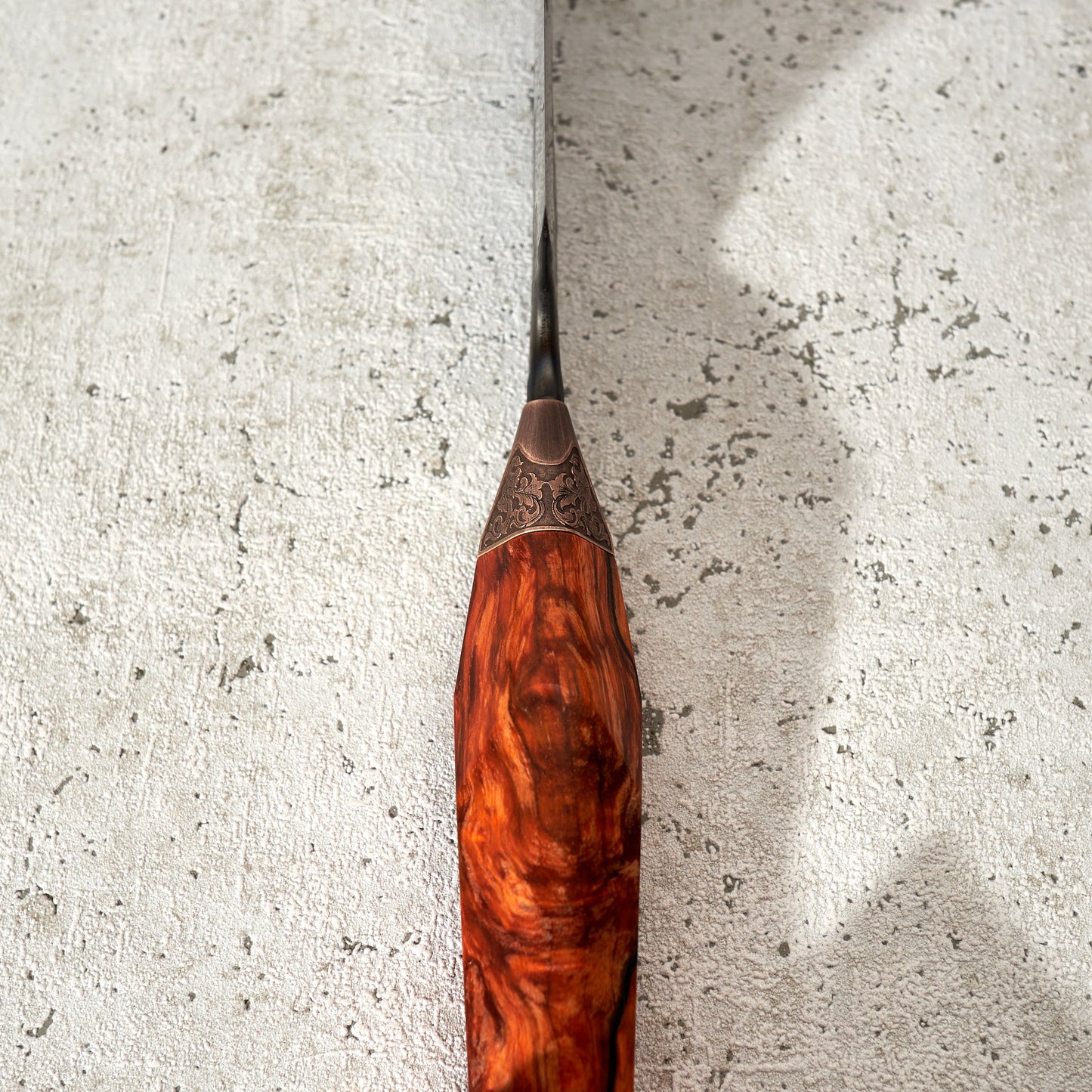
Zurück zum hoch facettierten und ergonomischen, abnehmbaren (Takedown-) Griff haben wir einen Satz kräftiger, stark konischer und patinierter Torpedo-Endkappen aus Bronze mit unglaublich detaillierten Gravuren von Philipp Mann von @darksigilworkshop. American Scroll, ein ornamentales Design, das von den Rundungen einer locker gerollten Pergamentrolle abgeleitet wurde, wurde bewusst verwendet, um die Rundungen von Benjamin Kamons unglaublich montierten Torpedo-Endkappen zu ergänzen. Auch die hintere Endkappe ist mit einem Single-Leaf-Bordürenmuster versehen, um den Übergang in den facettierten Griff zu betonen.

Dieses schöne Rankenwerk ist eine traditionelle dekorative Gravur und wird seit Jahrhunderten auf Schusswaffen, scharfkantigen Werkzeugen, Schmuck, Silberwaren, Rüstungen und heraldischen Insignien verwendet. Die wunderschön gravierten, bronzenen Endkappen und ein atemberaubendes Stück stabilisierte Maserbirke mit tiefroten, orangen, schwarzen und braunen Farbtönen vervollständigen das, was man nur als Erbstück dieser beiden erstaunlichen Handwerker bezeichnen kann.

Im Lieferumfang des Messers ist eine von Herrn Kamons einzigartigen schützenden Sayas enthalten

Product Specification
  • Blade Type:
  • Edge Length: 230mm
  • Spine Heel: 5mm
  • Spine Mid: 1.98mm
  • Spine Tip (20mm before): 0.75mm
  • Blade Height: 56mm
  • Weight: 278g
  • Cutting Edge Steel:
  • Steel class: Carbon
  • HRC: 65
  • Blade Construction:
  • Blade Finish: Strukturiert, Säuregeätzt (erzwungene Patina)
  • Grind:
  • Handle Construction:
  • Handle Materials: Bronze, Stabilised Spalted Masur Birch
  • Handedness: Beidhändig
  • Saya / Storage Included: Yes

Blade type

Gyuto

牛刀

The Japanese take on the Western chef's knife, and the most versatile blade in a modern kitchen. A gyuto carries a long, gently curved edge — most often 210 to 270 mm — that allows both push cuts and a rocking motion, with a pointed tip for fine work and enough height at the heel to keep knuckles clear of the board. It handles proteins, vegetables, and herbs without complaint, which is why most cooks reach for it first.

Compared with a European chef's knife, the gyuto is usually thinner, harder, and lighter, ground to a finer edge that rewards good board technique and regular honing. That same thinness is the trade-off: the edge is less forgiving of bone, frozen food, and twisting cuts, and it asks for a little more care in maintenance in exchange for its keenness.

View full knife type guide →

Cutting edge steel

1.2519

Low-alloy tungsten-chromium tool steel

Typical HRC
62–65
Corrosion class
Carbon
Production
Conventional
Origin
Germany (DIN 110WCrV5)

1.2519 is the classic German oil-hardening Cr-W-V tool steel — close kin to AISI O7 and a sister to 1.2419, with a touch more vanadium for finer carbides. The tungsten and chromium combine to produce hard, finely dispersed carbides that allow a thin geometry to hold an edge longer than the simple carbons, while the vanadium keeps grain size tidy through the heat treat.

In a kitchen knife, it lands comfortably between 62 and 64 HRC and behaves like a slightly more wear-resistant W2 — that is, it sharpens with little fuss on most stones, takes a fine edge, and rewards a deliberate heat treatment more than it punishes a casual one. It will patina, sometimes attractively, sometimes alarmingly to a first-time carbon owner; either way, a wipe-and-dry habit is enough to keep it civil.

You will find 1.2519 in the work of European bladesmiths who want a step up in edge retention from white-paper carbons without losing the easy stone feel. Among the makers Modern Cooking carries, Benjamin Kamon, Martin Huber, Tobias Heldqvist, Jonas Johnsson, and MCx work in 1.2519. It is one of the more honest "European answers to Aogami" — not the same metallurgy, but a similar relationship between feel at the stone and edge longevity.

View full steel guide →

Blade construction

Mono Steel

A knife forged from a single piece of steel — no laminations, no clad layers. The simplest and most direct construction. The entire blade is the cutting steel, with no softer outer jacket to protect or contrast it. Most contemporary Western kitchen knives in carbon and stainless steel are mono-steel constructions, as are honyaki and most European bladesmith work.

The trade-off is straightforward: mono-steel knives are easier to forge, sharpen, and reason about, but the entire blade carries the cutting steel's properties — including its reactivity if it's a clean carbon. There is no soft jacket to protect a more brittle core from impact, so the heat treatment and geometry have to do all the work.

View full construction guide →

Grind

Convex

A grind whose bevel bulges outward in a gentle curve from spine to edge, rather than running flat. That extra steel directly behind the edge makes a convex grind notably strong and resistant to chipping, while the curved geometry helps food release and lets the blade glide through dense ingredients with less wedging than a flat grind.

The strength comes at the cost of ultimate thinness and ease of maintenance. A convex edge has more metal behind it, so it is not quite as effortlessly keen as a thinly flat-ground edge, and it is harder to sharpen freehand — holding the curve takes a stropping technique or a deliberate hand rather than a single fixed angle. The reward is an exceptionally tough, smooth-cutting edge.

View full grind guide →

Handle construction

Hidden Tang

A construction in which the tang runs into the handle but stays concealed inside it, rather than showing between two scales. A narrower tang — a full-length stick or a shorter projection — is set into a drilled or burned channel in a one-piece handle and secured with adhesive, a friction fit, or a threaded fitting drawn up against the blade. This is the traditional construction of Japanese wa-handles and many European hidden-tang knives.

The design puts the handle material in charge of the look and feel: a single piece of wood, horn, or composite — often with a ferrule or spacers at the front — is shaped into any cross-section the maker wants, from the classic octagonal and D-shaped wa profiles to fully rounded Western forms. With no steel showing along the grip, the handle can be slim and light, and is frequently made to be removed and replaced, with the balance sitting toward the blade.

View full construction guide →

Shipping & Returns

Shipping

We process orders 5 days a week (Monday - Friday) and ship from our shop in Sydney, Australia. We ship with FedEx, UPS and DHL.

We are happy to offer free international shipping on a variety of orders depending on location and order value.

Free Shipping Regions and Minimum Order Values

For Australia and New Zealand the minimum is $500AUD. For the rest of the world it is approximately €1000EUR. The discount is applied automatically when you reach the minimum cart value at checkout.

Returns

If you're not entirely happy with your purchase, you can return it within 14 days of delivery for a refund. The item must be in its original condition with all original packaging.

  • Returns are accepted for 14 days
  • The customer is responsible for return shipping costs
  • A 15% restocking fee may be applied to change-of-mind returns
  • We do not accept returns on second-hand items for change of mind

Faulty or Damaged Items

You must notify us within 5 business days of receiving your order. Photographic evidence of damage is required. Once approved, Modern Cooking will cover return shipping costs.

Product Care

Cleaning: Clean by hand with warm water. Avoid wetting the handle when possible.

Sharpening: We advise using whetstones to sharpen your knives and a honing rod or steel to maintain the burr between sharpening sessions.

Reactive Steels: Reactive steels like Aogami Super, Apex Ultra or premium reactive German and Swedish steels are susceptible to rust if not properly cared for. Keep the knife dry between uses and when storing for longer periods, wiping the blade with Tsubaki oil or another food-safe oil is a wise choice. A patina can be a beautiful personal feature on your knife and helps to stop rust forming.

Handle Care: For non-stabilised wooden handles, apply Tsubaki oil or another food-safe oil from time to time. Food-safe wax can be applied to both stabilised and non-stabilised wooden handles. Never apply hot wax or oil as you risk warping or damaging the handle.

Vollständige Details anzeigen