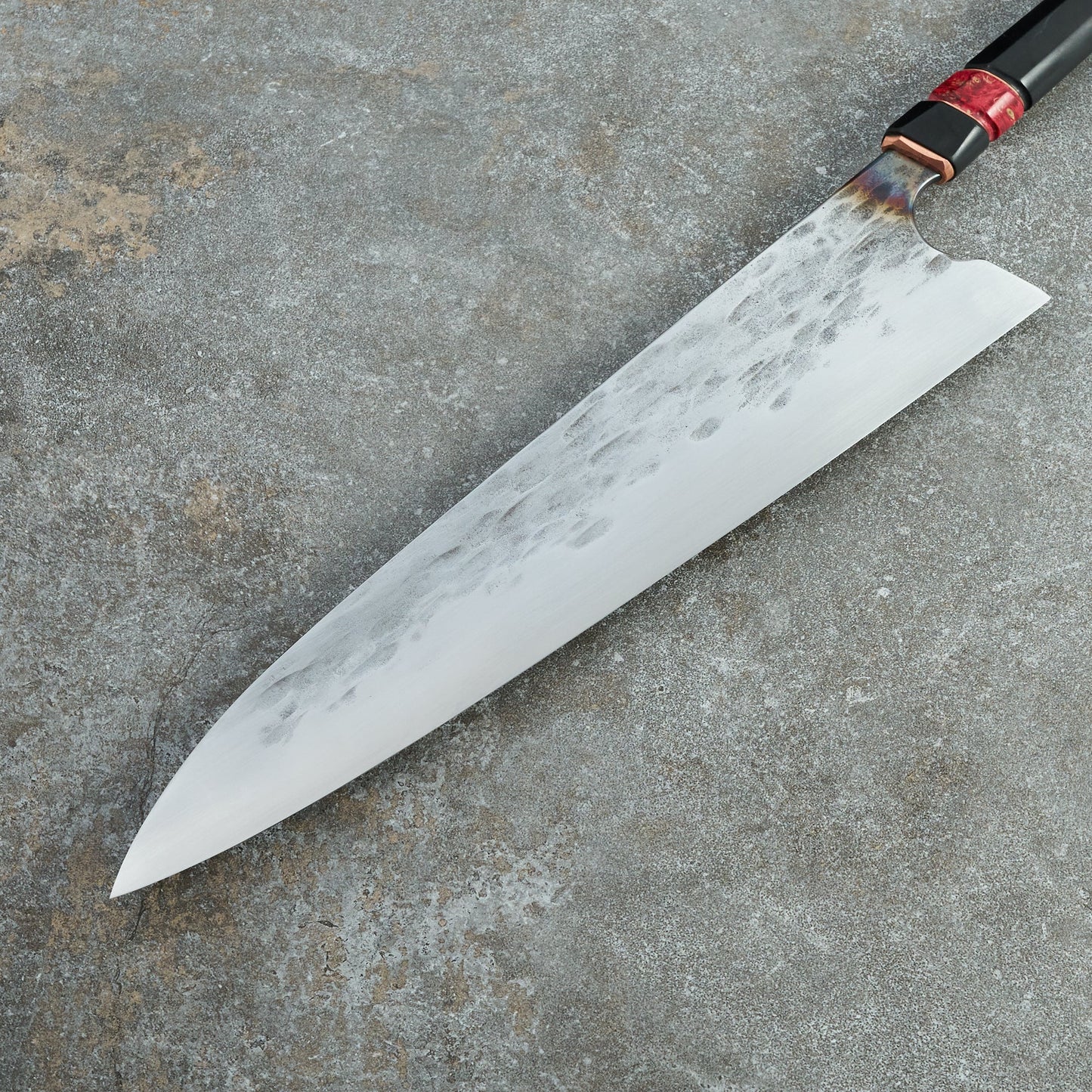
Gyuto 285mm Mono Apex Ultra „Iarla“
Gyuto 285mm Mono Apex Ultra „Iarla“
No longer available
Our Sydney workshop is closed until Monday 9 November. Orders placed now are very welcome and will ship in the order received from Tuesday 10 November. Shipping details
Dieses handgefertigte Küchenmesser des renommierten Messerschmieds Erik Gullikson ist ein wahrer Beweis für die Kunstfertigkeit und Präzision traditioneller Messerherstellung. Dieses außergewöhnliche Schneidwerkzeug verkörpert das klassische Gyuto-Profil, das für seine Vielseitigkeit und flüssigen Bewegungen bekannt ist. Der sanfte Radius der Klinge vom Ansatz bis zur Spitze ermöglicht nahtlose Stoßschnitte und lange, kontrollierte Scheiben und macht es zu einem wertvollen Besitz für Köche und kulinarische Enthusiasten. Ob in den Händen eines Profikochs oder eines passionierten Hobbykochs, das raffinierte Profil des Messers sorgt dafür, dass jeder Schnitt so glatt und präzise wie möglich ist. Es ist mehr als ein Werkzeug – es ist Ihr Partner für kulinarische Höchstleistungen.
Die Handwerkskunst dieses Messers geht über sein Profil hinaus, denn seine Geometrie zeigt Gulliksons akribische Liebe zum Detail. Die Klinge ist aus Apex Ultra-Stahl geschmiedet, einem Material, das für seine Leistung und Schnitthaltigkeit geschätzt wird, und verfügt über eine superfeine Verjüngung, die einer 285 mm langen Klinge die Beweglichkeit eines deutlich kleineren Messers verleiht. Diese feine Verjüngung erzeugt ein unvergleichliches Gefühl von Kontrolle, Balance und Reaktionsfähigkeit. Die Kraterstruktur und das handpolierte Satin-Finish der Klinge verleihen ihr ein Element rauer Schönheit und taktiler Raffinesse. Jeder Blick und jede Berührung offenbaren die meisterhafte Meisterleistung des Schmiedeprozesses, der eine Klinge entstehen lässt, die nicht nur ein Hochleistungswerkzeug, sondern auch ein Kunstwerk ist. Die Mischung aus Funktionalität und Ästhetik dieses Messers spiegelt die Hingabe und Leidenschaft wider, die Gullikson in jede Klinge steckt, die er schmiedet.
Beim Griff trifft Tradition auf moderne Innovation. Eriks ausgestellter, sargförmiger Griff in Rokakku-Hanmaru-Form ist ein herausragendes Merkmal und bietet einen ergonomischen Halt, der ebenso bequem wie optisch beeindruckend ist. Der Griff in Erbstückqualität besteht aus stabilisierter Hainbuche und stabilisiertem Rotahorn-Maserholz, akzentuiert durch geometrisch strukturierte Kupferabstandshalter. Handgefeilte und facettierte Rillen im Kupfer bieten zusätzlichen Halt und eine interessante Optik und heben den Griff auf ein selten gesehenes Niveau von Luxus und Handwerkskunst. Eine der bahnbrechendsten Innovationen des Messers ist der abnehmbare Kupferdübel am Griffende, mit dem der Benutzer die Balance nach seinen Wünschen einstellen kann. Mit eingesetztem Dübel verlagert sich der Schwerpunkt 30 mm vor die Hohlkehle und bietet so präzise Kontrolle. Das Ergebnis ist ein Messer, das sich leicht, wendig und perfekt ausbalanciert anfühlt und sicherstellt, dass jeder Schnitt sicher und mühelos ausgeführt wird. Dieses handgefertigte Meisterwerk von Erik Gullikson verkörpert die perfekte Harmonie aus Kunst, Handwerkskunst und Leistung und wird über Generationen hinweg geschätzt werden.
Getreu seiner Tradition, seine Kreationen auf Irisch zu benennen, hat Erik Gullikson dieses Stück „Iarla“ genannt, was auf Deutsch „Graf“ bedeutet. Dieser Name bringt die königliche Schönheit und den edlen Charakter des Messerdesigns perfekt zum Ausdruck und spiegelt sowohl seine ästhetische Pracht als auch seine unvergleichliche Leistung wider.
Product Specification
- Blade Type:
- Overall Length: 410 mm
- Edge Length: 285mm
- Spine Heel: 4.64mm
- Spine Mid: 1.62mm
- Spine Tip (20mm before): 0.8mm
- Blade Height: 61mm
- Weight: 220g
- Cutting Edge Steel:
- Steel class: Carbon
- HRC: 66
- Blade Construction:
- Blade Finish: Satinpolitur, Strukturiert
- Grind:
- Handle Construction:
- Handle Materials: Stabilised Hornbeam, Stabilised Red Maple Burl, Copper
- Handedness: Beidhändig
Shipping & Returns
Shipping & Returns
Shipping
We process orders Monday to Friday from our Sydney workshop. Australian orders are shipped with Australia Post and international orders with DHL Express. Shipping charges are calculated at checkout based on destination, shipment size and weight, and the carrier service available for the order.
Returns
If you're not entirely happy with your purchase, you can return it within 14 days of delivery for a refund. The item must be in its original condition with all original packaging.
- Returns are accepted for 14 days
- The customer is responsible for return shipping costs
- A 15% restocking fee may be applied to change-of-mind returns
- We do not accept returns on second-hand items for change of mind
Faulty or Damaged Items
You must notify us within 5 business days of receiving your order. Photographic evidence of damage is required. Once approved, Modern Cooking will cover return shipping costs.
Product Care
Product Care
Cleaning: Clean by hand with warm water. Avoid wetting the handle when possible.
Sharpening: We advise using whetstones to sharpen your knives and a honing rod or steel to maintain the burr between sharpening sessions.
Reactive Steels: Reactive steels like Aogami Super, Apex Ultra or premium reactive German and Swedish steels are susceptible to rust if not properly cared for. Keep the knife dry between uses and when storing for longer periods, wiping the blade with Tsubaki oil or another food-safe oil is a wise choice. A patina can be a beautiful personal feature on your knife and helps to stop rust forming.
Handle Care: For non-stabilised wooden handles, apply Tsubaki oil or another food-safe oil from time to time. Food-safe wax can be applied to both stabilised and non-stabilised wooden handles. Never apply hot wax or oil as you risk warping or damaging the handle.