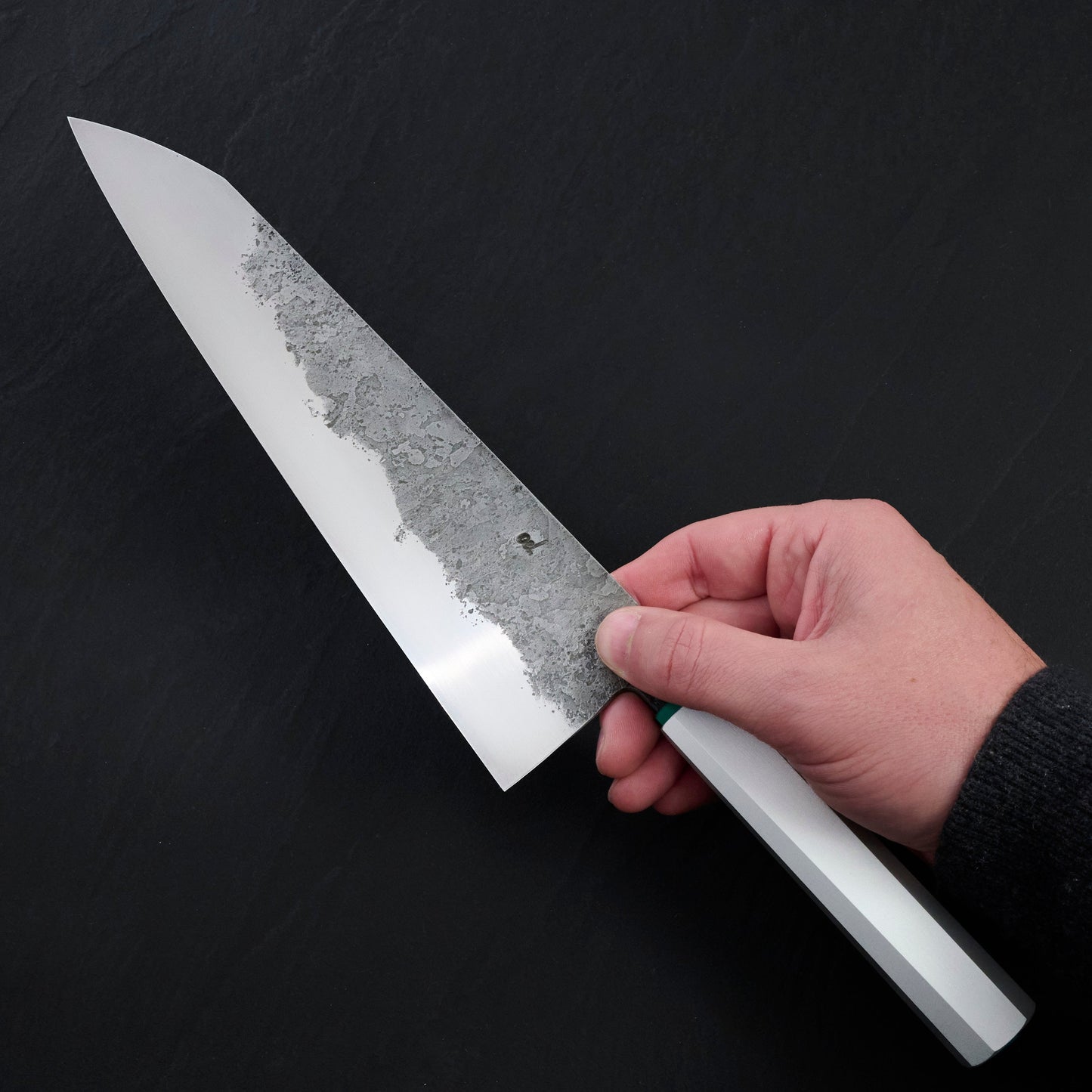
Gyuto 240 mm Benzin Mono Take Down
Gyuto 240 mm Benzin Mono Take Down
No longer available
Our Sydney workshop is closed until Monday 9 November. Orders placed now are very welcome and will ship in the order received from Tuesday 10 November. Shipping details
Dieses 240 mm lange Gyuto-Messer ist aus deutschem 1.3505 Werkzeugstahl geschmiedet, einem Material, das für seine außergewöhnliche Haltbarkeit und Schnitthaltigkeit bekannt ist. Es ist eine Kreation des renommierten deutschen Schmieds Oliver Märtens, dessen Werkstatt in Kassel für innovative Handwerkskunst und modernstes Design steht. Die Klinge spiegelt Olivers unverwechselbares Designethos wider, das stark von der Bauhaus-Bewegung inspiriert ist, die Einfachheit, Funktionalität und die nahtlose Verbindung von Form und Nutzen in den Vordergrund stellt. Diese Designphilosophie spiegelt sich in den klaren Linien und der zielgerichteten Ästhetik des Messers wider und macht es zu einem hochentwickelten Werkzeug für höchste Leistung.
Das Messer verfügt über ein markantes Gyuto-Profil mit breiten konvexen Fasen, die eine effiziente Schneidleistung und minimalen Widerstand gewährleisten. Der sich verjüngende Rücken trägt zu seinem agilen, ausgewogenen Gefühl bei und bietet hervorragende Kontrolle und Präzision bei jedem Schnitt. Der ergonomische Griff erhöht den Komfort bei längerem Gebrauch und zeugt von einem akribischen Fokus auf das Benutzererlebnis. Bemerkenswert ist, dass dieses Messer Olivers innovatives zerlegbares Griffdesign aufweist, mit dem das Messer mühelos auseinander- und wieder zusammengebaut werden kann, was eine unkomplizierte Reinigung, Wartung und sogar individuelle Anpassung gewährleistet. Eine detaillierte Erklärung der zerlegbaren Griffe finden Sie in diesem Video . Der Griff besteht aus eloxiertem Aluminium, gepaart mit speziellen petrolfarbenen Endkappen vorne und hinten und wird mit einer Feststellschraube aus Titan befestigt, was Haltbarkeit mit einem eleganten, modernen Aussehen verbindet.
Die Messer von Oliver Märtens werden für ihr erstklassiges Design gefeiert. Sie bieten außergewöhnliche Schneidleistung, unvergleichliche Ergonomie und eine markante und zugleich funktionale Ästhetik. Jedes Detail dieses Gyuto spiegelt Olivers Expertise wider, leistungsstarke Technik mit optisch ansprechenden Elementen zu verbinden, die den Nutzen in den Vordergrund stellen. Seine Designs heben sich in der Welt der Besteckprodukte ab und betonen nicht nur handwerkliches Können, sondern auch durchdachte Innovationen, die den Bedürfnissen von Profi- und Hobbyköchen gleichermaßen gerecht werden. Dieses Gyuto ist ein Paradebeispiel dafür, wie zielgerichtetes Design ein Küchenwerkzeug auf ein neues Niveau an Benutzerfreundlichkeit und Eleganz heben kann.
Product Specification
- Blade Type:
- Overall Length: 380 mm
- Edge Length: 240mm
- Spine Heel: 3.48mm
- Spine Mid: 1.81mm
- Spine Tip (20mm before): 0.85mm
- Blade Height: 64mm
- Weight: 241g
- Cutting Edge Steel:
- Steel class: Carbon
- HRC: 65
- Blade Construction:
- Blade Finish: Strukturiert, Satinpolitur
- Grind:
- Handle Construction:
- Handle Materials: Anodised Aluminium
- Handedness: Beidhändig
Shipping & Returns
Shipping & Returns
Shipping
We process orders Monday to Friday from our Sydney workshop. Australian orders are shipped with Australia Post and international orders with DHL Express. Shipping charges are calculated at checkout based on destination, shipment size and weight, and the carrier service available for the order.
Returns
If you're not entirely happy with your purchase, you can return it within 14 days of delivery for a refund. The item must be in its original condition with all original packaging.
- Returns are accepted for 14 days
- The customer is responsible for return shipping costs
- A 15% restocking fee may be applied to change-of-mind returns
- We do not accept returns on second-hand items for change of mind
Faulty or Damaged Items
You must notify us within 5 business days of receiving your order. Photographic evidence of damage is required. Once approved, Modern Cooking will cover return shipping costs.
Product Care
Product Care
Cleaning: Clean by hand with warm water. Avoid wetting the handle when possible.
Sharpening: We advise using whetstones to sharpen your knives and a honing rod or steel to maintain the burr between sharpening sessions.
Reactive Steels: Reactive steels like Aogami Super, Apex Ultra or premium reactive German and Swedish steels are susceptible to rust if not properly cared for. Keep the knife dry between uses and when storing for longer periods, wiping the blade with Tsubaki oil or another food-safe oil is a wise choice. A patina can be a beautiful personal feature on your knife and helps to stop rust forming.
Handle Care: For non-stabilised wooden handles, apply Tsubaki oil or another food-safe oil from time to time. Food-safe wax can be applied to both stabilised and non-stabilised wooden handles. Never apply hot wax or oil as you risk warping or damaging the handle.