Zu Produktinformationen springen
1 von 8

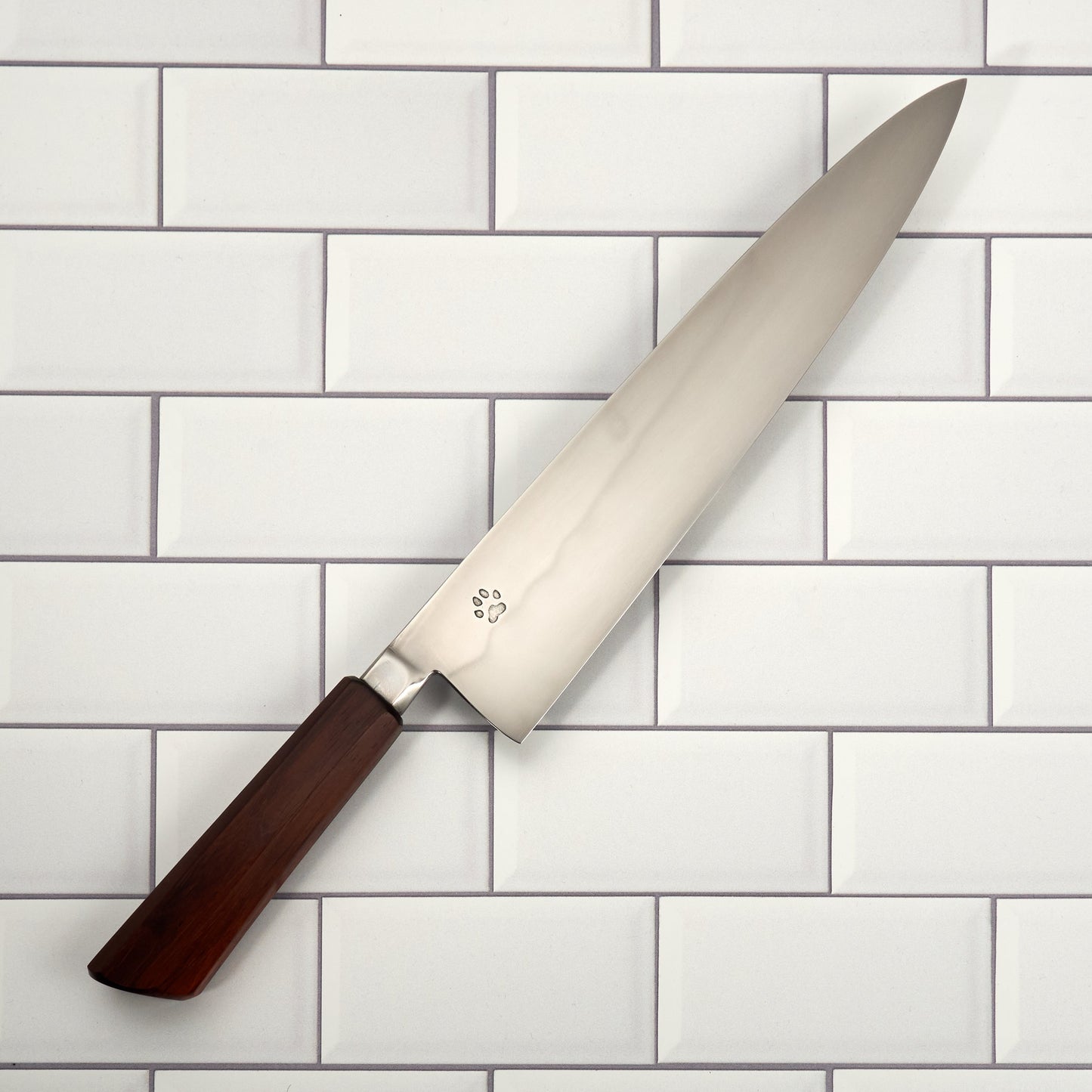
Gyuto 240 mm Aogami #2 Honyaki Integral & Makassar-Ebenholz

Gyuto 240 mm Aogami #2 Honyaki Integral & Makassar-Ebenholz

By Jonas Johnsson


No longer available

Jonas Johnsson

Reserve your place

We'll only email you when there's something to say. Invitations go out in signup order as new work becomes available.

Diesmal etwas anders als bei Jonas Johnsson. Vor einiger Zeit gelang es uns, Aogami #2-Stahl aus Japan zu importieren, von dem wir sofort wussten, dass wir ihn an Jonas schicken sollten. Aogami #2 ist ein großartiger Stahl für Honyaki-Klingen, und wer ist dafür besser geeignet als Jonas Johnsson, Europas herausragender Honyaki-Meister.

Die Ergebnisse sind da, und dies ist eine edel aussehende Klinge mit einer unglaublichen Geometrie, die dazu passt. Eine dünne Lasergeometrie mit einem Profil, das an das Yoshikane SKD Gyuto erinnert. Walkschliff-Boden, dieses Holz wird sich wie das Yoshikane auf dem Brett anfühlen, aber viel besser abschneiden.

Ein einzigartiger integrierter Kropf mit einer ergonomischen Vertiefung, die in den Griff übergeht. Das Messer liegt fantastisch in der Hand, flink, gut ausbalanciert, einfach ein sehr feines Stück Arbeit. Der Griff besteht aus einem wunderschön gemaserten Stück Makassar-Ebenholz, das eine erstaunliche Auswahl an Rot- und Brauntönen aufweist.

Jonas hat ein erstaunliches Gespür für Ästhetik und lässt diese saubere, hochglanzpolierte Klinge einfach neben dem atemberaubenden Makassar-Ebenholz sitzen. Nichts Kompliziertes, nur eine wunderschön geschmiedete Honyaki-Klinge mit atemberaubender Hochglanzpolitur und einem unglaublichen Stück Holz. Beide Stücke werden so behandelt, wie sie sein sollten, und dürfen glänzen. Ein zeitloses Stück, wunderschön!

Product Specification
  • Blade Type:
  • Edge Length: 240mm
  • Spine Heel: 2.61mm
  • Spine Mid: 1.48mm
  • Spine Tip (20mm before): 1.08mm
  • Blade Height: 48.75mm
  • Weight: 166mm
  • Cutting Edge Steel:
  • Steel class: Carbon
  • HRC: 65
  • Blade Construction:
  • Blade Finish: Spiegelpolitur
  • Grind:
  • Handle Construction:
  • Handle Materials: Macassar Ebony
  • Handedness: Beidhändig

Blade type

Gyuto

牛刀

The Japanese take on the Western chef's knife, and the most versatile blade in a modern kitchen. A gyuto carries a long, gently curved edge — most often 210 to 270 mm — that allows both push cuts and a rocking motion, with a pointed tip for fine work and enough height at the heel to keep knuckles clear of the board. It handles proteins, vegetables, and herbs without complaint, which is why most cooks reach for it first.

Compared with a European chef's knife, the gyuto is usually thinner, harder, and lighter, ground to a finer edge that rewards good board technique and regular honing. That same thinness is the trade-off: the edge is less forgiving of bone, frozen food, and twisting cuts, and it asks for a little more care in maintenance in exchange for its keenness.

View full knife type guide →

Cutting edge steel

Aogami #2

High-carbon tungsten-chromium steel

Typical HRC
61–64
Corrosion class
Carbon
Production
Conventional
Origin
Japan (Hitachi YSS / Proterial)

Aogami #2 — Blue Paper #2 — is the most widely encountered of the blue-paper steels and the one most cooks meet first. About 1.10 percent carbon plus half a percent each of chromium and tungsten is enough to noticeably extend edge retention over the white papers without dramatically changing how the steel feels at the stone.

In a typical clad gyuto or santoku the steel runs at 61–63 HRC, sharpens cleanly on most synthetic stones, and produces a reliable, hard-wearing edge. Toughness is good for the hardness — the lower carbon content compared to Blue #1 helps here — and the patina develops at a moderate, manageable pace. It is genuinely a workhorse: forgiving of slightly imperfect technique, tolerant of a wider range of foods, and broadly available across price points.

Among makers, Aogami #2 is the default blue paper for everyday clad knives, found across the bulk of the Sakai and Tosa traditions' working-cook offerings. Among the makers Modern Cooking carries, Katsushige Anryu and Jonas Johnsson work in Aogami #2. It is perhaps the steel that best illustrates Hitachi's philosophy: clean composition, predictable behaviour, ample room for the smith to leave a fingerprint.

View full steel guide →

Blade construction

Honyaki

The traditional Japanese single-steel forging technique, in which a high-carbon mono-steel blade is differentially hardened — clay is applied to the spine before quench, leaving only the edge to fully harden. The result is a hard cutting edge and a softer spine that improves toughness, plus the hamon (temper line) that defines the visual signature of the technique.

Honyaki is the high-water mark of Japanese knifemaking. The technique is unforgiving; a failed differential quench cracks the blade. Honyaki knives are almost always from a single high-purity carbon steel — Shirogami #1 is the canonical choice — and are priced and treated accordingly.

View full construction guide →

Grind

Walkschliff

A traditional Solingen grind — also called a kettle or kessel bulge grind — in which the blade is hollowed high on the side so its thickest point sits a little below the spine rather than at it. Below that bulge the steel is taken down to an extremely thin, finely convexed cutting edge, combining the rigidity of a thick upper blade with the keenness of a very thin one.

The Walkschliff is among the most demanding grinds to execute, historically reserved for the finest German knives and requiring years of a grinder's experience to do well. For the buyer it is a high-craft European alternative to the thin flat grinds of Japanese knives — strong, stable, and keen — but it is a hand-ground specialism, and a knife that carries it is priced for the skill it took to make.

View full grind guide →

Handle construction

Hidden Tang

A construction in which the tang runs into the handle but stays concealed inside it, rather than showing between two scales. A narrower tang — a full-length stick or a shorter projection — is set into a drilled or burned channel in a one-piece handle and secured with adhesive, a friction fit, or a threaded fitting drawn up against the blade. This is the traditional construction of Japanese wa-handles and many European hidden-tang knives.

The design puts the handle material in charge of the look and feel: a single piece of wood, horn, or composite — often with a ferrule or spacers at the front — is shaped into any cross-section the maker wants, from the classic octagonal and D-shaped wa profiles to fully rounded Western forms. With no steel showing along the grip, the handle can be slim and light, and is frequently made to be removed and replaced, with the balance sitting toward the blade.

View full construction guide →

Shipping & Returns

Shipping

We process orders 5 days a week (Monday - Friday) and ship from our shop in Sydney, Australia. We ship with FedEx, UPS and DHL.

We are happy to offer free international shipping on a variety of orders depending on location and order value.

Free Shipping Regions and Minimum Order Values

For Australia and New Zealand the minimum is $500AUD. For the rest of the world it is approximately €1000EUR. The discount is applied automatically when you reach the minimum cart value at checkout.

Returns

If you're not entirely happy with your purchase, you can return it within 14 days of delivery for a refund. The item must be in its original condition with all original packaging.

  • Returns are accepted for 14 days
  • The customer is responsible for return shipping costs
  • A 15% restocking fee may be applied to change-of-mind returns
  • We do not accept returns on second-hand items for change of mind

Faulty or Damaged Items

You must notify us within 5 business days of receiving your order. Photographic evidence of damage is required. Once approved, Modern Cooking will cover return shipping costs.

Product Care

Cleaning: Clean by hand with warm water. Avoid wetting the handle when possible.

Sharpening: We advise using whetstones to sharpen your knives and a honing rod or steel to maintain the burr between sharpening sessions.

Reactive Steels: Reactive steels like Aogami Super, Apex Ultra or premium reactive German and Swedish steels are susceptible to rust if not properly cared for. Keep the knife dry between uses and when storing for longer periods, wiping the blade with Tsubaki oil or another food-safe oil is a wise choice. A patina can be a beautiful personal feature on your knife and helps to stop rust forming.

Handle Care: For non-stabilised wooden handles, apply Tsubaki oil or another food-safe oil from time to time. Food-safe wax can be applied to both stabilised and non-stabilised wooden handles. Never apply hot wax or oil as you risk warping or damaging the handle.

Vollständige Details anzeigen