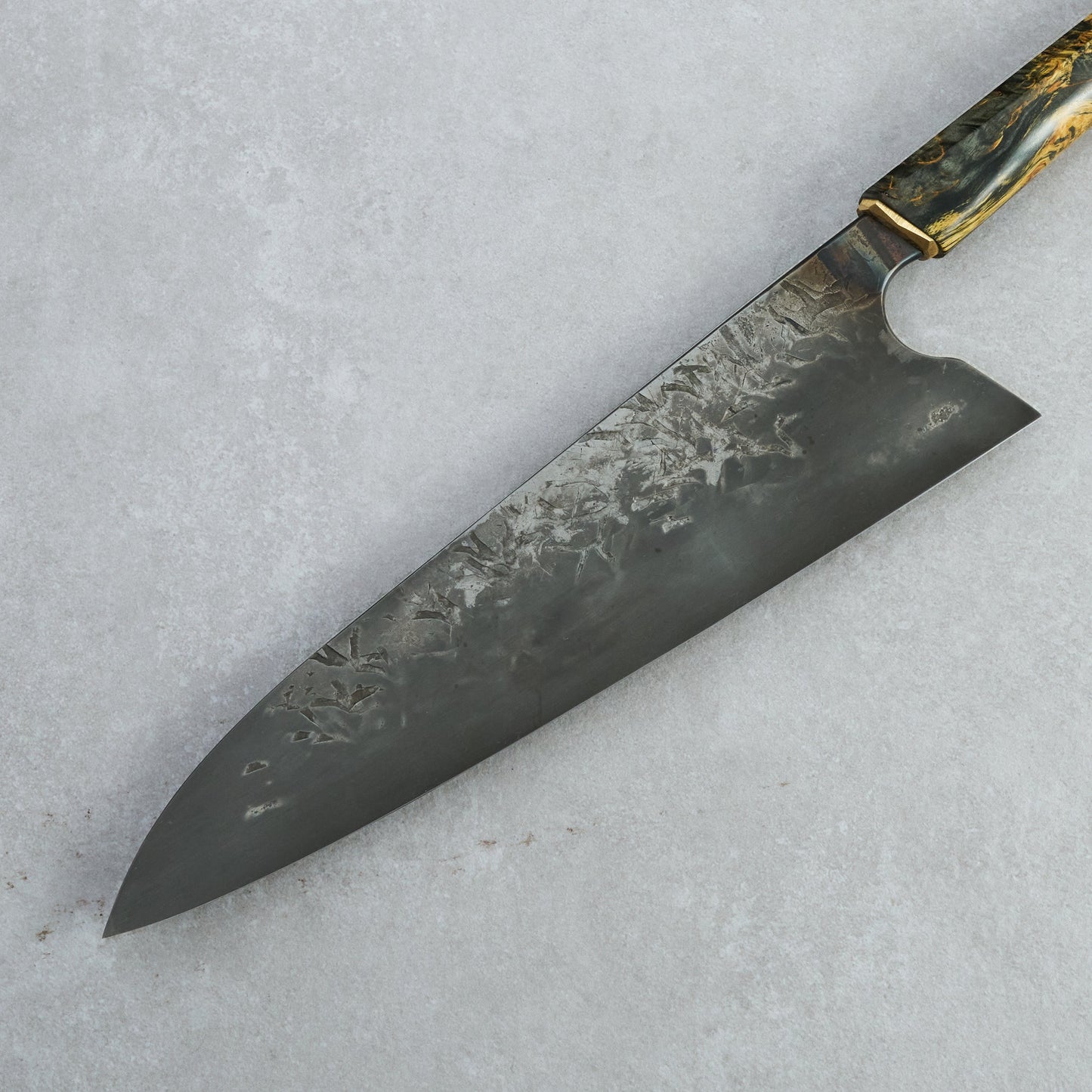
Gyuto 235 mm Mono Apex Ultra Black Etch "Duille Liath" ausgestellter Sarggriff
Gyuto 235 mm Mono Apex Ultra Black Etch "Duille Liath" ausgestellter Sarggriff
No longer available
Our Sydney workshop is closed until Monday 9 November. Orders placed now are very welcome and will ship in the order received from Tuesday 10 November. Shipping details
Wir präsentieren das exquisite „Duille Liath“, ein einzigartiges, handgefertigtes Küchenmesser, meisterhaft geschmiedet vom renommierten Kunsthandwerker Erik Gullikson. Der Name „Duille Liath“, was auf Irisch „Aschenblatt“ bedeutet, spiegelt treffend die organische Eleganz und zeitlose Handwerkskunst des Messers wider. Dieses außergewöhnliche Küchenwerkzeug mit klassischem Gyuto-Profil verkörpert die perfekte Balance aus Tradition und Innovation. Das Profil weist einen subtilen, durchgehenden Radius vom Ansatz bis zur Spitze auf, ideal für lange, sanfte Scheiben und präzise Stoßschnitte. In den Händen eines erfahrenen Kochs oder leidenschaftlichen Hobbykochs wird das „Duille Liath“ zu einer Erweiterung ihrer eigenen Präzision und bereichert jede kulinarische Kreation mit Anmut und Leichtigkeit. Es ist nicht nur ein Küchenwerkzeug; es ist eine Hommage an Handwerkskunst, Technik und Zweckmäßigkeit.
Das Herzstück von „Duille Liath“ ist seine überlegene Klingengeometrie, die es von gewöhnlichen Küchenmessern abhebt. Geschmiedet aus dem Hochleistungsstahl Apex Ultra, dient dieses Material als perfekte Grundlage für Erik Gulliksons meisterhafte Ausführung der ultrafeinen Verjüngung. Das Ergebnis ist eine Klinge, die sich unglaublich flink und wendig anfühlt und auf feinste Griff- und Bewegungsänderungen reagiert. Die sich verjüngende Geometrie reduziert den Widerstand beim Gleiten durch die Zutaten und sorgt für einen glatten, präzisen und nahezu mühelosen Schnitt. Die charakteristische „Zweig“-Textur auf der Klingenoberfläche, gepaart mit einer schwarz geätzten Oberfläche, verstärkt nicht nur die Optik, sondern spiegelt auch Eriks künstlerische Meisterschaft wider. Dieses strukturierte Muster bietet eine einzigartige Ästhetik und verleiht gleichzeitig ein taktiles Element, das zielgerichtet und bewusst wirkt. Die kunstvolle Gestaltung der Klingenoberfläche ergänzt ihre Leistung perfekt und schafft ein Messer, das optisch ebenso beeindruckend wie technisch überlegen ist.
Eriks Liebe zum Detail erstreckt sich auch auf den Griff, der sein neues, ausgestelltes Sargkegel-Design „Rokakku Hanmaru“ aufweist. Dieser ergonomische Griff ist aus stabilisierter schwarz-gelber Maserbirke gefertigt, einem Material, das Wärme und Charakter ausstrahlt. Der Kropf aus Messing in Erbstückqualität, verziert mit einer geometrisch strukturierten Oberfläche, sorgt für Ausgewogenheit und Haltbarkeit und untermauert die kühne visuelle Aussage des Griffs. Der Kropf verfügt über eine Erbstück- oder Museumspassform, die sicherstellt, dass die Lücken zwischen dem Kropf und dem Holzteil des Griffs mit der Zeit nicht unangenehm werden, falls sich das Holz bewegt. Zusammen erzeugen der Messingkropf und die leuchtend gelbe und schwarze Birke einen atemberaubenden Kontrast zur dunklen, geätzten Klinge. Das gesamte Messer fühlt sich bemerkenswert leicht, perfekt ausbalanciert und äußerst wendig an und vermittelt dem Benutzer das Gefühl, ein Präzisionsinstrument von höchstem Kaliber zu führen. Jeder Aspekt von „Duille Liath“ zeigt Erik Gulliksons meisterhafte Beherrschung von Materialien, Geometrie und Design. Das Ergebnis ist ein Küchenmesser, das sowohl ein Kunstwerk als auch ein funktionales Meisterwerk ist.
Product Specification
- Blade Type:
- Overall Length: 355 mm
- Edge Length: 235mm
- Spine Heel: 4.66mm
- Spine Mid: 1.85mm
- Spine Tip (20mm before): 0.7mm
- Blade Height: 62.35mm
- Weight: 184g
- Cutting Edge Steel:
- Steel class: Carbon
- HRC: 66
- Blade Construction:
- Blade Finish: Mattlack, Strukturiert, Säuregeätzt (erzwungene Patina)
- Grind:
- Handle Construction:
- Handle Materials: Stabilised Black Yellow Masur Birch
- Handedness: Beidhändig
Shipping & Returns
Shipping & Returns
Shipping
We process orders Monday to Friday from our Sydney workshop. Australian orders are shipped with Australia Post and international orders with DHL Express. Shipping charges are calculated at checkout based on destination, shipment size and weight, and the carrier service available for the order.
Returns
If you're not entirely happy with your purchase, you can return it within 14 days of delivery for a refund. The item must be in its original condition with all original packaging.
- Returns are accepted for 14 days
- The customer is responsible for return shipping costs
- A 15% restocking fee may be applied to change-of-mind returns
- We do not accept returns on second-hand items for change of mind
Faulty or Damaged Items
You must notify us within 5 business days of receiving your order. Photographic evidence of damage is required. Once approved, Modern Cooking will cover return shipping costs.
Product Care
Product Care
Cleaning: Clean by hand with warm water. Avoid wetting the handle when possible.
Sharpening: We advise using whetstones to sharpen your knives and a honing rod or steel to maintain the burr between sharpening sessions.
Reactive Steels: Reactive steels like Aogami Super, Apex Ultra or premium reactive German and Swedish steels are susceptible to rust if not properly cared for. Keep the knife dry between uses and when storing for longer periods, wiping the blade with Tsubaki oil or another food-safe oil is a wise choice. A patina can be a beautiful personal feature on your knife and helps to stop rust forming.
Handle Care: For non-stabilised wooden handles, apply Tsubaki oil or another food-safe oil from time to time. Food-safe wax can be applied to both stabilised and non-stabilised wooden handles. Never apply hot wax or oil as you risk warping or damaging the handle.