Zu Produktinformationen springen
1 von 16

Gyuto 230 mm & Pizzaschneider 90 mm Honyaki „Float Grip“ Set

Gyuto 230 mm & Pizzaschneider 90 mm Honyaki „Float Grip“ Set

By Toma Fenes


No longer available

Toma Fenes

Reserve your place

We'll only email you when there's something to say. Invitations go out in signup order as new work becomes available.

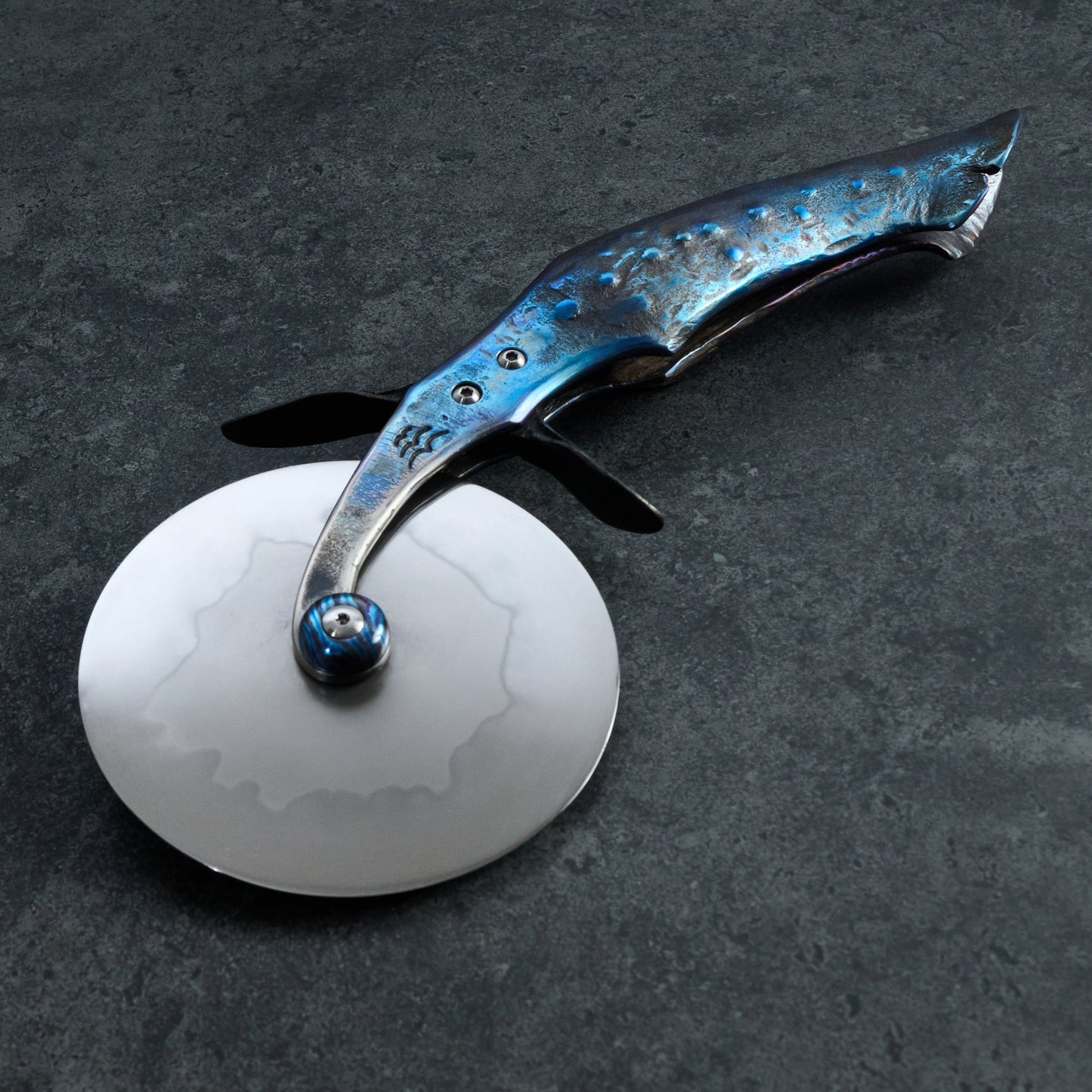
Dieses exquisite Set, gefertigt vom rumänischen Kunsthandwerker Toma Fenes, ist ein einzigartiges Meisterwerk, das funktionalen Nutzen mit einem Hauch von Mystik und Eleganz verbindet. Das Set besteht aus zwei verschiedenen Teilen: einem Gyuto, bekannt für seine Vielseitigkeit beim Schneiden, Würfeln und Hacken, und einem kunstvoll gestalteten Pizzaschneider. Beide Klingen sind aus hochwertigem schwedischem 26c3-Kohlenstoffstahl geschmiedet, der aufgrund seiner Reinheit, außergewöhnlichen Schärfe und Haltbarkeit ausgewählt wurde. Ihre Faszination wird noch verstärkt durch die Tatsache, dass jede Klinge aus Honyaki geschmiedet wurde und über ein Hamon verfügt, das den sorgfältigen Schmiedeprozess hervorhebt und ein visuelles Element hinzufügt, das typisch für traditionelle japanische Klingen ist. Das Hamon verbessert nicht nur die Ästhetik jedes Werkzeugs, sondern symbolisiert auch dessen Stärke und Haltbarkeit, wodurch dieses Set ebenso funktional wie optisch beeindruckend wird.

Die Griffe beider Teile sind mit Tomas patentiertem „Float Grip“-Design aus leichtem Titan gefertigt und sorgen für einen komfortablen und dennoch robusten Griff. Der „Float Grip“-Effekt erzeugt die Illusion, als würden die Griffe schweben oder von den Klingen getrennt sein, was durch Tomas einzigartiges genietetes und geteiltes Design erreicht wird. Dieser schwebende Aspekt wird durch die ergonomischen, glatten Konturen noch verstärkt, was eine längere Nutzung ohne Beschwerden ermöglicht. Das innovative Griffdesign ist von Elfenwaffen inspiriert, insbesondere von J.R.R. Tolkiens „Herr der Ringe“, und verkörpert eine mystische Eleganz, die ihren Reiz verstärkt.

Das Gyuto-Messer ist zusätzlich mit Nieten aus 999er Silber ausgestattet, die strategisch über den Griff und den strukturierten Bereich der Klinge verteilt sind. Diese silbernen Akzente verleihen einen Hauch von Luxus und Raffinesse und werten die Optik auf. Der Pizzaschneider ist mit Titan-Damast-Unterlegscheiben (Timascus) ausgestattet, die das Rad sichern und Tomas Liebe zum Detail und zur Materialqualität unterstreichen. Das Rad des Schneiders hat einen Durchmesser von ca. 90 mm und bietet so ausreichend Schutz zum Schneiden, während ein durchdachter Fingerschutz den Daumen während der Verwendung stützt und so Komfort und Kontrolle gewährleistet. Dieses Set mit seiner Mischung aus zeitloser Ästhetik und funktionaler Handwerkskunst veranschaulicht Toma Fenes' Meisterschaft und Fantasie im Bereich der handwerklichen Messerherstellung.

Product Specification
  • Blade Type:
  • Overall Length: 360 mm
  • Edge Length: 230mm
  • Spine Heel: 4.98mm
  • Spine Mid: 2.4mm
  • Spine Tip (20mm before): 0.99mm
  • Blade Height: 62mm
  • Weight: 212g
  • Cutting Edge Steel:
  • Steel class: Carbon
  • HRC: 65
  • Blade Construction:
  • Blade Finish: Säuregeätzt (Zwangspatina)Satinpolitur
  • Grind:
  • Handle Construction:
  • Handle Materials: Titanium
  • Handedness: Beidhändig

Blade type

Gyuto

牛刀

The Japanese take on the Western chef's knife, and the most versatile blade in a modern kitchen. A gyuto carries a long, gently curved edge — most often 210 to 270 mm — that allows both push cuts and a rocking motion, with a pointed tip for fine work and enough height at the heel to keep knuckles clear of the board. It handles proteins, vegetables, and herbs without complaint, which is why most cooks reach for it first.

Compared with a European chef's knife, the gyuto is usually thinner, harder, and lighter, ground to a finer edge that rewards good board technique and regular honing. That same thinness is the trade-off: the edge is less forgiving of bone, frozen food, and twisting cuts, and it asks for a little more care in maintenance in exchange for its keenness.

View full knife type guide →

Cutting edge steel

26C3

High-carbon, low-alloy fine-grain steel

Typical HRC
63–67
Corrosion class
Carbon
Production
Conventional
Origin
Sweden (Sandvik / Alleima)

26C3 is one of the most quietly important kitchen knife steels of the past decade. Originally engineered by Sandvik as a razor steel — its lineage runs straight to UHB-20C — it carries about 1.25 to 1.30 percent carbon, very low manganese and sulphur, and a small chromium addition to control grain size. The result is a steel that hardens cleanly into the mid-sixties HRC while retaining genuinely useful toughness for its hardness, an unusual combination outside the powder-metallurgy world.

For the cook, 26C3 sharpens the way the best Japanese white papers sharpen — a quick burr that wipes off cleanly, and a polished edge that holds a screaming apex without microchipping. Toughness at 64 HRC is comparable to or better than 52100 at the same hardness in published testing, which is part of why the Larrin-Thomas-and-friends generation of makers gravitated to it; it lets you grind thinner without paying for it later. Like all clean carbons, it patinas willingly and benefits from a wipe between tasks.

26C3 has become something of a default among UK and European bladesmiths who want a no-compromise carbon edge, and it is the chemical parent of SheffCut, which adds a sliver of niobium to refine grain further. Among the makers Modern Cooking carries, Birch & Bevel, Karol Karyś, Jonas Johnsson, Tobias Heldqvist, Brook Turner, and Fredrik Spåre work in 26C3. It is one of the few non-stainless steels you can recommend to a cook coming from VG-10 without apology.

View full steel guide →

Blade construction

Honyaki

The traditional Japanese single-steel forging technique, in which a high-carbon mono-steel blade is differentially hardened — clay is applied to the spine before quench, leaving only the edge to fully harden. The result is a hard cutting edge and a softer spine that improves toughness, plus the hamon (temper line) that defines the visual signature of the technique.

Honyaki is the high-water mark of Japanese knifemaking. The technique is unforgiving; a failed differential quench cracks the blade. Honyaki knives are almost always from a single high-purity carbon steel — Shirogami #1 is the canonical choice — and are priced and treated accordingly.

View full construction guide →

Grind

Convex

A grind whose bevel bulges outward in a gentle curve from spine to edge, rather than running flat. That extra steel directly behind the edge makes a convex grind notably strong and resistant to chipping, while the curved geometry helps food release and lets the blade glide through dense ingredients with less wedging than a flat grind.

The strength comes at the cost of ultimate thinness and ease of maintenance. A convex edge has more metal behind it, so it is not quite as effortlessly keen as a thinly flat-ground edge, and it is harder to sharpen freehand — holding the curve takes a stropping technique or a deliberate hand rather than a single fixed angle. The reward is an exceptionally tough, smooth-cutting edge.

View full grind guide →

Handle construction

Half Tang

A construction in which the tang extends partway into the handle rather than running its full length. The tang is forged or cut as a partial projection from the blade — often a stub or tapered stick — and seated into the handle material, set into a drilled or slotted channel and fixed with adhesive, a pin, or a friction fit. Because the steel stops short of the butt, the body of the handle is built from the handle material itself, and the weight sits forward toward the blade.

Visually and in the hand it reads as a one-piece handle: a grip of wood, horn, or composite shaped, rounded, and finished without a strip of steel running through it, much like a hidden tang but with a shorter internal anchor. It is a light, blade-forward construction, and in a kitchen knife the tang's role is to hold the blade securely in a comfortable handle rather than to carry the prying and impact loads a hard-use outdoor tool is built around.

View full construction guide →

Shipping & Returns

Shipping

We process orders 5 days a week (Monday - Friday) and ship from our shop in Sydney, Australia. We ship with FedEx, UPS and DHL.

We are happy to offer free international shipping on a variety of orders depending on location and order value.

Free Shipping Regions and Minimum Order Values

For Australia and New Zealand the minimum is $500AUD. For the rest of the world it is approximately €1000EUR. The discount is applied automatically when you reach the minimum cart value at checkout.

Returns

If you're not entirely happy with your purchase, you can return it within 14 days of delivery for a refund. The item must be in its original condition with all original packaging.

  • Returns are accepted for 14 days
  • The customer is responsible for return shipping costs
  • A 15% restocking fee may be applied to change-of-mind returns
  • We do not accept returns on second-hand items for change of mind

Faulty or Damaged Items

You must notify us within 5 business days of receiving your order. Photographic evidence of damage is required. Once approved, Modern Cooking will cover return shipping costs.

Product Care

Cleaning: Clean by hand with warm water. Avoid wetting the handle when possible.

Sharpening: We advise using whetstones to sharpen your knives and a honing rod or steel to maintain the burr between sharpening sessions.

Reactive Steels: Reactive steels like Aogami Super, Apex Ultra or premium reactive German and Swedish steels are susceptible to rust if not properly cared for. Keep the knife dry between uses and when storing for longer periods, wiping the blade with Tsubaki oil or another food-safe oil is a wise choice. A patina can be a beautiful personal feature on your knife and helps to stop rust forming.

Handle Care: For non-stabilised wooden handles, apply Tsubaki oil or another food-safe oil from time to time. Food-safe wax can be applied to both stabilised and non-stabilised wooden handles. Never apply hot wax or oil as you risk warping or damaging the handle.

Vollständige Details anzeigen