Zu Produktinformationen springen
1 von 7

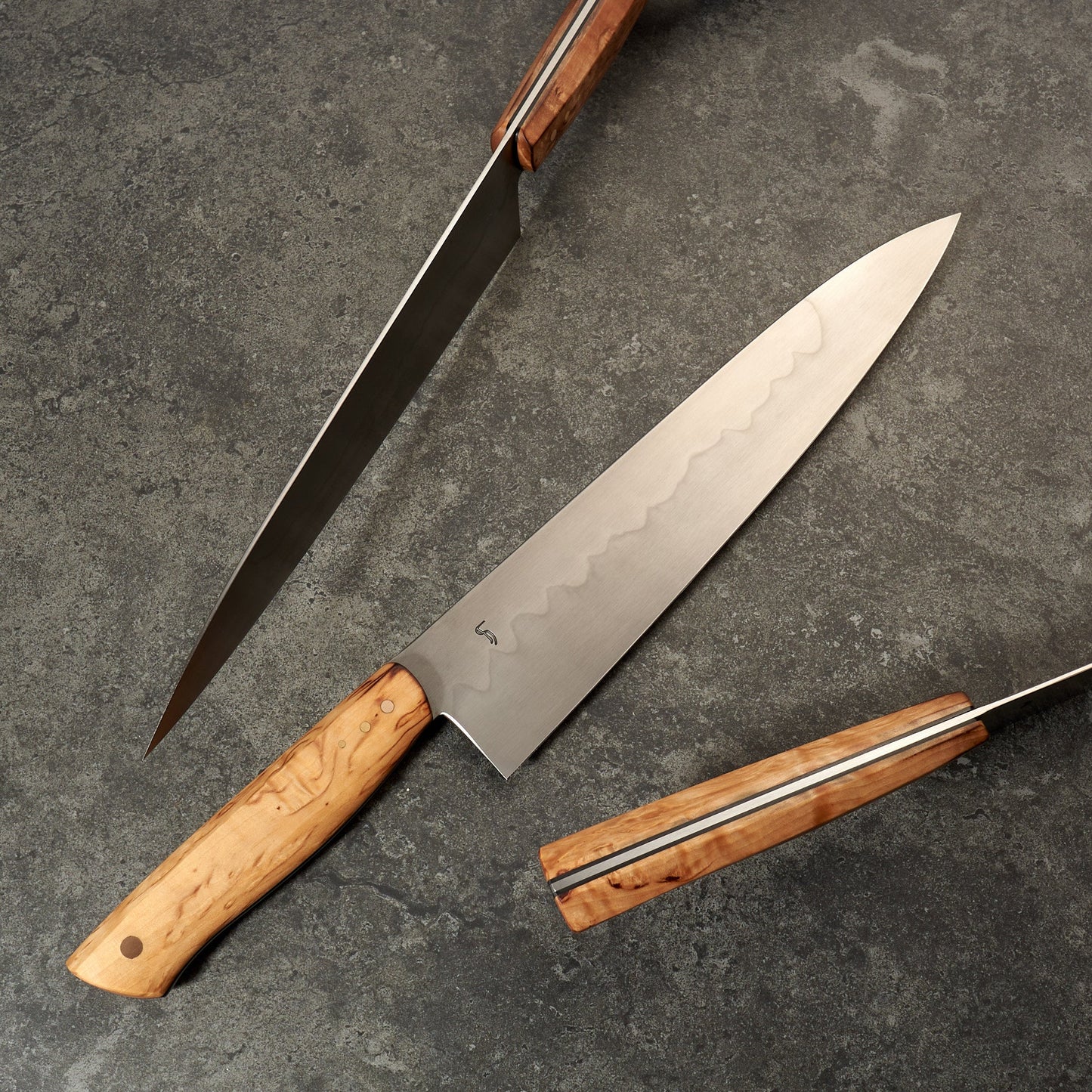
Gyuto 230 mm 26C3 Honyaki Full Tang Limited Edition von Fredrik Spåre

Gyuto 230 mm 26C3 Honyaki Full Tang Limited Edition von Fredrik Spåre

By MCX


Normaler Preis €448,95 EUR
Normaler Preis Verkaufspreis €448,95 EUR
Sale Ausverkauft
Inkl. Steuern. Versand wird beim Checkout berechnet

Nicht vorrätig

Anzahl

Mit dem Masamoto KS als Referenz wollten Fredrik und ich einen absoluten Laser mit einem niedrigeren Profil als unsere früheren Kooperationen liefern. Eine leichte, flinke Klinge, perfekt für feine Detailarbeiten. Es wäre jedoch nicht richtig, das KS einfach zu kopieren, wir wollten ein Messer liefern, das einzigartig ist, aber dennoch in der Art und Weise, wie es die Menschen lieben, ähnlich ist.

Das Profil auf dieser Klinge ist gerade nach oben KS, aber hier enden die Ähnlichkeiten. Wir haben diesem Messer eine aggressive distale Verjüngung von 2 mm auf weniger als 1 mm in Richtung der nadelähnlichen Spitze gegeben. Der Schliff ist auch 50/50 konvex im Gegensatz zum KS, der typischerweise einen asymmetrischen Schliff von 70/30 hat. Da diese Klinge in Schweden geschmiedet wird, mussten wir auch den Stahl ändern, sodass Sie bei dieser Klinge 26c3 „Spicey White“ anstelle des klassischen Shirogami-Stahls erhalten, der beim KS verwendet wird. Es ist ein sehr ähnlicher Stahl, in der Tat fast identisch, aber vielleicht etwas verschleißfester und vor allem in Schweden hergestellt.

Der vielleicht größte Unterschied zwischen den beiden Messern besteht darin, dass es sich um ein Full-Tang-Messer mit westlichem Griff handelt. Der Griff verfügt über unser neues MCX-Profil, das Elemente der Rokkaku-Hanmaru-Form beibehält, die wir bei früheren Chargen mit einer glockenförmigeren Unterseite verwendet haben. Das ist die Richtung, in die wir in Zukunft mit der MCX-Reihe gehen werden.

Oh, und es ist ein Honyaki, der Masamoto KS ist kein Honyaki ;)

Product Specification
  • Blade Type:
  • Edge Length: 230mm
  • Spine Heel: 2.1mm
  • Spine Mid: 1.8mm
  • Spine Tip (20mm before): 0.95mm
  • Blade Height: 51mm
  • Weight: 215g
  • Cutting Edge Steel:
  • Steel class: Carbon
  • HRC: 65+
  • Blade Construction:
  • Blade Finish: Mattpolitur
  • Grind:
  • Handle Construction:
  • Handle Materials: Stabilised Masur Birch, Brass
  • Handedness: Beidhändig

Blade type

Gyuto

牛刀

The Japanese take on the Western chef's knife, and the most versatile blade in a modern kitchen. A gyuto carries a long, gently curved edge — most often 210 to 270 mm — that allows both push cuts and a rocking motion, with a pointed tip for fine work and enough height at the heel to keep knuckles clear of the board. It handles proteins, vegetables, and herbs without complaint, which is why most cooks reach for it first.

Compared with a European chef's knife, the gyuto is usually thinner, harder, and lighter, ground to a finer edge that rewards good board technique and regular honing. That same thinness is the trade-off: the edge is less forgiving of bone, frozen food, and twisting cuts, and it asks for a little more care in maintenance in exchange for its keenness.

View full knife type guide →

Cutting edge steel

26C3

High-carbon, low-alloy fine-grain steel

Typical HRC
63–67
Corrosion class
Carbon
Production
Conventional
Origin
Sweden (Sandvik / Alleima)

26C3 is one of the most quietly important kitchen knife steels of the past decade. Originally engineered by Sandvik as a razor steel — its lineage runs straight to UHB-20C — it carries about 1.25 to 1.30 percent carbon, very low manganese and sulphur, and a small chromium addition to control grain size. The result is a steel that hardens cleanly into the mid-sixties HRC while retaining genuinely useful toughness for its hardness, an unusual combination outside the powder-metallurgy world.

For the cook, 26C3 sharpens the way the best Japanese white papers sharpen — a quick burr that wipes off cleanly, and a polished edge that holds a screaming apex without microchipping. Toughness at 64 HRC is comparable to or better than 52100 at the same hardness in published testing, which is part of why the Larrin-Thomas-and-friends generation of makers gravitated to it; it lets you grind thinner without paying for it later. Like all clean carbons, it patinas willingly and benefits from a wipe between tasks.

26C3 has become something of a default among UK and European bladesmiths who want a no-compromise carbon edge, and it is the chemical parent of SheffCut, which adds a sliver of niobium to refine grain further. Among the makers Modern Cooking carries, Birch & Bevel, Karol Karyś, Jonas Johnsson, Tobias Heldqvist, Brook Turner, and Fredrik Spåre work in 26C3. It is one of the few non-stainless steels you can recommend to a cook coming from VG-10 without apology.

View full steel guide →

Blade construction

Honyaki

The traditional Japanese single-steel forging technique, in which a high-carbon mono-steel blade is differentially hardened — clay is applied to the spine before quench, leaving only the edge to fully harden. The result is a hard cutting edge and a softer spine that improves toughness, plus the hamon (temper line) that defines the visual signature of the technique.

Honyaki is the high-water mark of Japanese knifemaking. The technique is unforgiving; a failed differential quench cracks the blade. Honyaki knives are almost always from a single high-purity carbon steel — Shirogami #1 is the canonical choice — and are priced and treated accordingly.

View full construction guide →

Grind

Convex

A grind whose bevel bulges outward in a gentle curve from spine to edge, rather than running flat. That extra steel directly behind the edge makes a convex grind notably strong and resistant to chipping, while the curved geometry helps food release and lets the blade glide through dense ingredients with less wedging than a flat grind.

The strength comes at the cost of ultimate thinness and ease of maintenance. A convex edge has more metal behind it, so it is not quite as effortlessly keen as a thinly flat-ground edge, and it is harder to sharpen freehand — holding the curve takes a stropping technique or a deliberate hand rather than a single fixed angle. The reward is an exceptionally tough, smooth-cutting edge.

View full grind guide →

Handle construction

Full Tang

A construction in which the blade steel runs the full length and width of the handle, forming a flat core between two handle scales. The scales are fixed to either face of the tang with pins, rivets, or adhesive, and the tang's outline stays visible as a strip of steel around the top, bottom, and butt of the handle — often with the pin heads showing as a row down each side. It is the dominant construction in Western kitchen and outdoor knives.

Because the steel continues all the way to the butt, the handle is essentially the tang dressed in two scales, and the grip is ground and shaped from that sandwiched assembly as a whole. The extra steel carries weight and balance back toward the hand, giving the solid, blade-and-handle-as-one feel that defines the style, and it leaves the edge of the tang on show as part of the knife's line.

View full construction guide →

Shipping & Returns

Shipping

We process orders 5 days a week (Monday - Friday) and ship from our shop in Sydney, Australia. We ship with FedEx, UPS and DHL.

We are happy to offer free international shipping on a variety of orders depending on location and order value.

Free Shipping Regions and Minimum Order Values

For Australia and New Zealand the minimum is $500AUD. For the rest of the world it is approximately €1000EUR. The discount is applied automatically when you reach the minimum cart value at checkout.

Returns

If you're not entirely happy with your purchase, you can return it within 14 days of delivery for a refund. The item must be in its original condition with all original packaging.

  • Returns are accepted for 14 days
  • The customer is responsible for return shipping costs
  • A 15% restocking fee may be applied to change-of-mind returns
  • We do not accept returns on second-hand items for change of mind

Faulty or Damaged Items

You must notify us within 5 business days of receiving your order. Photographic evidence of damage is required. Once approved, Modern Cooking will cover return shipping costs.

Product Care

Cleaning: Clean by hand with warm water. Avoid wetting the handle when possible.

Sharpening: We advise using whetstones to sharpen your knives and a honing rod or steel to maintain the burr between sharpening sessions.

Reactive Steels: Reactive steels like Aogami Super, Apex Ultra or premium reactive German and Swedish steels are susceptible to rust if not properly cared for. Keep the knife dry between uses and when storing for longer periods, wiping the blade with Tsubaki oil or another food-safe oil is a wise choice. A patina can be a beautiful personal feature on your knife and helps to stop rust forming.

Handle Care: For non-stabilised wooden handles, apply Tsubaki oil or another food-safe oil from time to time. Food-safe wax can be applied to both stabilised and non-stabilised wooden handles. Never apply hot wax or oil as you risk warping or damaging the handle.

Vollständige Details anzeigen