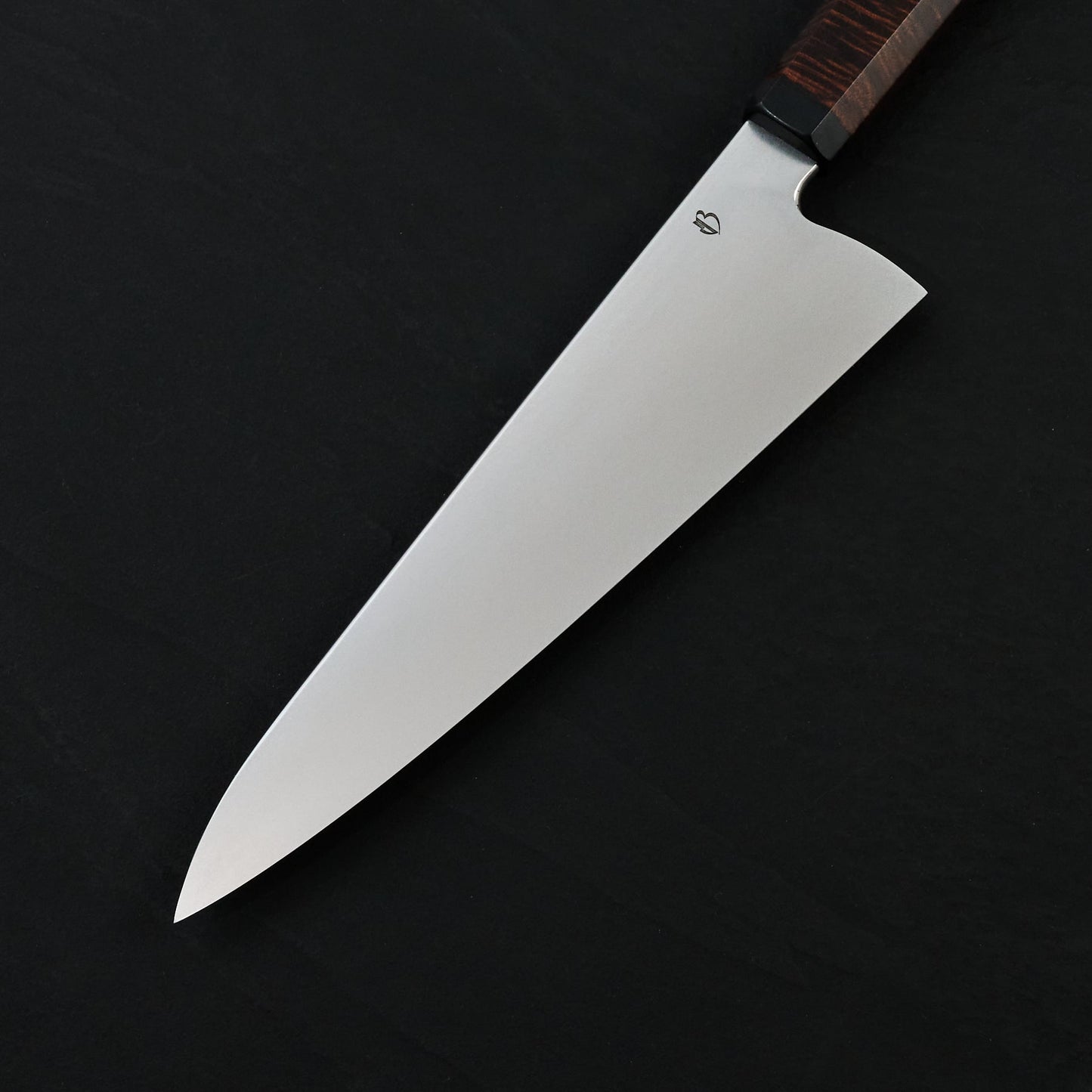
Gyuto 225 mm AEB-L Orbital, Gidgee & doppeltes schwarzes Canvas-Micarta
Gyuto 225 mm AEB-L Orbital, Gidgee & doppeltes schwarzes Canvas-Micarta
By Dan Bidinger
No longer available
Our Sydney workshop is closed until Monday 9 November. Orders placed now are very welcome and will ship in the order received from Tuesday 10 November. Shipping details
Dieses exquisite, einzigartige Küchenmesser ist die Verkörperung meisterhafter Handwerkskunst des Messermachers Dan Bidinger. Inspiriert vom legendären Gyuto präsentiert es einen modernen Twist, der es von traditionellen Silhouetten abhebt. Die Klinge weist eine stark verjüngte Höhe auf, wodurch ein robuster Rücken gewährleistet wird, der sich in einer kraftvollen und sicheren Bewegung auf dem Schneidebrett niederschlägt. Egal, ob Sie durch empfindliche Kräuter schneiden oder dichtes Wurzelgemüse bewältigen, das Profil des Messers ermöglicht präzise Kontrolle und mühelose Manövrierbarkeit. Die Kunstfertigkeit dieses Designs spiegelt Dans Hingabe wider, sowohl schöne als auch funktionale Klingen zu schaffen. Das Ergebnis ist ein kulinarisches Werkzeug, das sich wie eine Verlängerung der Hand des Kochs anfühlt. Seine Liebe zum Detail ist in jedem Zentimeter des Messers zu erkennen, vom elegant konturierten Rücken bis zur sorgfältig verarbeiteten Schneide.
Das Herzstück dieser Klinge ist der bei Dan’sa Bidinger beliebte AEB-L Premium-Edelstahl, der für seine hohe Schärfe und beeindruckende Schnitthaltigkeit geschätzt wird. Die dünnen konvexen Fasen in Kombination mit einer sich verjüngenden Rückenstärke betonen die Fähigkeit der Klinge, mit minimalem Widerstand durch Zutaten zu gleiten. Diese raffinierte Geometrie, kombiniert mit dem stark verjüngten Profil, steigert die Gesamtleistung und macht das Messer außergewöhnlich wendig. AEB-L-Stahl ist für seine feine Körnung bekannt, die eine spitze Schneide ermöglicht, die länger scharf bleibt. Wer mehr über die tieferen metallurgischen Eigenschaften dieses Edelstahls erfahren möchte, findet bei einer kurzen Suche im Internet heraus, warum er unter Messermachern so beliebt ist. Die Kombination aus hochwertigen Materialien und sorgfältiger Verarbeitung gewährleistet, dass die Klinge alles von präzisem Schneiden bis hin zu anspruchsvolleren Aufgaben bewältigt, ohne dabei ihre rasiermesserscharfe Schneide oder ihre zeitlose Eleganz einzubüßen.
Der Griff – eine klassische Konstruktion mit verdecktem Erl aus hochwertigem australischem Ringed Gidgee und doppelt schwarzem Canvas Micarta – macht das Messer noch einzigartiger. Diese markante Kombination sorgt für eine langlebige und elegante Haptik voller subtiler Kontrasttöne und -strukturen. Die achteckige Form ist ergonomisch und komfortabel zugleich und ermöglicht einen sicheren Halt, der die Ermüdung der Hand bei längerem Gebrauch reduziert. Darüber hinaus verleiht das Orbital-Finish der Klinge eine besondere Optik, die jedes Stück unbestreitbar originell macht und gleichzeitig das handwerkliche Erbe des Messers unterstreicht. Zusammen mit seiner außergewöhnlichen Schneidleistung macht dieses Finish das Messer zu einem bemerkenswerten Statement in jeder Küche. Letztendlich demonstriert jeder Aspekt dieser Kreation – von der unverwechselbaren Geometrie bis zum meisterhaften Griffdesign – Dan Bidingers Engagement für Exzellenz und führt zu einem seltenen und außergewöhnlichen Werkzeug, das Sie jahrelang schätzen werden.
Product Specification
- Blade Type:
- Overall Length: 365 mm
- Edge Length: 225mm
- Spine Heel: 4.55mm
- Spine Mid: 3.19mm
- Spine Tip (20mm before): 1.46mm
- Blade Height: 60.87mm
- Weight: 248g
- Cutting Edge Steel:
- Steel class: Stainless
- HRC: 65
- Blade Construction:
- Blade Finish: Gebürstet
- Grind:
- Handle Construction:
- Handle Materials: Gidget, Double Black canvas Micarta
- Handedness: Beidhändig
Shipping & Returns
Shipping & Returns
Shipping
We process orders Monday to Friday from our Sydney workshop. Australian orders are shipped with Australia Post and international orders with DHL Express. Shipping charges are calculated at checkout based on destination, shipment size and weight, and the carrier service available for the order.
Returns
If you're not entirely happy with your purchase, you can return it within 14 days of delivery for a refund. The item must be in its original condition with all original packaging.
- Returns are accepted for 14 days
- The customer is responsible for return shipping costs
- A 15% restocking fee may be applied to change-of-mind returns
- We do not accept returns on second-hand items for change of mind
Faulty or Damaged Items
You must notify us within 5 business days of receiving your order. Photographic evidence of damage is required. Once approved, Modern Cooking will cover return shipping costs.
Product Care
Product Care
Cleaning: Clean by hand with warm water. Avoid wetting the handle when possible.
Sharpening: We advise using whetstones to sharpen your knives and a honing rod or steel to maintain the burr between sharpening sessions.
Reactive Steels: Reactive steels like Aogami Super, Apex Ultra or premium reactive German and Swedish steels are susceptible to rust if not properly cared for. Keep the knife dry between uses and when storing for longer periods, wiping the blade with Tsubaki oil or another food-safe oil is a wise choice. A patina can be a beautiful personal feature on your knife and helps to stop rust forming.
Handle Care: For non-stabilised wooden handles, apply Tsubaki oil or another food-safe oil from time to time. Food-safe wax can be applied to both stabilised and non-stabilised wooden handles. Never apply hot wax or oil as you risk warping or damaging the handle.