Zu Produktinformationen springen
1 von 6

Gyuto 215mm Edelstahl (410) verkleidet 52100 SanMai Integral

Gyuto 215mm Edelstahl (410) verkleidet 52100 SanMai Integral

By Niko Nicolaides


Normaler Preis €2.414,95 EUR
Normaler Preis Verkaufspreis €2.414,95 EUR
Sale Ausverkauft
Inkl. Steuern. Versand wird beim Checkout berechnet

Niedriger Lagerbestand: 1 verbleibend

Anzahl

Bringen Sie Schönheit und Präzision in Ihre kulinarische Welt mit diesem atemberaubenden K-Tip Gyuto aus den geschickten Händen von Niko Nicolaides. Dieses Messer ist nicht nur ein Küchenwerkzeug; es ist ein Beweis für Kunstfertigkeit und Präzision, der Ihr Kocherlebnis verändern wird.

Mit einer Kantenlänge von 215 mm bietet die Klinge die perfekte Balance zwischen Kontrolle und Vielseitigkeit. Die Rückenmaße, die von 2,84 mm an der Ferse bis 1,34 mm an der Spitze reichen, sorgen für müheloses Schneiden und Präzision. Die Klingenhöhe von 49,45 mm und das Gewicht von 208 g tragen zu einem harmonischen Gefühl in Ihrer Hand bei.

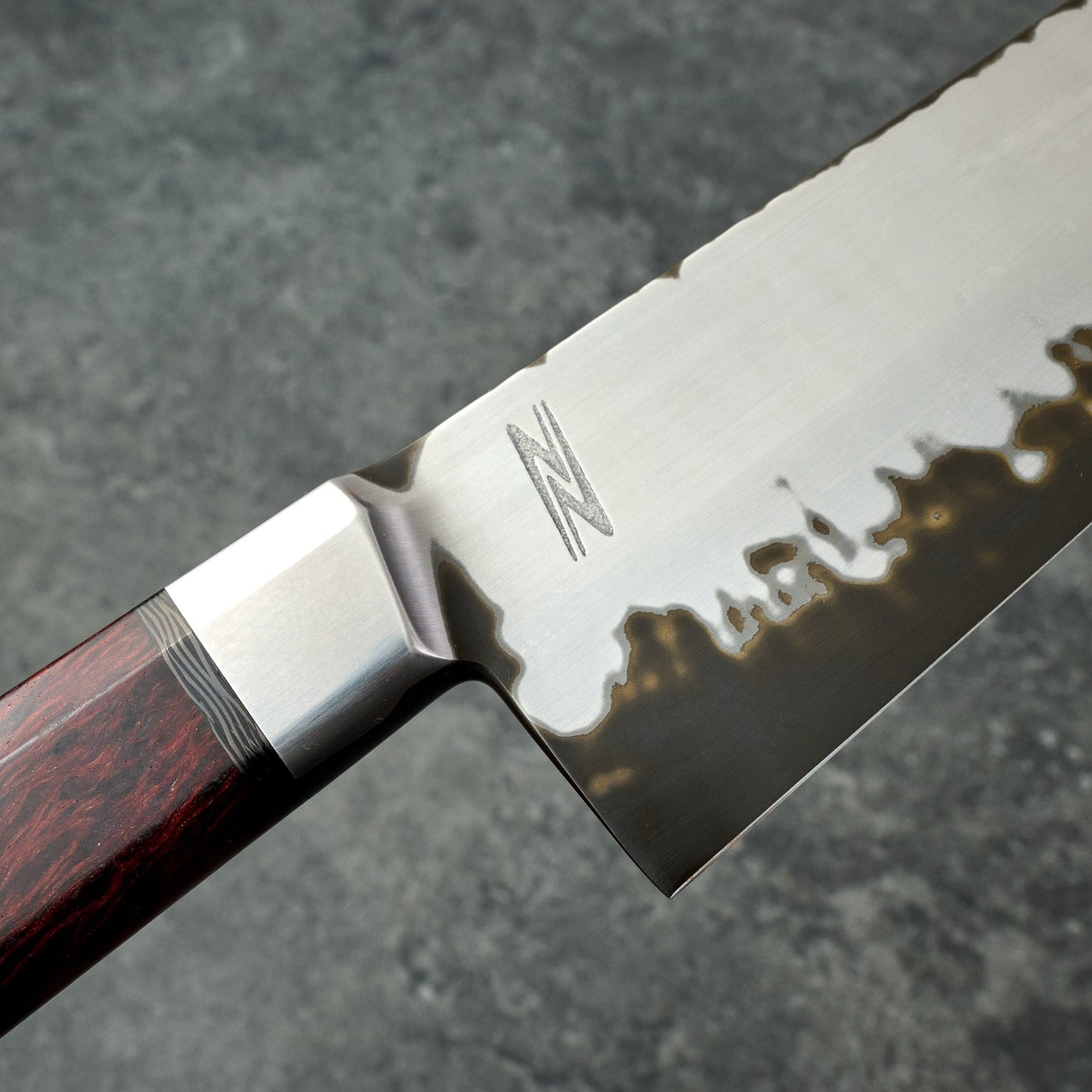
Dieses mit viel Liebe zum Detail gefertigte Gyuto verfügt über einen integrierten geschmiedeten Kropf, der sowohl die Ästhetik als auch die Balance verbessert. Die Klinge ist ein Meisterwerk für sich und verfügt über eine hausgemachte San Mai-Stahlkonstruktion mit einem Kern aus 52100-Stahl, der mit 410 rostfreiem Stahl ummantelt ist. Ein sehr guter Stahl, der auf 63 HRC gehärtet ist, die Klinge verspricht anhaltende Schärfe und Zähigkeit.

Der konvexe Schliff der Klinge sorgt für optimale Schneidleistung, während die säuregeätzte Oberfläche Charakter verleiht und die fachmännische Handwerkskunst zur Schau stellt. Der integrierte Griff aus Sheoak-Spitzenholz bietet einen bequemen Griff und wertet das Messer optisch auf.

Lassen Sie sich von der Kunstfertigkeit dieses K-Tip Gyuto von Niko Nicolaides verwöhnen, bei dem Form und Funktion in perfekter Harmonie zusammentreffen. Egal, ob Sie ein professioneller Koch oder ein begeisterter Hobbykoch sind, dieses Messer wird Ihre kulinarische Reise bereichern und jede Essenszubereitung zu einem Vergnügen machen.

Product Specification
  • Blade Type:
  • Edge Length: 215mm
  • Spine Heel: 2.84mm
  • Spine Mid: 2.22mm
  • Spine Tip (20mm before): 1.34mm
  • Blade Height: 49.45mm
  • Weight: 208g
  • Cutting Edge Steel:
  • Steel class: Carbon
  • HRC: 63
  • Blade Construction:
  • Blade Finish: Säuregeätzt (Zwangspatina)Satinpolitur
  • Grind:
  • Handle Construction:
  • Handle Materials: Lace Sheoak
  • Handedness: Beidhändig

Blade type

Gyuto

牛刀

The Japanese take on the Western chef's knife, and the most versatile blade in a modern kitchen. A gyuto carries a long, gently curved edge — most often 210 to 270 mm — that allows both push cuts and a rocking motion, with a pointed tip for fine work and enough height at the heel to keep knuckles clear of the board. It handles proteins, vegetables, and herbs without complaint, which is why most cooks reach for it first.

Compared with a European chef's knife, the gyuto is usually thinner, harder, and lighter, ground to a finer edge that rewards good board technique and regular honing. That same thinness is the trade-off: the edge is less forgiving of bone, frozen food, and twisting cuts, and it asks for a little more care in maintenance in exchange for its keenness.

View full knife type guide →

Cutting edge steel

52100

Low-alloy chromium bearing/tool steel

Typical HRC
61–65
Corrosion class
Carbon
Production
Conventional
Origin
United States (AISI 52100); identical to 1.3505 and 100Cr6

52100 is the most respected non-stainless steel in the Western kitchen knife tradition — a chrome-bearing alloy that began life as a ball-bearing grade and has, over decades of custom-maker use, become a reference for what a thoughtful carbon steel should feel like. Roughly one percent carbon and one and a half percent chromium put it just below the stainless threshold but well within the territory where chromium meaningfully refines grain and tightens the carbide structure.

A good 52100 kitchen knife typically lands between 62 and 63 HRC. It sharpens with little drama on almost any stone, takes an edge as clean as the simple carbons, and holds it for longer thanks to those Cr-rich carbides. Toughness is excellent for the hardness — published comparative data positions it as one of the better-balanced carbon steels available, especially when the heat treat includes the cryogenic treatment that this steel rewards. It will patina, but more politely than a white paper, and it is forgiving enough that a single rinse-and-dry routine is usually enough.

52100 is the canonical choice for cooks who love carbon-steel feel but want a touch more refinement than 1084, W2, or even 80CrV2. It dominates the American custom scene and shows up across high-end stock-removal work from a wide range of forging custom shops. Among the makers Modern Cooking carries, Fredrik Spåre, Brook Turner, and Nordquist Designs work in 52100. Note that it is the same alloy as German 1.3505 and the European 100Cr6; if a maker tells you they have used one, they have used all three.

Also known as:1.3505, 100Cr6

View full steel guide →

Blade construction

Laminated Steel

A category covering knives built from multiple layers of different steels forge-welded together. The hard cutting steel is sandwiched between softer outer layers (cladding) that protect the core, add toughness, and often contribute visual contrast.

The most common laminated constructions in the Modern Cooking catalogue are:

SanMai (三枚) — three layers: hard cutting steel in the centre, softer cladding on both sides. The traditional and most common form.

GoMai (五枚) — five layers: a hard core, two intermediate layers, and two outer layers. Adds visual depth and structural complexity.

KuMai (九枚) — nine layers: similar logic, with more cladding layers for additional pattern and structural variation.

GoMai and KuMai are often chosen not only for the additional layers and visual depth, but also because the intermediate layers can act as a nickel diffusion barrier — limiting carbon migration out of the core into the cladding during forge welding, and protecting the core's intended carbon content through the heat of the forging process.

In all cases the cutting performance is determined by the core steel; the outer layers are cosmetic and structural. The lamination contributes corrosion protection (when a stainless jacket clads a carbon core), reduced reactivity, and the visible boundary between core and cladding that gives the knife its character.

View full construction guide →

Grind

Convex

A grind whose bevel bulges outward in a gentle curve from spine to edge, rather than running flat. That extra steel directly behind the edge makes a convex grind notably strong and resistant to chipping, while the curved geometry helps food release and lets the blade glide through dense ingredients with less wedging than a flat grind.

The strength comes at the cost of ultimate thinness and ease of maintenance. A convex edge has more metal behind it, so it is not quite as effortlessly keen as a thinly flat-ground edge, and it is harder to sharpen freehand — holding the curve takes a stropping technique or a deliberate hand rather than a single fixed angle. The reward is an exceptionally tough, smooth-cutting edge.

View full grind guide →

Handle construction

Integral

A construction in which the bolster — and, in a full integral, a frame around the handle as well — is formed from the same single piece of steel as the blade rather than added as a separate part. The bolster and blade are continuous metal, forged or machined from one billet so there is no seam between them, with the tang carrying the handle material behind the integral section.

The design announces itself at the transition from blade to handle: a seamless steel bolster, and on a frame integral a steel surround bordering the handle material on every side. That unbroken metal gives a distinctive, resolved look and a forward, substantial feel, and removes the joint where a fitted bolster would otherwise meet the blade. It is a hallmark of high-end Western knifemaking and a demanding piece of forging or machining to execute cleanly.

View full construction guide →

Shipping & Returns

Shipping

We process orders 5 days a week (Monday - Friday) and ship from our shop in Sydney, Australia. We ship with FedEx, UPS and DHL.

We are happy to offer free international shipping on a variety of orders depending on location and order value.

Free Shipping Regions and Minimum Order Values

For Australia and New Zealand the minimum is $500AUD. For the rest of the world it is approximately €1000EUR. The discount is applied automatically when you reach the minimum cart value at checkout.

Returns

If you're not entirely happy with your purchase, you can return it within 14 days of delivery for a refund. The item must be in its original condition with all original packaging.

  • Returns are accepted for 14 days
  • The customer is responsible for return shipping costs
  • A 15% restocking fee may be applied to change-of-mind returns
  • We do not accept returns on second-hand items for change of mind

Faulty or Damaged Items

You must notify us within 5 business days of receiving your order. Photographic evidence of damage is required. Once approved, Modern Cooking will cover return shipping costs.

Product Care

Cleaning: Clean by hand with warm water. Avoid wetting the handle when possible.

Sharpening: We advise using whetstones to sharpen your knives and a honing rod or steel to maintain the burr between sharpening sessions.

Reactive Steels: Reactive steels like Aogami Super, Apex Ultra or premium reactive German and Swedish steels are susceptible to rust if not properly cared for. Keep the knife dry between uses and when storing for longer periods, wiping the blade with Tsubaki oil or another food-safe oil is a wise choice. A patina can be a beautiful personal feature on your knife and helps to stop rust forming.

Handle Care: For non-stabilised wooden handles, apply Tsubaki oil or another food-safe oil from time to time. Food-safe wax can be applied to both stabilised and non-stabilised wooden handles. Never apply hot wax or oil as you risk warping or damaging the handle.

Vollständige Details anzeigen