Zu Produktinformationen springen
1 von 8

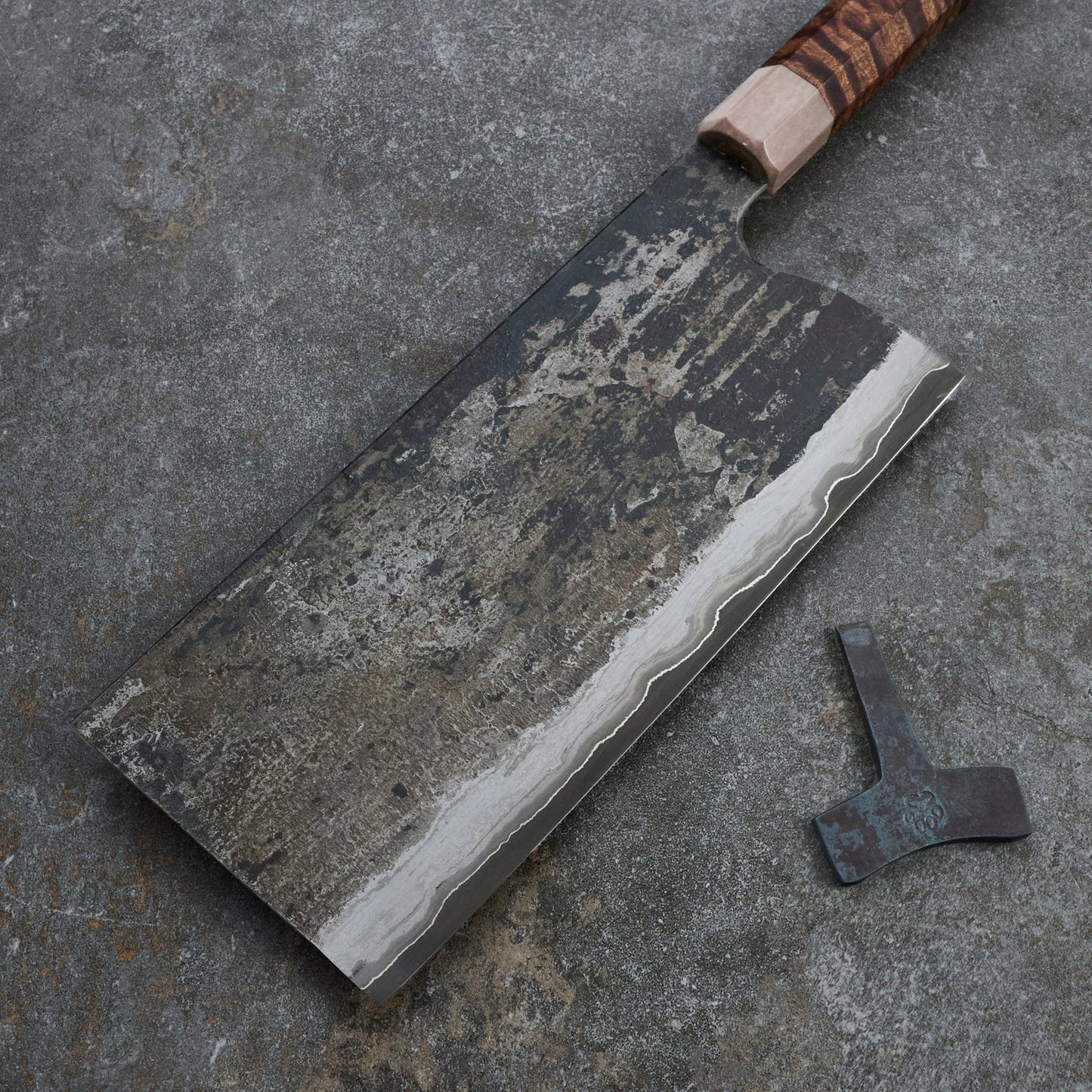
Brook Turner X Isa Smedjan Chinesisches Kochmesser 210 × 100 mm, Blackwood & Horn, Takedown

Brook Turner X Isa Smedjan Chinesisches Kochmesser 210 × 100 mm, Blackwood & Horn, Takedown

By Collaboration


No longer available

Brook Turner

Reserve your place

We'll only email you when there's something to say. Invitations go out in signup order as new work becomes available.

Dieses Gemüsebeil ist eine gelungene Zusammenarbeit zwischen Brook Turner und Jonas Johnsson und wurde für Ästhetik und Leistung entwickelt. Die Klinge wurde von Brook Turner aus 26C3-Stahl geschmiedet, der für seine Schärfe und langlebige Schneide bekannt ist. Dank der 5-lagigen Konstruktion und dem konvexen Schliff schneidet die Klinge mühelos und präzise selbst durch härtestes Gemüse. Die einzigartige Oberfläche – roh geschmiedet, säuregeätzt und satiniert – verschönert nicht nur die Optik, sondern bietet auch zusätzlichen Rostschutz und sorgt so für lange Haltbarkeit.

Ebenso beeindruckend ist der abnehmbare Griff, den Jonas Johnsson aus tasmanischem Blackwood und Hirschgeweih gefertigt hat und der perfekt zur Klinge passt. Sein verdeckter Erl und das abnehmbare Design ermöglichen eine einfache Reinigung und Pflege und bieten gleichzeitig einen komfortablen und ausgewogenen Griff, der sowohl für Links- als auch für Rechtshänder geeignet ist. Das Hackmesser wird mit einem Werkzeug zum Abnehmen des Griffs geliefert, das Jonas aus regionalem Schmiedeeisen handgeschmiedet hat.

Mit einem Gewicht, das die perfekte Balance zwischen Gewicht und Kontrolle bietet, ist dieses Hackmesser für größere Aufgaben geeignet. Ob Sie hacken, schneiden oder würfeln, die außergewöhnliche Schärfe und die robuste Bauweise des Hackmessers sorgen für Freude in der Küche.

Product Specification
  • Blade Type:
  • Overall Length: 367 mm
  • Edge Length: 210mm
  • Spine Heel: 2.31mm
  • Spine Mid: 2.19mm
  • Spine Tip (20mm before): 1.88mm
  • Blade Height: 100mm
  • Weight: 432g
  • Cutting Edge Steel:
  • Steel class: Carbon
  • HRC: 65
  • Blade Construction:
  • Blade Finish: Schmiedeeisen, Säuregeätzt (erzwungene Patina), Satinpolitur
  • Grind:
  • Handle Construction:
  • Handle Materials: Tasmanian Blackwood, Deer Antler
  • Handedness: Beidhändig

Blade type

Chinesisches Kochmesser

Ein hohes, dünn ausgeschliffenes Allzweckmesser — trotz seiner Silhouette kein Knochenhacker. Die breite, rechteckige Klinge ist dünn und rasiermesserscharf ausgeschliffen, gemacht für Schnitte im Druckschnitt und feine Gemüsearbeit; die hohe Klingenfläche dient zugleich als Schaufel, um Geschnittenes vom Brett in die Pfanne zu tragen. In geübten Händen deckt es den Großteil der Küchenarbeit ab.

Der Kompromiss liegt in der Form: Weil es die Silhouette mit dem westlichen Hackbeil teilt, wird es oft für einen schweren Hacker gehalten — die Schneide ist jedoch fein, hart und dünn, Knochen oder Gefrorenes beschädigen sie. Aus der Schulter im kontrollierten Druckschnitt geführt statt aus dem Handgelenk geschwungen, ist es eines der vielseitigsten und angenehmsten Messer auf dem Brett.

View full knife type guide →

Cutting edge steel

26C3

High-carbon, low-alloy fine-grain steel

Typical HRC
63–67
Corrosion class
Carbon
Production
Conventional
Origin
Sweden (Sandvik / Alleima)

26C3 is one of the most quietly important kitchen knife steels of the past decade. Originally engineered by Sandvik as a razor steel — its lineage runs straight to UHB-20C — it carries about 1.25 to 1.30 percent carbon, very low manganese and sulphur, and a small chromium addition to control grain size. The result is a steel that hardens cleanly into the mid-sixties HRC while retaining genuinely useful toughness for its hardness, an unusual combination outside the powder-metallurgy world.

For the cook, 26C3 sharpens the way the best Japanese white papers sharpen — a quick burr that wipes off cleanly, and a polished edge that holds a screaming apex without microchipping. Toughness at 64 HRC is comparable to or better than 52100 at the same hardness in published testing, which is part of why the Larrin-Thomas-and-friends generation of makers gravitated to it; it lets you grind thinner without paying for it later. Like all clean carbons, it patinas willingly and benefits from a wipe between tasks.

26C3 has become something of a default among UK and European bladesmiths who want a no-compromise carbon edge, and it is the chemical parent of SheffCut, which adds a sliver of niobium to refine grain further. Among the makers Modern Cooking carries, Birch & Bevel, Karol Karyś, Jonas Johnsson, Tobias Heldqvist, Brook Turner, and Fredrik Spåre work in 26C3. It is one of the few non-stainless steels you can recommend to a cook coming from VG-10 without apology.

View full steel guide →

Blade construction

Laminated Steel

A category covering knives built from multiple layers of different steels forge-welded together. The hard cutting steel is sandwiched between softer outer layers (cladding) that protect the core, add toughness, and often contribute visual contrast.

The most common laminated constructions in the Modern Cooking catalogue are:

SanMai (三枚) — three layers: hard cutting steel in the centre, softer cladding on both sides. The traditional and most common form.

GoMai (五枚) — five layers: a hard core, two intermediate layers, and two outer layers. Adds visual depth and structural complexity.

KuMai (九枚) — nine layers: similar logic, with more cladding layers for additional pattern and structural variation.

GoMai and KuMai are often chosen not only for the additional layers and visual depth, but also because the intermediate layers can act as a nickel diffusion barrier — limiting carbon migration out of the core into the cladding during forge welding, and protecting the core's intended carbon content through the heat of the forging process.

In all cases the cutting performance is determined by the core steel; the outer layers are cosmetic and structural. The lamination contributes corrosion protection (when a stainless jacket clads a carbon core), reduced reactivity, and the visible boundary between core and cladding that gives the knife its character.

View full construction guide →

Grind

Convex

A grind whose bevel bulges outward in a gentle curve from spine to edge, rather than running flat. That extra steel directly behind the edge makes a convex grind notably strong and resistant to chipping, while the curved geometry helps food release and lets the blade glide through dense ingredients with less wedging than a flat grind.

The strength comes at the cost of ultimate thinness and ease of maintenance. A convex edge has more metal behind it, so it is not quite as effortlessly keen as a thinly flat-ground edge, and it is harder to sharpen freehand — holding the curve takes a stropping technique or a deliberate hand rather than a single fixed angle. The reward is an exceptionally tough, smooth-cutting edge.

View full grind guide →

Handle construction

Takedown

A takedown is a hidden-tang construction built to come apart. The tang passes through the handle and is drawn up by a threaded fitting — a nut at the butt, or a pommel that screws down — so the handle can be dismantled and re-fitted rather than being permanently bonded in place. Everything else follows the hidden-tang pattern: a concealed tang inside a one-piece handle, with no steel showing along the grip.

The point of the design is serviceability. Because the handle is mechanical rather than glued, it can be taken off for thorough cleaning and drying, swapped for a different material or profile, or replaced entirely if it is ever damaged — all without destroying the original fittings. It is the construction to choose for a knife meant to be maintained and kept for the long term, and for owners who like the option of changing a handle later.

View full construction guide →

Shipping & Returns

Shipping

We process orders 5 days a week (Monday - Friday) and ship from our shop in Sydney, Australia. We ship with FedEx, UPS and DHL.

We are happy to offer free international shipping on a variety of orders depending on location and order value.

Free Shipping Regions and Minimum Order Values

For Australia and New Zealand the minimum is $500AUD. For the rest of the world it is approximately €1000EUR. The discount is applied automatically when you reach the minimum cart value at checkout.

Returns

If you're not entirely happy with your purchase, you can return it within 14 days of delivery for a refund. The item must be in its original condition with all original packaging.

  • Returns are accepted for 14 days
  • The customer is responsible for return shipping costs
  • A 15% restocking fee may be applied to change-of-mind returns
  • We do not accept returns on second-hand items for change of mind

Faulty or Damaged Items

You must notify us within 5 business days of receiving your order. Photographic evidence of damage is required. Once approved, Modern Cooking will cover return shipping costs.

Product Care

Cleaning: Clean by hand with warm water. Avoid wetting the handle when possible.

Sharpening: We advise using whetstones to sharpen your knives and a honing rod or steel to maintain the burr between sharpening sessions.

Reactive Steels: Reactive steels like Aogami Super, Apex Ultra or premium reactive German and Swedish steels are susceptible to rust if not properly cared for. Keep the knife dry between uses and when storing for longer periods, wiping the blade with Tsubaki oil or another food-safe oil is a wise choice. A patina can be a beautiful personal feature on your knife and helps to stop rust forming.

Handle Care: For non-stabilised wooden handles, apply Tsubaki oil or another food-safe oil from time to time. Food-safe wax can be applied to both stabilised and non-stabilised wooden handles. Never apply hot wax or oil as you risk warping or damaging the handle.

Vollständige Details anzeigen