Zu Produktinformationen springen
1 von 5

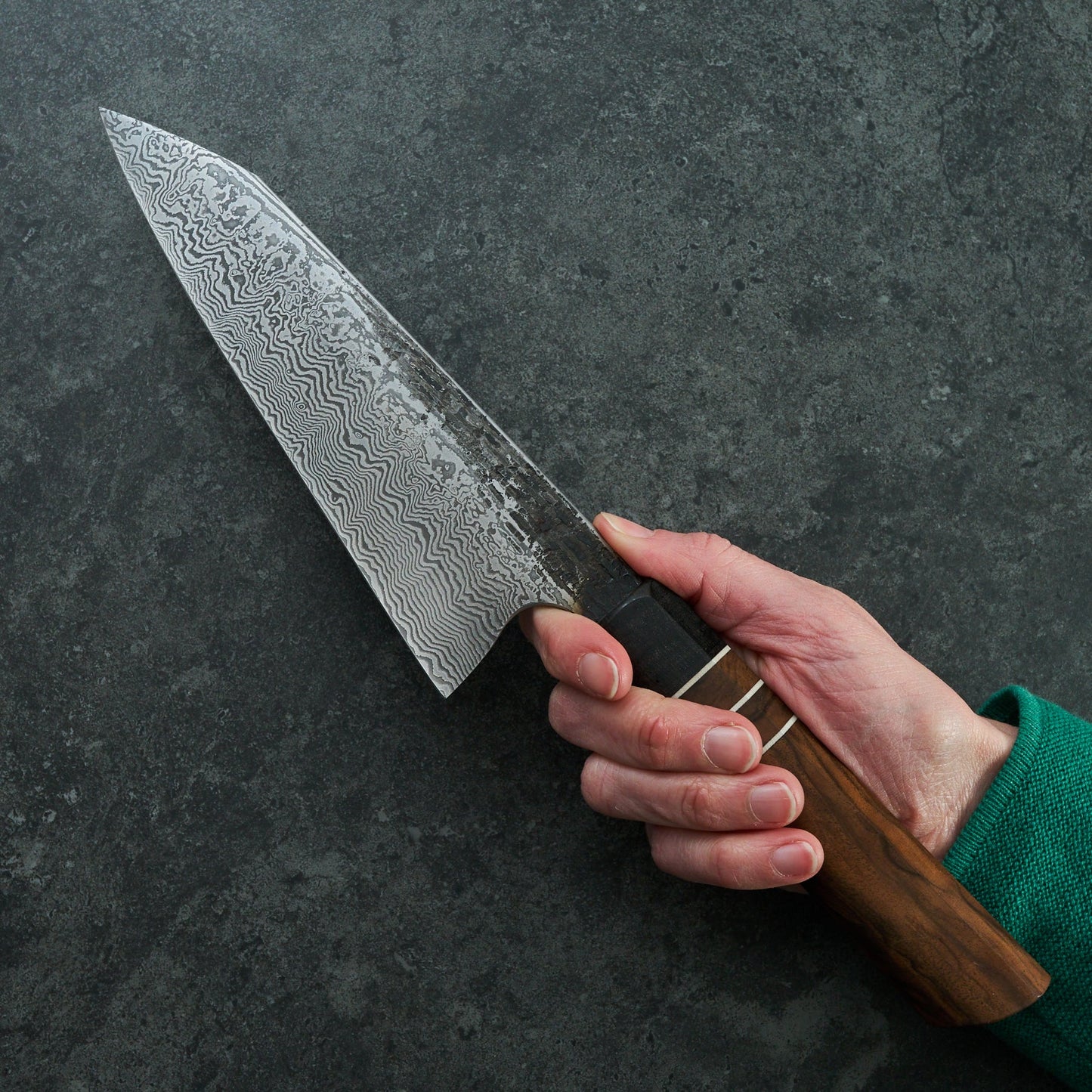
Santoku 180mm 100 Lagen Damast Türkischer Nussbaum

Santoku 180mm 100 Lagen Damast Türkischer Nussbaum

By Martin Huber


Normaler Preis 9.402,01 NOK
Normaler Preis Verkaufspreis 9.402,01 NOK
Sale Ausverkauft
Inkl. Steuern. Versand wird beim Checkout berechnet

Niedriger Lagerbestand: 1 verbleibend

Anzahl

Die mit kompromissloser Liebe zum Detail gefertigten Küchenmesser von Martin Huber stellen den Höhepunkt handwerklicher Klingenherstellung dar. In Zusammenarbeit mit Martin haben wir eine außergewöhnliche Produktreihe geschaffen, die zeitlose Handwerkskunst mit innovativer Stahltechnologie und durchdachtem Design verbindet.

Jedes Messer wird aus hochwertigen Materialien geschmiedet, darunter markanter 50- und 100-lagiger Damaszenerstahl sowie die leistungsstarken wolframlegierten Kohlenstoffstähle 1.2419 und Apex Ultra – Stähle aus deutscher und österreichischer Produktion mit ähnlichen Leistungsmerkmalen wie die japanischen Stähle Blue und Blue Super. Diese Stähle bieten eine unglaubliche Schnitthaltigkeit, eine feine Körnung und die perfekte Balance aus Zähigkeit und Härte – ideal für anspruchsvolle Küchenumgebungen.

Martins Klingen sind bekannt für ihre präzise Geometrie, außergewöhnliche Konizität und perfekt geschliffenen Fasen. Das Ergebnis ist eine hervorragende Balance, müheloses Lösen der Lebensmittel und eine unübertroffene Schneidleistung, die Profis und passionierte Hobbyköche gleichermaßen zu schätzen wissen.

Die Griffe sind ergonomisch geformt und auf Komfort und Kontrolle ausgelegt. Von klassischen Coke-Flaschen-Silhouetten mit durchgehendem Erl und elegant verjüngtem Erl bis hin zu Rokkaku-Hanmaru-Griffen mit verstecktem Erl ist jedes Exemplar eine Studie in Form und Funktion. Die Auswahl der Griffmaterialien ist ebenso außergewöhnlich – mit exotischen Harthölzern wie Tasmanischem Blackwood, Türkischem Nussbaum und Amerikanischem Wüsteneisenholz sowie seltenen Maserknollen, stabilisierter Mooreiche und kunstharzgebundenen Kunststoffen. Viele sind mit hochwertigen Elementen wie TruStone, Messing, Edelstahl, Knochen, Horn und sogar hauseigenem Mokume-gane verziert.

Jedes Martin Huber Messer ist ein Meisterwerk in Passform und Verarbeitung – hier treffen traditionelle Techniken auf moderne Präzision. Das Ergebnis ist ein Werkzeug mit hervorragender Leistung, einem unglaublichen Handgefühl und einer Ästhetik, die ebenso raffiniert ist wie seine Schneide.

Product Specification
  • Blade Type:
  • Overall Length: 330 mm
  • Edge Length: 180mm
  • Spine Heel: 3.48mm
  • Spine Mid: 2.05mm
  • Spine Tip (20mm before): 1mm
  • Blade Height: 56mm
  • Weight: 147g
  • Cutting Edge Steel:
  • Steel class: Carbon
  • HRC: 61
  • Blade Construction:
  • Blade Finish: Säuregeätzt (erzwungene Patina), Brute de Forge, Mattlack
  • Grind:
  • Handle Construction:
  • Handle Materials: Bog Oak, Turkish Walnut
  • Handedness: Beidhändig

Blade type

Santoku

三徳

A shorter, lighter all-purpose knife — usually 165 to 180 mm — built around the same "three virtues" the name describes: meat, fish, and vegetables. The edge is flatter than a gyuto's, with a rounded, sheepsfoot-style tip, favouring a straight up-and-down push cut over a rocking motion. Its compact length and modest height make it easy to control, which has made it the default home-kitchen knife across much of the world.

The santoku trades reach and tip precision for manageability. The flatter profile and shorter blade suit smaller hands, smaller boards, and cooks who chop rather than rock, but those same dimensions limit it on large proteins and tall vegetables where a longer, taller blade does the work more easily. Think of it as a gyuto's more approachable counterpart rather than a replacement.

View full knife type guide →

Cutting edge steel

Damascus

Pattern-welded composite construction (term, not an alloy)

Typical HRC
Determined by core / outer steel
Corrosion class
Varies
Production
Pattern-welded
Origin
Global

“Damascus” is a construction technique rather than a single steel — though that deserves a careful qualification. A damascus billet is built by forge-welding alternating layers of two or more steels — typically a higher- and a lower-carbon partner, or a contrasting-nickel pair — and then folding, twisting, ladder-cutting, or otherwise manipulating the billet to expose the layer interfaces in a pattern. The visual interest comes from the etch, which preferentially attacks one of the steels. A damascus billet is never melted and homogenised into a single chemistry the way a conventional alloy is; but once the layers are forge-welded they are bonded at a molecular level, so for every practical purpose the finished billet behaves as one steel.

For a kitchen knife the relevant question is always: what is the cutting steel? Damascus reaches the edge in two ways. In clad damascus the pattern-welded material is only a decorative jacket wrapped around a separate core — a stainless core such as AEB-L or MagnaCut, or a carbon core such as 26C3 or Apex Ultra — and it is that core, not the jacket, that does the cutting. In full damascus the entire blade is pattern-welded (the more common approach in custom Western work), and the cutting edge is formed by the harder of the laminate’s component steels.

This is one of the points where a customer-facing entry has to be honest: a beautiful damascus pattern is a craft achievement, but it does not on its own tell you how the knife will cut. The cutting steel does that — and a good maker will always list both the pattern and the steel behind the edge.

View full steel guide →

Blade construction

Damascus

Damascus, or pattern-welded steel, is made by forge-welding multiple layers of different alloys together, then manipulating that billet — through folding, twisting, ladder-cutting and similar techniques — to disrupt the layer interfaces and create a distinctive pattern. The pattern is revealed by acid etching, which attacks the alloys at different rates, darkening some layers while leaving others bright.

The result is a single, unified steel. It may be used purely decoratively as an outer cladding layer, or on its own in a solid “mono-Damascus” construction. Because the finished steel is a blend, its hardness and toughness are dictated entirely by the alloys chosen to go into it — which makes steel selection especially important to evaluate in a mono-Damascus knife, where the pattern-welded material forms the cutting edge itself.

You may also encounter “super Damascus,” a name given to pattern-welded steel made from high-performance, high-toughness alloys. These steels are more difficult to forge-weld successfully, and that added challenge is reflected in their value.

View full construction guide →

Grind

Flat

A grind in which the blade tapers in a straight line from the spine down toward the edge, with no curve or hollow in the bevel. The flat grind is the most common geometry on modern double-bevel kitchen knives because it balances cutting performance and durability: thin enough behind the edge to slice well, with enough steel behind it to stay strong.

A true full flat grind, running from spine to edge, is keen but can wedge in dense produce as the food meets the widening blade; many kitchen knives use a partial flat grind that begins lower on the blade to manage that. The flat grind's appeal is its predictability — it sharpens straightforwardly, behaves consistently, and asks nothing unusual of the user.

View full grind guide →

Handle construction

Hidden Tang

A construction in which the tang runs into the handle but stays concealed inside it, rather than showing between two scales. A narrower tang — a full-length stick or a shorter projection — is set into a drilled or burned channel in a one-piece handle and secured with adhesive, a friction fit, or a threaded fitting drawn up against the blade. This is the traditional construction of Japanese wa-handles and many European hidden-tang knives.

The design puts the handle material in charge of the look and feel: a single piece of wood, horn, or composite — often with a ferrule or spacers at the front — is shaped into any cross-section the maker wants, from the classic octagonal and D-shaped wa profiles to fully rounded Western forms. With no steel showing along the grip, the handle can be slim and light, and is frequently made to be removed and replaced, with the balance sitting toward the blade.

View full construction guide →

Shipping & Returns

Shipping

We process orders 5 days a week (Monday - Friday) and ship from our shop in Sydney, Australia. We ship with FedEx, UPS and DHL.

We are happy to offer free international shipping on a variety of orders depending on location and order value.

Free Shipping Regions and Minimum Order Values

For Australia and New Zealand the minimum is $500AUD. For the rest of the world it is approximately €1000EUR. The discount is applied automatically when you reach the minimum cart value at checkout.

Returns

If you're not entirely happy with your purchase, you can return it within 14 days of delivery for a refund. The item must be in its original condition with all original packaging.

  • Returns are accepted for 14 days
  • The customer is responsible for return shipping costs
  • A 15% restocking fee may be applied to change-of-mind returns
  • We do not accept returns on second-hand items for change of mind

Faulty or Damaged Items

You must notify us within 5 business days of receiving your order. Photographic evidence of damage is required. Once approved, Modern Cooking will cover return shipping costs.

Product Care

Cleaning: Clean by hand with warm water. Avoid wetting the handle when possible.

Sharpening: We advise using whetstones to sharpen your knives and a honing rod or steel to maintain the burr between sharpening sessions.

Reactive Steels: Reactive steels like Aogami Super, Apex Ultra or premium reactive German and Swedish steels are susceptible to rust if not properly cared for. Keep the knife dry between uses and when storing for longer periods, wiping the blade with Tsubaki oil or another food-safe oil is a wise choice. A patina can be a beautiful personal feature on your knife and helps to stop rust forming.

Handle Care: For non-stabilised wooden handles, apply Tsubaki oil or another food-safe oil from time to time. Food-safe wax can be applied to both stabilised and non-stabilised wooden handles. Never apply hot wax or oil as you risk warping or damaging the handle.

Vollständige Details anzeigen