Zu Produktinformationen springen
1 von 7

Gyuto 245 mm Mizu Honyaki C105 Spiegel, Tasmanisches Schwarzholz und Ebenholz

Gyuto 245 mm Mizu Honyaki C105 Spiegel, Tasmanisches Schwarzholz und Ebenholz

By Jonas Johnsson


No longer available

Jonas Johnsson

Reserve your place

We'll only email you when there's something to say. Invitations go out in signup order as new work becomes available.

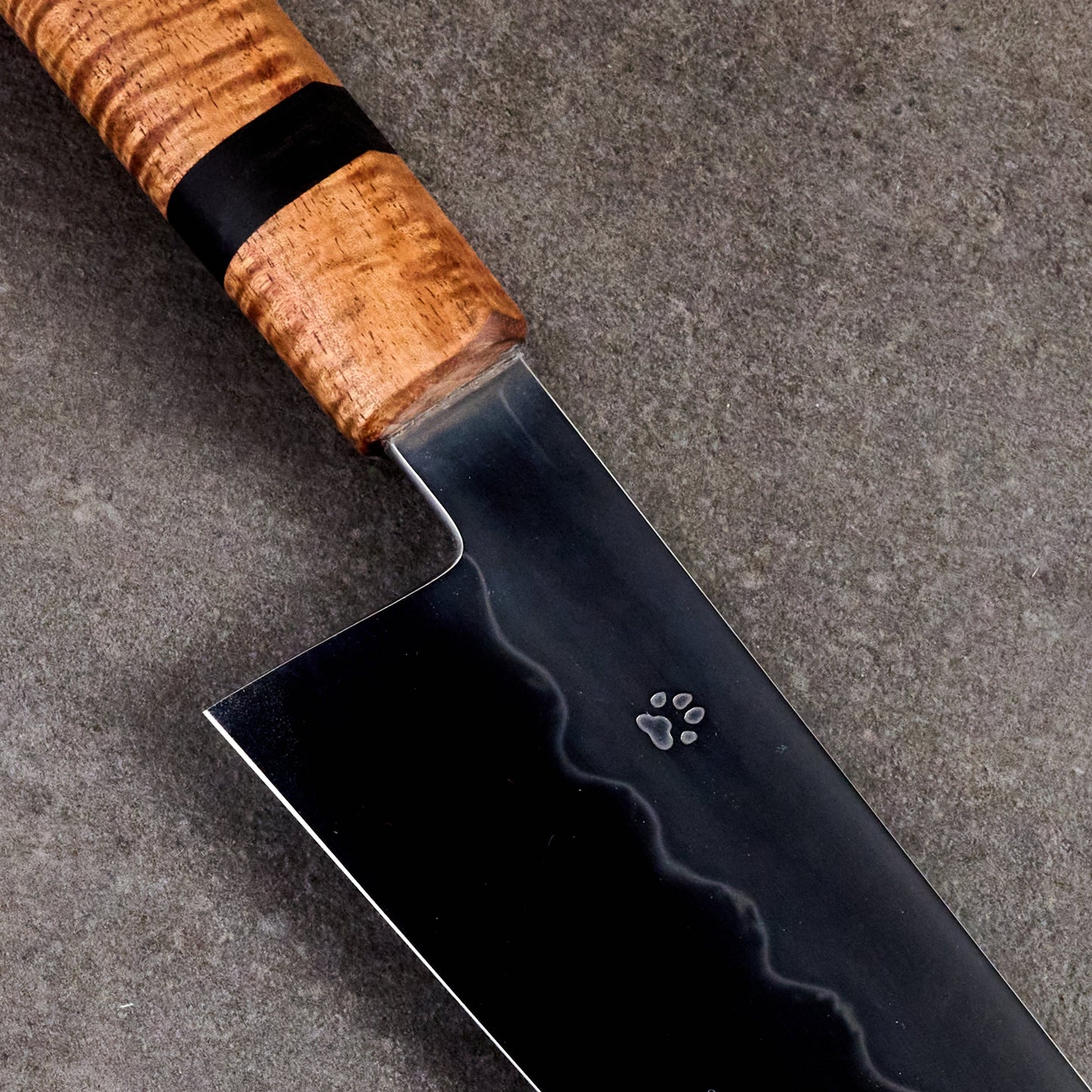
Möglicherweise das unglaublichste Mizu Honyaki, das wir je gesehen haben. Die Leistung ist einfach atemberaubend. Das Profil ist ein klassisches japanisches Gyuto, aber es ist nur ein perfektes Beispiel und zeigt, warum dieses Profil so beliebt ist. Der Kantenradius, ein sanfter Schwung, sorgt für eine perfekte Aktion auf dem Board. Eine feine und gleichmäßige Verjüngung und ein präziser Walkschliff-Schliff. Es wird eine wahre Freude sein, damit zu spielen.

Ästhetisch ist es ein Meisterwerk. Kontrastreich und mit einem Spiegelglanz, der so perfekt ist, dass man ihn nur bewundern kann. Der Hamon ist eine dunstige, neblige Schönheit, die wie eine Wolke in einem spiegelpolierten Himmel sitzt.

Abgerundet wird das Ganze durch einen schlichten und dennoch atemberaubenden Griff aus tasmanischem Blackwood und Ebenholz. Eine wirklich komplementäre Kombination. Das Blackwood zeichnet sich durch eine unglaubliche Maserung voller Ringe und einen sanften Goldton aus.

Jonas Johnsson zeigt uns, warum er Europas Honyaki-König ist – einfach wunderschön!

Product Specification
  • Blade Type:
  • Edge Length: 245mm
  • Spine Heel: 3.16mm
  • Spine Mid: 1.9mm
  • Spine Tip (20mm before): 0.85mm
  • Blade Height: 53.75mm
  • Weight: 173g
  • Cutting Edge Steel:
  • Steel class: Carbon
  • HRC: 65
  • Blade Construction:
  • Blade Finish: Spiegelpolitur
  • Grind:
  • Handle Construction:
  • Handle Materials: Tasmanian Blackwood, Ebony
  • Handedness: Beidhändig

Blade type

Gyuto

牛刀

The gyuto is the Japanese interpretation of the western chef knife, and the most versatile blade in a modern kitchen. It carries a long edge, most often 210 to 270 mm, that runs flatter through the heel than its western counterpart before rising in a gentle, late curve to a fine point — a line that favours push- and pull-cutting while still allowing a rocking motion when the work calls for it. There is enough height at the heel to keep knuckles clear of the board, and the tip is fine enough for detail work, which is why most cooks reach for it first.

The flatter edge is the defining characteristic and the trade-off both. More of the blade lands on the board at once, which suits push cutting and gives clean, decisive contact through an ingredient, but a cook who works primarily by rocking will find less curve to work with than a western profile offers. Modern makers increasingly blur the line between the two, drawing a profile that rocks and push-cuts equally well — Birch & Bevel's Modern Gyuto profile, Antoine Kniamen's Western Gyuto, and Benjamin Kamon's own gyuto profile are all examples of that hybrid thinking.

View full knife type guide →

Cutting edge steel

C105

Plain high-carbon water-hardening tool steel

Typical HRC
62–65
Corrosion class
Carbon
Production
Conventional
Origin
Europe (DIN 1.1545, also C105U)

C105 — sometimes labelled C105U — is the EN-system answer to AISI W1 and Japanese SK3 / SK105: roughly 1.05 percent carbon, no meaningful alloying, water- or oil-quenched. It is the cleanest of the common European carbons short of 125SC, and it has a long history as a file and woodworking tool steel.

In a kitchen knife it runs comfortably at 63–64 HRC with a careful heat treat. The behaviour at the stone is identical in spirit to Shirogami #2 — quick burr, polished apex, easy refinement — and edge retention is similarly modest. Toughness is good for a steel this lean, and the patina behaviour is exactly what you would expect: enthusiastic, attractive once it stabilises, and a reminder to keep a clean tea towel within reach.

You will encounter C105 most often in the work of European bladesmiths who prize a near-pure carbon steel without the cost premium of Lohmann's 125SC, as well as in the better tiers of historic German production where it sometimes still appears under the C105U or "1.1545" name. Among the makers Modern Cooking carries, Jonas Johnsson works in C105.

View full steel guide →

Blade construction

Honyaki

The traditional Japanese single-steel forging technique, in which a high-carbon mono-steel blade is differentially hardened — clay is applied to the spine before quench, leaving only the edge to fully harden. The result is a hard cutting edge and a softer spine that improves toughness, plus the hamon (temper line) that defines the visual signature of the technique.

Honyaki is the high-water mark of Japanese knifemaking. The technique is unforgiving; a failed differential quench cracks the blade. Honyaki knives are almost always from a single high-purity carbon steel — Shirogami #1 is the canonical choice — and are priced and treated accordingly.

View full construction guide →

Grind

Walkschliff

The Kesselscher Walkschliff is a traditional Solingen grind in which each face of the blade curves outward from the spine, reaching its greatest thickness slightly below it before tapering towards the edge. Beneath this pronounced convex “bulge,” the blade is ground exceptionally thin and continues into a fine, subtly convex cutting edge. This distributes material through the upper blade for rigidity and stability while preserving the low cutting resistance of a very thin edge.

Achieving this compound geometry consistently demands considerable control, specialist knowledge and experience, whether it is produced on a traditional grinding wheel or with a belt grinder. Once part of Solingen’s celebrated grinding tradition, the Walkschliff is now practised by relatively few makers. A well-executed example is valued for the way it reconciles qualities that can otherwise seem opposed: strength through the body of the blade, fineness behind the edge and an exceptionally keen, confident cut.

View full grind guide →

Handle construction

Hidden Tang

A construction in which the tang runs into the handle but stays concealed inside it, rather than showing between two scales. A narrower tang — a full-length stick or a shorter projection — is set into a drilled or burned channel in a one-piece handle and secured with adhesive, a friction fit, or a threaded fitting drawn up against the blade. This is the traditional construction of Japanese wa-handles and many European hidden-tang knives.

The design puts the handle material in charge of the look and feel: a single piece of wood, horn, or composite — often with a ferrule or spacers at the front — is shaped into any cross-section the maker wants, from the classic octagonal and D-shaped wa profiles to fully rounded Western forms. With no steel showing along the grip, the handle can be slim and light, and is frequently made to be removed and replaced, with the balance sitting toward the blade.

View full construction guide →

Shipping & Returns

Shipping

We process orders 5 days a week (Monday - Friday) and ship from our shop in Sydney, Australia. We ship with FedEx, UPS and DHL.

We are happy to offer free international shipping on a variety of orders depending on location and order value.

Free Shipping Regions and Minimum Order Values

For Australia and New Zealand the minimum is $500AUD. For the rest of the world it is approximately €1000EUR. The discount is applied automatically when you reach the minimum cart value at checkout.

Returns

If you're not entirely happy with your purchase, you can return it within 14 days of delivery for a refund. The item must be in its original condition with all original packaging.

  • Returns are accepted for 14 days
  • The customer is responsible for return shipping costs
  • A 15% restocking fee may be applied to change-of-mind returns
  • We do not accept returns on second-hand items for change of mind

Faulty or Damaged Items

You must notify us within 5 business days of receiving your order. Photographic evidence of damage is required. Once approved, Modern Cooking will cover return shipping costs.

Product Care

Cleaning: Clean by hand with warm water. Avoid wetting the handle when possible.

Sharpening: We advise using whetstones to sharpen your knives and a honing rod or steel to maintain the burr between sharpening sessions.

Reactive Steels: Reactive steels like Aogami Super, Apex Ultra or premium reactive German and Swedish steels are susceptible to rust if not properly cared for. Keep the knife dry between uses and when storing for longer periods, wiping the blade with Tsubaki oil or another food-safe oil is a wise choice. A patina can be a beautiful personal feature on your knife and helps to stop rust forming.

Handle Care: For non-stabilised wooden handles, apply Tsubaki oil or another food-safe oil from time to time. Food-safe wax can be applied to both stabilised and non-stabilised wooden handles. Never apply hot wax or oil as you risk warping or damaging the handle.

Vollständige Details anzeigen