Skip to product information
1 of 6

Sujihiki 270mm B1D Aogami #1 Damascus Clad Cherry & Oak

Sujihiki 270mm B1D Aogami #1 Damascus Clad Cherry & Oak

By Hado Knives


Regular price $1,095.00 SGD
Regular price Sale price $1,095.00 SGD
Sale Sold out
Taxes included. Shipping calculated at checkout.

Out of stock

Quantity

Forged in Sakai, Japan by master blacksmith Yoshikazu Tanaka, the core steel on this HADO Sumi B1D Sujihiki 270mm is a custom-forged San Mai laminate featuring Aogami #1, clad in a subtly refined yet beautifully finished Damascus. Aogami steel offers exceptional edge retention, sharpness, and toughness, making it an outstanding choice for precision slicing.

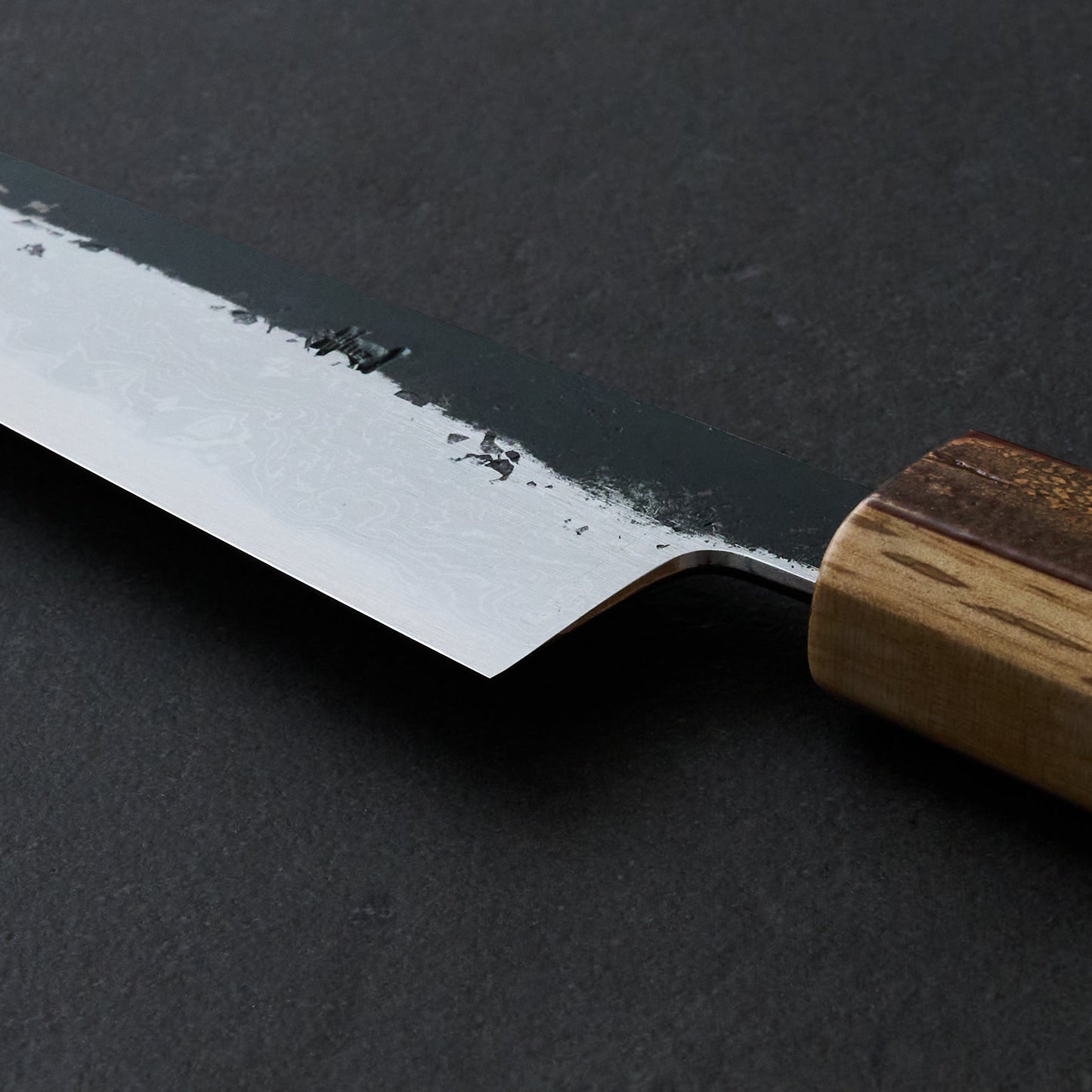
This Sujihiki from HADO features a sleek, streamlined profile optimized for effortless slicing. Ground and sharpened by HADO Knives’ Tadataka Maruyama, the spine maintains a consistent thickness, beautifully polished up until the primary bevel. From there, it tapers rapidly towards the tip, providing excellent balance and control. A wide bevel, flat-ground blade, these knives are exceptionally sharp and thin behind the edge. A slight flex when pressing your fingernail against the edge highlights just how finely ground and keen these knives are.

Designed for precision and finesse, the sujihiki excels in slicing proteins with minimal resistance, ensuring ultra-clean cuts. With its fine, razor-sharp edge, it glides effortlessly through fish, meats, and other delicate ingredients.

Elegant in every aspect, the Sumi B1D series showcases a striking contrast of dark black Kurouchi, subtly etched Damascus, and satin-polished bevels. The handle is a stunning and unique combination of cherry bark and oak, finished with a thick, durable lacquer clear coat.

As the latest addition to HADO Knives' exceptional lineup of Sakai-made premium kitchen knives, the Sumi B1D Sujihiki 270mm is a remarkable fusion of craftsmanship, performance, and aesthetics.

Product Specification
  • Blade Type:
  • Overall Length: 420mm
  • Edge Length: 270mm
  • Spine Heel: 2.47mm
  • Spine Mid: 2.55mm
  • Spine Tip (20mm before): 1.58mm
  • Blade Height: 39mm
  • Weight: 166g
  • Cutting Edge Steel:
  • Steel class: Carbon
  • HRC: 65
  • Blade Construction:
  • Blade Finish: KurouchiAcid Etched (Forced Patina)Satin Polish
  • Grind:
  • Handle Construction:
  • Handle Materials: Oak, Cherry Bark
  • Handedness: Ambidextrous

Blade type

Sujihiki

筋引

A long, slender slicing knife — typically 240 to 300 mm — and the Japanese equivalent of a Western carving knife. The narrow blade and long, straight edge are built to part cooked and raw proteins in a single smooth draw, producing clean slices with minimal sawing and minimal tearing of the surface. Height is kept low so the blade tracks straight through the cut.

A sujihiki is a specialist, and a worthwhile one for anyone who carves roasts, portions fish, or slices proteins regularly. Its length and narrowness make it poor for general board work and chopping, so it lives alongside a chef's knife rather than instead of one. The reward for that dedicated slot is slices a shorter, taller knife simply cannot match.

View full knife type guide →

Cutting edge steel

Aogami #1

High-carbon tungsten-chromium steel

Typical HRC
62–66
Corrosion class
Carbon
Production
Conventional
Origin
Japan (Hitachi YSS / Proterial)

Aogami #1 — Blue Paper #1 — is the higher-carbon sibling of Aogami #2 and the closest blue-paper relative of Shirogami #1. About 1.30 percent carbon, half a percent of chromium, and one and a half percent tungsten put it in a sweet spot: meaningfully better edge retention than the white papers, without the carbide load of Aogami Super.

The cook's experience with Blue #1 is one of balance. It hardens to 63–64 HRC in good hands, sharpens almost as cleanly as a white paper, and holds a refined edge longer because the W- and Cr-bearing carbides resist abrasion. Toughness is modest — these are still high-carbon steels with limited alloy modification — but the steel is well-behaved at the apex and the patina develops more slowly than on a white.

It is less common than Blue #2 or Blue Super in the current market but well loved by knowledgeable users who want the "blue feel" without giving up too much keenness. Look for it in the work of more traditional smiths who run honyaki and clad constructions where the steel's grain refinement can be shown off. Among the makers Modern Cooking carries, Hado Knives works in Aogami #1.

View full steel guide →

Blade construction

Laminated Steel

A category covering knives built from multiple layers of different steels forge-welded together. The hard cutting steel is sandwiched between softer outer layers (cladding) that protect the core, add toughness, and often contribute visual contrast.

The most common laminated constructions in the Modern Cooking catalogue are:

SanMai (三枚) — three layers: hard cutting steel in the centre, softer cladding on both sides. The traditional and most common form.

GoMai (五枚) — five layers: a hard core, two intermediate layers, and two outer layers. Adds visual depth and structural complexity.

KuMai (九枚) — nine layers: similar logic, with more cladding layers for additional pattern and structural variation.

GoMai and KuMai are often chosen not only for the additional layers and visual depth, but also because the intermediate layers can act as a nickel diffusion barrier — limiting carbon migration out of the core into the cladding during forge welding, and protecting the core's intended carbon content through the heat of the forging process.

In all cases the cutting performance is determined by the core steel; the outer layers are cosmetic and structural. The lamination contributes corrosion protection (when a stainless jacket clads a carbon core), reduced reactivity, and the visible boundary between core and cladding that gives the knife its character.

View full construction guide →

Grind

Flat

A grind in which the blade tapers in a straight line from the spine down toward the edge, with no curve or hollow in the bevel. The flat grind is the most common geometry on modern double-bevel kitchen knives because it balances cutting performance and durability: thin enough behind the edge to slice well, with enough steel behind it to stay strong.

A true full flat grind, running from spine to edge, is keen but can wedge in dense produce as the food meets the widening blade; many kitchen knives use a partial flat grind that begins lower on the blade to manage that. The flat grind's appeal is its predictability — it sharpens straightforwardly, behaves consistently, and asks nothing unusual of the user.

View full grind guide →

Handle construction

Hidden Tang

A construction in which the tang runs into the handle but stays concealed inside it, rather than showing between two scales. A narrower tang — a full-length stick or a shorter projection — is set into a drilled or burned channel in a one-piece handle and secured with adhesive, a friction fit, or a threaded fitting drawn up against the blade. This is the traditional construction of Japanese wa-handles and many European hidden-tang knives.

The design puts the handle material in charge of the look and feel: a single piece of wood, horn, or composite — often with a ferrule or spacers at the front — is shaped into any cross-section the maker wants, from the classic octagonal and D-shaped wa profiles to fully rounded Western forms. With no steel showing along the grip, the handle can be slim and light, and is frequently made to be removed and replaced, with the balance sitting toward the blade.

View full construction guide →

Shipping & Returns

Shipping

We process orders 5 days a week (Monday - Friday) and ship from our shop in Sydney, Australia. We ship with FedEx, UPS and DHL.

We are happy to offer free international shipping on a variety of orders depending on location and order value.

Free Shipping Regions and Minimum Order Values

For Australia and New Zealand the minimum is $500AUD. For the rest of the world it is approximately €1000EUR. The discount is applied automatically when you reach the minimum cart value at checkout.

Returns

If you're not entirely happy with your purchase, you can return it within 14 days of delivery for a refund. The item must be in its original condition with all original packaging.

  • Returns are accepted for 14 days
  • The customer is responsible for return shipping costs
  • A 15% restocking fee may be applied to change-of-mind returns
  • We do not accept returns on second-hand items for change of mind

Faulty or Damaged Items

You must notify us within 5 business days of receiving your order. Photographic evidence of damage is required. Once approved, Modern Cooking will cover return shipping costs.

Product Care

Cleaning: Clean by hand with warm water. Avoid wetting the handle when possible.

Sharpening: We advise using whetstones to sharpen your knives and a honing rod or steel to maintain the burr between sharpening sessions.

Reactive Steels: Reactive steels like Aogami Super, Apex Ultra or premium reactive German and Swedish steels are susceptible to rust if not properly cared for. Keep the knife dry between uses and when storing for longer periods, wiping the blade with Tsubaki oil or another food-safe oil is a wise choice. A patina can be a beautiful personal feature on your knife and helps to stop rust forming.

Handle Care: For non-stabilised wooden handles, apply Tsubaki oil or another food-safe oil from time to time. Food-safe wax can be applied to both stabilised and non-stabilised wooden handles. Never apply hot wax or oil as you risk warping or damaging the handle.

View full details