Mizuno Tanrenjo X Jonas Johnsson 5 Piece Honyaki Collection
Mizuno Tanrenjo X Jonas Johnsson 5 Piece Honyaki Collection
By PRE-OWNED
Low stock: 1 left
Our Sydney workshop is closed until Monday 9 November. Orders placed now are very welcome and will ship in the order received from Tuesday 10 November. Shipping details
Couldn't load pickup availability
This custom collection has been produced as part of a collaboration between Modern Cooking, Mizuno Tanrenjo, and Jonas Johnsson. The collection was commissioned by a local European Michelin stared chef.
The set features custom handles and sayas produced in Sweden by Jonas Johnsson. As Europe’s preeminent honyaki master we wanted to put these two master craftsman together with the goal of producing a truly unique set of masterpieces.
Established in 1872, Mizuno Tanrenjo is one of Japan’s most prestigious workshops. Over 5 generations of Mizuno blacksmiths have trained with Japan’s best knife and sword smiths to establish a name that is considered one of the best around.
Current master Jun Mizuno is a recognized master sword smith. His superior craftsmanship and extraordinary honyaki katana works have been recognized by two of Japan’s top Ichinomiyas (shrines) which have commissioned his katana as part of their permanent collections — an extraordinary accolade and recognition of Jun Mizuno's skill as a blacksmith.
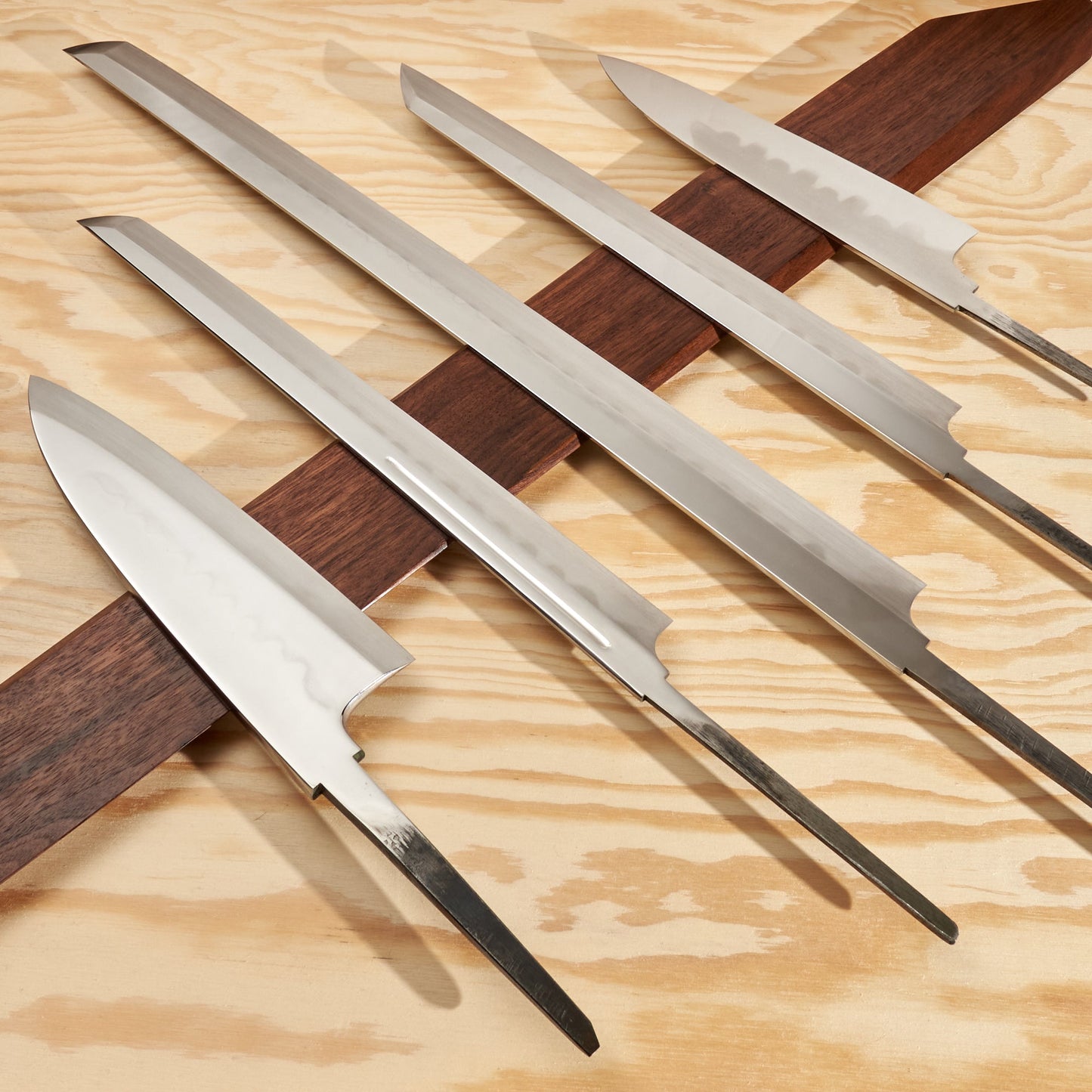
These five culinary knives are forged in Shirogami #3 steel, steel known for its purity and traditionally used in the production of classic Japanese Honyaki. The set includes a 240mm Gyuto , a 240mm Deba, a 360mm Shinnomune, a 360mm K-Tip Yanagiba and a very impressive 540mm Magurokiri.
Its a true honour to be working with such amazingly talented craftsmen and to be given the chance to produce such an amazing collection of knives. The knives are a stunning example of traditional craftsmanship, and they are surely a unique and historic set.
CONDITION: New, never used (Modern Cooking Verified)
Product Specification
- Edge Length: 240mm - 560mm
- Cutting Edge Steel:
- Steel class: Carbon
- HRC: 65
- Blade Construction:
- Blade Finish: Mirror Polish
- Grind:
- Handle Construction:
- Handle Materials: Stacked Birch Bark, Brass, Stainless Steel
- Handedness: Ambidextrous
- Saya / Storage Included: Yes
Shipping & Returns
Shipping & Returns
Shipping
We process orders Monday to Friday from our Sydney workshop. Australian orders are shipped with Australia Post and international orders with DHL Express. Shipping charges are calculated at checkout based on destination, shipment size and weight, and the carrier service available for the order.
Returns
If you're not entirely happy with your purchase, you can return it within 14 days of delivery for a refund. The item must be in its original condition with all original packaging.
- Returns are accepted for 14 days
- The customer is responsible for return shipping costs
- A 15% restocking fee may be applied to change-of-mind returns
- We do not accept returns on second-hand items for change of mind
Faulty or Damaged Items
You must notify us within 5 business days of receiving your order. Photographic evidence of damage is required. Once approved, Modern Cooking will cover return shipping costs.
Product Care
Product Care
Cleaning: Clean by hand with warm water. Avoid wetting the handle when possible.
Sharpening: We advise using whetstones to sharpen your knives and a honing rod or steel to maintain the burr between sharpening sessions.
Reactive Steels: Reactive steels like Aogami Super, Apex Ultra or premium reactive German and Swedish steels are susceptible to rust if not properly cared for. Keep the knife dry between uses and when storing for longer periods, wiping the blade with Tsubaki oil or another food-safe oil is a wise choice. A patina can be a beautiful personal feature on your knife and helps to stop rust forming.
Handle Care: For non-stabilised wooden handles, apply Tsubaki oil or another food-safe oil from time to time. Food-safe wax can be applied to both stabilised and non-stabilised wooden handles. Never apply hot wax or oil as you risk warping or damaging the handle.