Skip to product information
1 of 7

Gyuto 220mm Tanto Stainless 14C28N

Gyuto 220mm Tanto Stainless 14C28N

By Oliver Märtens


No longer available

Oliver Märtens

Reserve your place

We'll only email you when there's something to say. Invitations go out in signup order as new work becomes available.

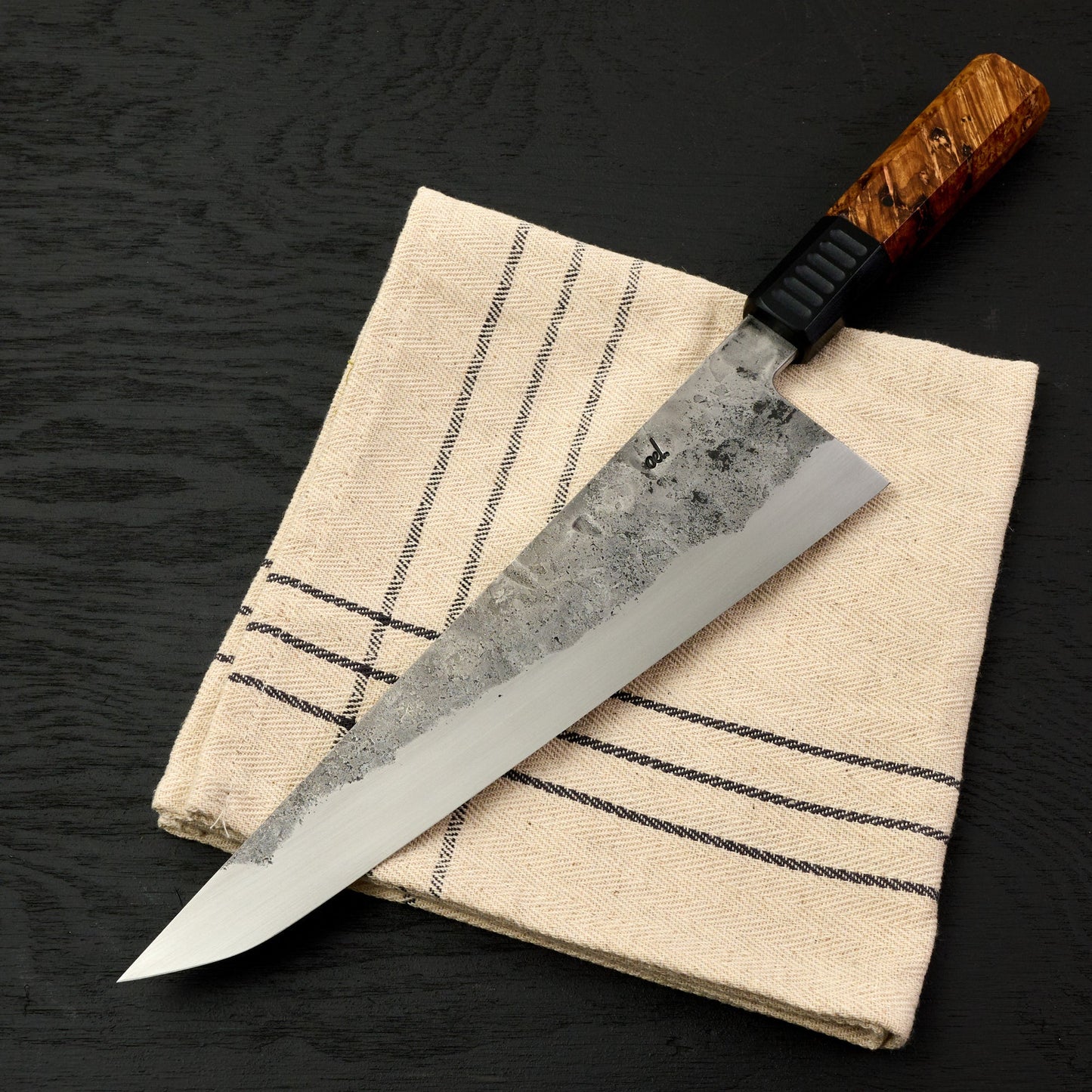
Razor sharp! As I run the blade edge across my fingernail you can see it flex in the light. Oliver Märtens flexing? I have discussed in detail the quality of Oliver’s design and honestly if you are reading this text, I assume it was the photos of this beautiful piece that caught your attention. Its stunning, you won’t get any arguments from me.

The iconic octagonal Oel handle is stunning in stabilized Norwegian Maple, the figure is just incredible. Oliver’s tasteful design, the beautiful timber paired with the black G10 bolster and the classic, brushed, brute de forge finish on the blade. Honestly, what’s not to like. 

So, let’s talk about the performance a little. This is not a classic profile and Märtens is not known for doing traditional Japanese style profiles. His designs feature iconic profiles that are more aggressive and angular in style. With that said the ergonomics are there and the edge profiles are exactly how you want them to be. This tanto tipped blade is a push cutting machine and the ultra-thin edge and aggressively tapered spine give this knife some serious slicing chops! Speaking of chops, the relatively flat edge profile is perfect for a chopping action. Thin, sharp, nicely tapered, balanced and ergonomic, I think we have ticked all the boxes.

This piece is forged in premium 14C28N stainless steel, it’s hard, and it’s tough and it takes a great edge. With heirloom design and premium performance, we think Oliver’s work speaks for itself. Take it from us, you won’t be disappointed.

Product Specification
  • Blade Type:
  • Edge Length: 220mm
  • Spine Heel: 3.89mm
  • Spine Mid: 1.71mm
  • Spine Tip (20mm before): 0.99mm
  • Blade Height: 58.16mm
  • Weight: 171g
  • Cutting Edge Steel:
  • Steel class: Stainless
  • HRC: 63
  • Blade Construction:
  • Blade Finish: Brut de Forge, Brushed, Satin Polish
  • Grind:
  • Handle Construction:
  • Handle Materials: Stabilised Norway Maple, Black G10
  • Handedness: Ambidextrous

Blade type

Gyuto

牛刀

The gyuto is the Japanese interpretation of the western chef knife, and the most versatile blade in a modern kitchen. It carries a long edge, most often 210 to 270 mm, that runs flatter through the heel than its western counterpart before rising in a gentle, late curve to a fine point — a line that favours push- and pull-cutting while still allowing a rocking motion when the work calls for it. There is enough height at the heel to keep knuckles clear of the board, and the tip is fine enough for detail work, which is why most cooks reach for it first.

The flatter edge is the defining characteristic and the trade-off both. More of the blade lands on the board at once, which suits push cutting and gives clean, decisive contact through an ingredient, but a cook who works primarily by rocking will find less curve to work with than a western profile offers. Modern makers increasingly blur the line between the two, drawing a profile that rocks and push-cuts equally well — Birch & Bevel's Modern Gyuto profile, Antoine Kniamen's Western Gyuto, and Benjamin Kamon's own gyuto profile are all examples of that hybrid thinking.

View full knife type guide →

Cutting edge steel

14C28N

Fine-grain martensitic stainless steel

Typical HRC
59–62
Corrosion class
Stainless
Production
Conventional
Origin
Sweden (Sandvik / Alleima)

14C28N is Sandvik's modernised, nitrogen-enriched evolution of AEB-L. About 0.62 percent carbon, 14 percent chromium, and a small but deliberate nitrogen addition give it slightly better corrosion resistance than its predecessor while preserving the very fine grain structure that makes the family famous.

For a kitchen knife at the working-cook end of the price range — Wüsthof Classic Ikon, Opinel, the Kramer Henckels lines — 14C28N is one of the best stainless steels available. It runs at 60 HRC, sharpens almost as cleanly as a clean carbon, holds an edge competitively for its hardness, and behaves at the apex like a steel that was designed by people who understood exactly what they were after. Toughness at 60 HRC is excellent, comparable to AEB-L and well above most of the older 440-series stainlesses.

If a customer wants a stainless workhorse from a production kitchen knife, 14C28N is a genuine recommendation rather than a polite one. Among the makers Modern Cooking carries, Oliver Märtens works in 14C28N. It is the modern face of fine-grain stainless and a worthy peer to the better entries in the Japanese stainless lineup.

View full steel guide →

Blade construction

Mono Steel

A knife forged from a single piece of steel — no laminations, no clad layers. The simplest and most direct construction. The entire blade is the cutting steel, with no softer outer jacket to protect or contrast it. Most contemporary Western kitchen knives in carbon and stainless steel are mono-steel constructions, as are honyaki and most European bladesmith work.

The trade-off is straightforward: mono-steel knives are easier to forge, sharpen, and reason about, but the entire blade carries the cutting steel's properties — including its reactivity if it's a clean carbon. There is no soft jacket to protect a more brittle core from impact, so the heat treatment and geometry have to do all the work.

View full construction guide →

Grind

Convex

A grind whose faces curve outward in a continuous arc rather than falling in a straight line. The practical consequence is that it has no shoulder — no abrupt step where a bevel meets the blade face. Food release improves for the same reason: a curved face touches the cut surface along a narrow band instead of a full flat plane, so slices break away rather than clinging. Drag behaves differently too. A convex blade carries more steel than a flat grind of the same spine thickness, so it is not the lowest-drag geometry available, but the resistance it does create builds smoothly through the cut instead of arriving all at once as the food meets a bevel transition. The feel is progressive rather than sudden.

The curve also supports the edge. Steel thickens quickly behind the apex, which raises edge stability at a given sharpening angle — the apex is less prone to rolling or chipping under lateral load. How much of that you get depends on where the convexity sits. A face can be curved the whole way from spine to edge, or the curve can be confined to the last millimetre or two as a convex "appleseed" edge on an otherwise flat blade. The first shapes how the knife moves through food; the second is felt almost entirely at the edge.

View full grind guide →

Handle construction

Hidden Tang

A construction in which the tang runs into the handle but stays concealed inside it, rather than showing between two scales. A narrower tang — a full-length stick or a shorter projection — is set into a drilled or burned channel in a one-piece handle and secured with adhesive, a friction fit, or a threaded fitting drawn up against the blade. This is the traditional construction of Japanese wa-handles and many European hidden-tang knives.

The design puts the handle material in charge of the look and feel: a single piece of wood, horn, or composite — often with a ferrule or spacers at the front — is shaped into any cross-section the maker wants, from the classic octagonal and D-shaped wa profiles to fully rounded Western forms. With no steel showing along the grip, the handle can be slim and light, and is frequently made to be removed and replaced, with the balance sitting toward the blade.

View full construction guide →

Shipping & Returns

Shipping

We process orders 5 days a week (Monday - Friday) and ship from our shop in Sydney, Australia. We ship with FedEx, UPS and DHL.

We are happy to offer free international shipping on a variety of orders depending on location and order value.

Free Shipping Regions and Minimum Order Values

For Australia and New Zealand the minimum is $500AUD. For the rest of the world it is approximately €1000EUR. The discount is applied automatically when you reach the minimum cart value at checkout.

Returns

If you're not entirely happy with your purchase, you can return it within 14 days of delivery for a refund. The item must be in its original condition with all original packaging.

  • Returns are accepted for 14 days
  • The customer is responsible for return shipping costs
  • A 15% restocking fee may be applied to change-of-mind returns
  • We do not accept returns on second-hand items for change of mind

Faulty or Damaged Items

You must notify us within 5 business days of receiving your order. Photographic evidence of damage is required. Once approved, Modern Cooking will cover return shipping costs.

Product Care

Cleaning: Clean by hand with warm water. Avoid wetting the handle when possible.

Sharpening: We advise using whetstones to sharpen your knives and a honing rod or steel to maintain the burr between sharpening sessions.

Reactive Steels: Reactive steels like Aogami Super, Apex Ultra or premium reactive German and Swedish steels are susceptible to rust if not properly cared for. Keep the knife dry between uses and when storing for longer periods, wiping the blade with Tsubaki oil or another food-safe oil is a wise choice. A patina can be a beautiful personal feature on your knife and helps to stop rust forming.

Handle Care: For non-stabilised wooden handles, apply Tsubaki oil or another food-safe oil from time to time. Food-safe wax can be applied to both stabilised and non-stabilised wooden handles. Never apply hot wax or oil as you risk warping or damaging the handle.

View full details