Skip to product information
1 of 6

Cleaver 175mm Wrought Iron Clad Aogami #2 Water Quenched

Cleaver 175mm Wrought Iron Clad Aogami #2 Water Quenched

By Isasmedjan


No longer available

Jonas Johnsson

Reserve your place

We'll only email you when there's something to say. Invitations go out in signup order as new work becomes available.

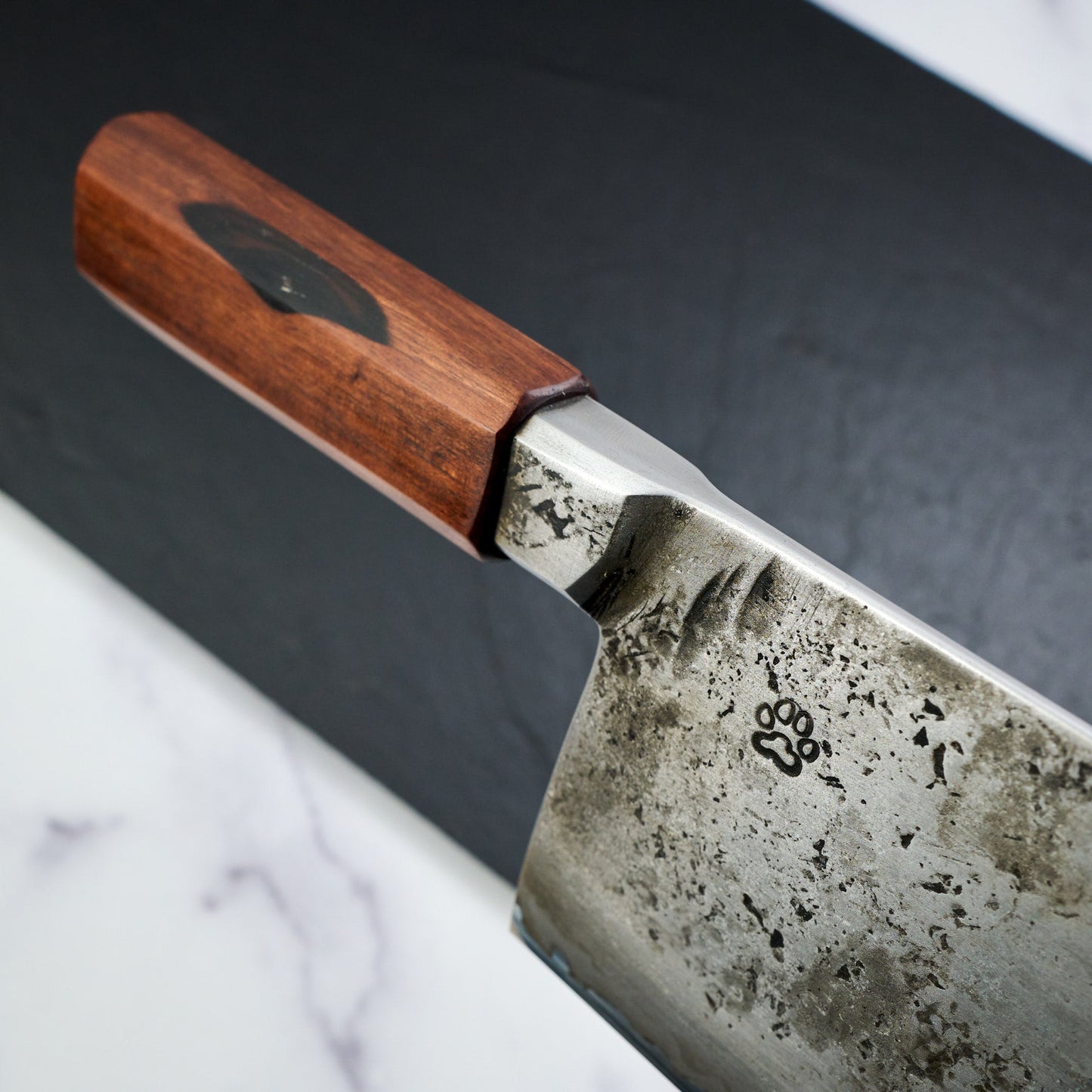
A nimble vegetable cleaver from Swedish blacksmith Jonas Johnsson with a tough, water quenched cutting edge in Aogami #2 steel.

Cleavers always present a challenge to the bladesmith due to the broad surface area of the blade and the addition of water quenching makes this one something special. Water quenching gives the steel additional hardness but comes with higher risks than a typical oil quench, making this another example of why Jonas is such a talented craftsman.

Clad in wrought iron and with a forged integral bolster it is as though Jonas was showing off a little with this one. The blade is finished with a lovely mirror stone polish on the zero ground bevels. The result is a razor-sharp blade full of contrast.

The knife is fitted with an ebony stumpy octagonal grip. It feels balanced and ergonomic in the hand and has fine taper. Another beautiful piece of work from Jonas.

Product Specification
  • Blade Type:
  • Edge Length: 175mm
  • Spine Heel: 3.65mm
  • Spine Mid: 1.65mm
  • Spine Tip (20mm before): 1.27mm
  • Blade Height: 81mm
  • Weight: 276g
  • Cutting Edge Steel:
  • Steel class: Carbon
  • HRC: 65
  • Blade Construction:
  • Blade Finish: Mirror Polish
  • Grind:
  • Handle Construction:
  • Handle Materials: Ebony
  • Handedness: Ambidextrous

Blade type

Cleaver

A broad, heavy, rectangular blade — and a term that covers two very different tools. The heavy Western butcher's cleaver is built with a thick spine and robust edge to chop through bone and joints; the lighter Chinese vegetable cleaver (càidāo) has a tall, thin blade that is a surprisingly nimble all-purpose knife, with a wide face useful for scooping. Knowing which one is meant matters.

A true butcher's cleaver trades all finesse for the mass and durability needed to split bone, and it has little place in delicate work. The Chinese vegetable version is far more versatile than its size suggests but is not built for bone at all, despite the shared silhouette. The shape promises power; the specific knife determines whether that power comes with any subtlety.

View full knife type guide →

Cutting edge steel

Aogami #2

High-carbon tungsten-chromium steel

Typical HRC
61–64
Corrosion class
Carbon
Production
Conventional
Origin
Japan (Hitachi YSS / Proterial)

Aogami #2 — Blue Paper #2 — is the most widely encountered of the blue-paper steels and the one most cooks meet first. About 1.10 percent carbon plus half a percent each of chromium and tungsten is enough to noticeably extend edge retention over the white papers without dramatically changing how the steel feels at the stone.

In a typical clad gyuto or santoku the steel runs at 61–63 HRC, sharpens cleanly on most synthetic stones, and produces a reliable, hard-wearing edge. Toughness is good for the hardness — the lower carbon content compared to Blue #1 helps here — and the patina develops at a moderate, manageable pace. It is genuinely a workhorse: forgiving of slightly imperfect technique, tolerant of a wider range of foods, and broadly available across price points.

Among makers, Aogami #2 is the default blue paper for everyday clad knives, found across the bulk of the Sakai and Tosa traditions' working-cook offerings. Among the makers Modern Cooking carries, Katsushige Anryu and Jonas Johnsson work in Aogami #2. It is perhaps the steel that best illustrates Hitachi's philosophy: clean composition, predictable behaviour, ample room for the smith to leave a fingerprint.

View full steel guide →

Blade construction

Laminated Steel

A category covering knives built from multiple layers of different steels forge-welded together. The hard cutting steel is sandwiched between softer outer layers (cladding) that protect the core, add toughness, and often contribute visual contrast.

The most common laminated constructions in the Modern Cooking catalogue are:

SanMai (三枚) — three layers: hard cutting steel in the centre, softer cladding on both sides. The traditional and most common form.

GoMai (五枚) — five layers: a hard core, two intermediate layers, and two outer layers. Adds visual depth and structural complexity.

KuMai (九枚) — nine layers: similar logic, with more cladding layers for additional pattern and structural variation.

GoMai and KuMai are often chosen not only for the additional layers and visual depth, but also because the intermediate layers can act as a nickel diffusion barrier — limiting carbon migration out of the core into the cladding during forge welding, and protecting the core's intended carbon content through the heat of the forging process.

In all cases the cutting performance is determined by the core steel; the outer layers are cosmetic and structural. The lamination contributes corrosion protection (when a stainless jacket clads a carbon core), reduced reactivity, and the visible boundary between core and cladding that gives the knife its character.

View full construction guide →

Grind

Walkschliff

A traditional Solingen grind — also called a kettle or kessel bulge grind — in which the blade is hollowed high on the side so its thickest point sits a little below the spine rather than at it. Below that bulge the steel is taken down to an extremely thin, finely convexed cutting edge, combining the rigidity of a thick upper blade with the keenness of a very thin one.

The Walkschliff is among the most demanding grinds to execute, historically reserved for the finest German knives and requiring years of a grinder's experience to do well. For the buyer it is a high-craft European alternative to the thin flat grinds of Japanese knives — strong, stable, and keen — but it is a hand-ground specialism, and a knife that carries it is priced for the skill it took to make.

View full grind guide →

Handle construction

Integral

A construction in which the bolster — and, in a full integral, a frame around the handle as well — is formed from the same single piece of steel as the blade rather than added as a separate part. The bolster and blade are continuous metal, forged or machined from one billet so there is no seam between them, with the tang carrying the handle material behind the integral section.

The design announces itself at the transition from blade to handle: a seamless steel bolster, and on a frame integral a steel surround bordering the handle material on every side. That unbroken metal gives a distinctive, resolved look and a forward, substantial feel, and removes the joint where a fitted bolster would otherwise meet the blade. It is a hallmark of high-end Western knifemaking and a demanding piece of forging or machining to execute cleanly.

View full construction guide →

Shipping & Returns

Shipping

We process orders 5 days a week (Monday - Friday) and ship from our shop in Sydney, Australia. We ship with FedEx, UPS and DHL.

We are happy to offer free international shipping on a variety of orders depending on location and order value.

Free Shipping Regions and Minimum Order Values

For Australia and New Zealand the minimum is $500AUD. For the rest of the world it is approximately €1000EUR. The discount is applied automatically when you reach the minimum cart value at checkout.

Returns

If you're not entirely happy with your purchase, you can return it within 14 days of delivery for a refund. The item must be in its original condition with all original packaging.

  • Returns are accepted for 14 days
  • The customer is responsible for return shipping costs
  • A 15% restocking fee may be applied to change-of-mind returns
  • We do not accept returns on second-hand items for change of mind

Faulty or Damaged Items

You must notify us within 5 business days of receiving your order. Photographic evidence of damage is required. Once approved, Modern Cooking will cover return shipping costs.

Product Care

Cleaning: Clean by hand with warm water. Avoid wetting the handle when possible.

Sharpening: We advise using whetstones to sharpen your knives and a honing rod or steel to maintain the burr between sharpening sessions.

Reactive Steels: Reactive steels like Aogami Super, Apex Ultra or premium reactive German and Swedish steels are susceptible to rust if not properly cared for. Keep the knife dry between uses and when storing for longer periods, wiping the blade with Tsubaki oil or another food-safe oil is a wise choice. A patina can be a beautiful personal feature on your knife and helps to stop rust forming.

Handle Care: For non-stabilised wooden handles, apply Tsubaki oil or another food-safe oil from time to time. Food-safe wax can be applied to both stabilised and non-stabilised wooden handles. Never apply hot wax or oil as you risk warping or damaging the handle.

View full details