Skip to product information
1 of 9

Filleting Knife 180mm Böhler N690 Stainless

Filleting Knife 180mm Böhler N690 Stainless

By Martin Huber


No longer available

Martin Huber

Reserve your place

We'll only email you when there's something to say. Invitations go out in signup order as new work becomes available.

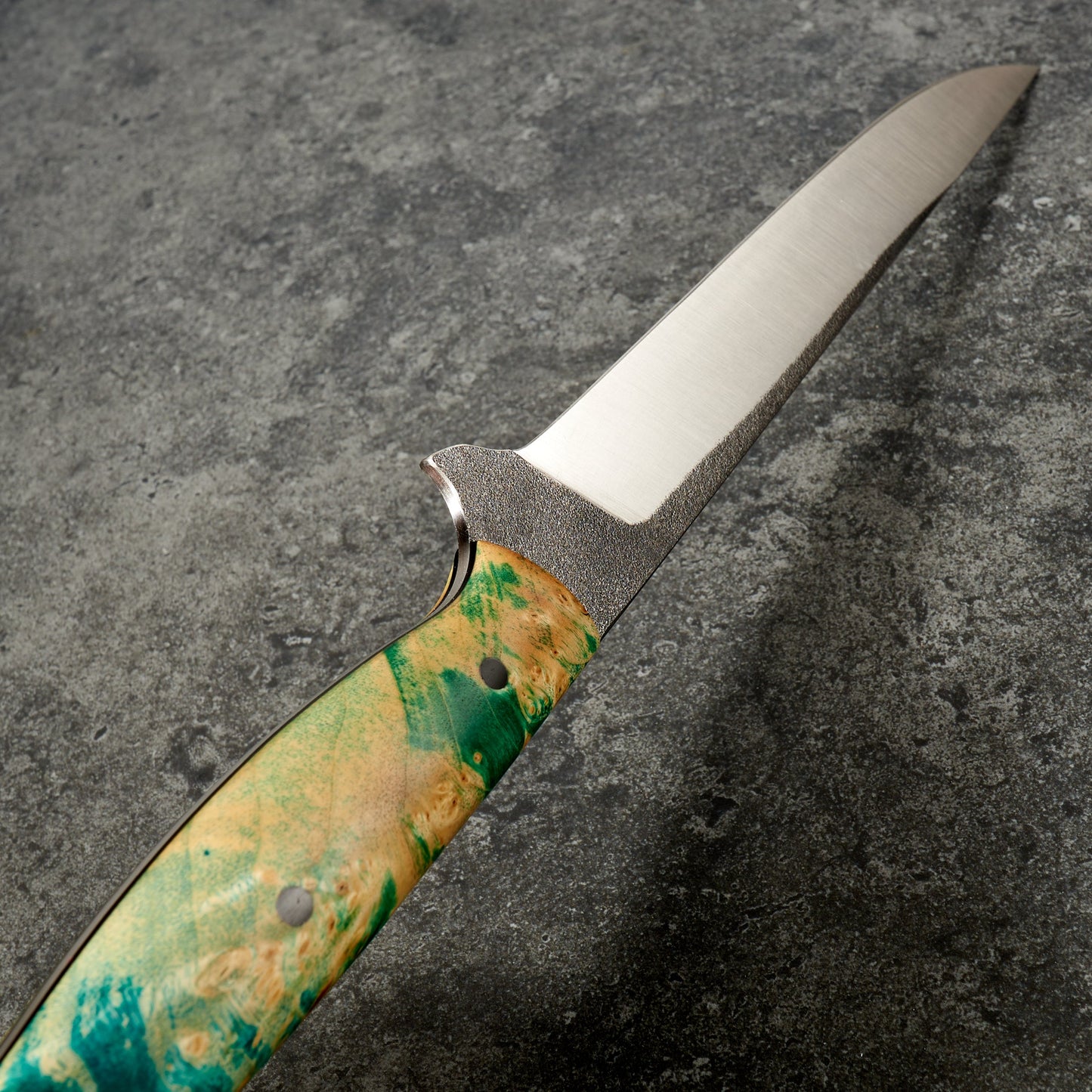
A very cool and clean looking filleting knife from Austrian bladesmith Martin Huber. Forged in premium Böhler (Baller!) N690 stainless steel, light weight and nimble the blade is stiff with a nice curved and pointed tip, which is perfect for removing silver skin and getting between joints. A 180mm blade length is great for long slices and drawing the knife between the flesh and unwanted material.

The handle features a nice finger guard and very comfortable form, which is idea for the nimble pivoting motions required for butchery.

With a satin finish on the blade, a touch of kurouchi along the spine and a vibrant and cool yellow and blue dyed and stabilised maple burl handle this is just about the coolest filleting knife we have come across. It feels dialled in and its going to perform well. If you are in the market for a high performance filleting knife with a tonne of style this is likely to make you happy.

Product Specification
  • Blade Type:
  • Edge Length: 180mm
  • Spine Heel: 2.67mm
  • Spine Mid: 2.60mm
  • Spine Tip (20mm before): 1.44mm
  • Blade Height: 25mm
  • Weight: 1.29g
  • Cutting Edge Steel:
  • Steel class: Stainless
  • HRC: 60+
  • Blade Construction:
  • Blade Finish: Kurouchi, Matte Polish
  • Grind:
  • Handle Construction:
  • Handle Materials: Dyed Maple Burl, Carbon Fibre Pins
  • Handedness: Ambidextrous

Blade type

Filleting Knife

A long, narrow, flexible knife designed to part fish from bone and skin. The pronounced flex lets the blade follow the spine and ribcage of a fish, lifting clean fillets with minimal waste, while the slender point slips under skin and pin bones. Lengths vary with the fish, from short blades for trout to long ones for large round fish and flatfish.

Flexibility is what makes the knife and what narrows its use. The same supple blade that tracks a fish skeleton so well is poor at anything requiring force or a straight, stiff cut, so the filleting knife stays firmly in its lane. For anyone who processes whole fish it is close to indispensable; for anyone who does not, it rarely leaves the drawer.

View full knife type guide →

Cutting edge steel

Böhler N690

Cobalt-modified high-chromium martensitic stainless

Typical HRC
59–62
Corrosion class
Stainless
Production
Conventional
Origin
Austria (Böhler-Uddeholm / voestalpine)

N690 is an Austrian high-chromium stainless with a small but deliberate cobalt addition, putting it metallurgically alongside Japanese VG-10 — and in fact the two steels are often discussed as European and Japanese answers to the same problem. About 1.07 percent carbon, 17 percent chromium, 1.1 percent molybdenum, 0.1 percent vanadium, and 1.5 percent cobalt give it strong corrosion resistance, decent edge retention, and reasonable toughness for the alloy class.

For a kitchen knife N690 runs at 60–61 HRC in production form, sharpens with the slight reluctance typical of a high-Cr stainless, and produces a competent, durable edge. It is a house steel across a number of Austrian and Italian production makers, and on Modern Cooking it reaches the catalogue through Martin Huber's occasional N690 work.

Compared to the powder stainlesses (SG2, MagnaCut) it is a clear step behind on edge retention and refinement; compared to the older 440-series stainlesses it is a clear step ahead. It is, in short, a solid premium stainless that does what it promises.

View full steel guide →

Blade construction

Mono Steel

A knife forged from a single piece of steel — no laminations, no clad layers. The simplest and most direct construction. The entire blade is the cutting steel, with no softer outer jacket to protect or contrast it. Most contemporary Western kitchen knives in carbon and stainless steel are mono-steel constructions, as are honyaki and most European bladesmith work.

The trade-off is straightforward: mono-steel knives are easier to forge, sharpen, and reason about, but the entire blade carries the cutting steel's properties — including its reactivity if it's a clean carbon. There is no soft jacket to protect a more brittle core from impact, so the heat treatment and geometry have to do all the work.

View full construction guide →

Grind

Flat

A grind in which the blade tapers in a straight line from the spine down toward the edge, with no curve or hollow in the bevel. The flat grind is the most common geometry on modern double-bevel kitchen knives because it balances cutting performance and durability: thin enough behind the edge to slice well, with enough steel behind it to stay strong.

A true full flat grind, running from spine to edge, is keen but can wedge in dense produce as the food meets the widening blade; many kitchen knives use a partial flat grind that begins lower on the blade to manage that. The flat grind's appeal is its predictability — it sharpens straightforwardly, behaves consistently, and asks nothing unusual of the user.

View full grind guide →

Handle construction

Full Tang

A construction in which the blade steel runs the full length and width of the handle, forming a flat core between two handle scales. The scales are fixed to either face of the tang with pins, rivets, or adhesive, and the tang's outline stays visible as a strip of steel around the top, bottom, and butt of the handle — often with the pin heads showing as a row down each side. It is the dominant construction in Western kitchen and outdoor knives.

Because the steel continues all the way to the butt, the handle is essentially the tang dressed in two scales, and the grip is ground and shaped from that sandwiched assembly as a whole. The extra steel carries weight and balance back toward the hand, giving the solid, blade-and-handle-as-one feel that defines the style, and it leaves the edge of the tang on show as part of the knife's line.

View full construction guide →

Shipping & Returns

Shipping

We process orders 5 days a week (Monday - Friday) and ship from our shop in Sydney, Australia. We ship with FedEx, UPS and DHL.

We are happy to offer free international shipping on a variety of orders depending on location and order value.

Free Shipping Regions and Minimum Order Values

For Australia and New Zealand the minimum is $500AUD. For the rest of the world it is approximately €1000EUR. The discount is applied automatically when you reach the minimum cart value at checkout.

Returns

If you're not entirely happy with your purchase, you can return it within 14 days of delivery for a refund. The item must be in its original condition with all original packaging.

  • Returns are accepted for 14 days
  • The customer is responsible for return shipping costs
  • A 15% restocking fee may be applied to change-of-mind returns
  • We do not accept returns on second-hand items for change of mind

Faulty or Damaged Items

You must notify us within 5 business days of receiving your order. Photographic evidence of damage is required. Once approved, Modern Cooking will cover return shipping costs.

Product Care

Cleaning: Clean by hand with warm water. Avoid wetting the handle when possible.

Sharpening: We advise using whetstones to sharpen your knives and a honing rod or steel to maintain the burr between sharpening sessions.

Reactive Steels: Reactive steels like Aogami Super, Apex Ultra or premium reactive German and Swedish steels are susceptible to rust if not properly cared for. Keep the knife dry between uses and when storing for longer periods, wiping the blade with Tsubaki oil or another food-safe oil is a wise choice. A patina can be a beautiful personal feature on your knife and helps to stop rust forming.

Handle Care: For non-stabilised wooden handles, apply Tsubaki oil or another food-safe oil from time to time. Food-safe wax can be applied to both stabilised and non-stabilised wooden handles. Never apply hot wax or oil as you risk warping or damaging the handle.

View full details