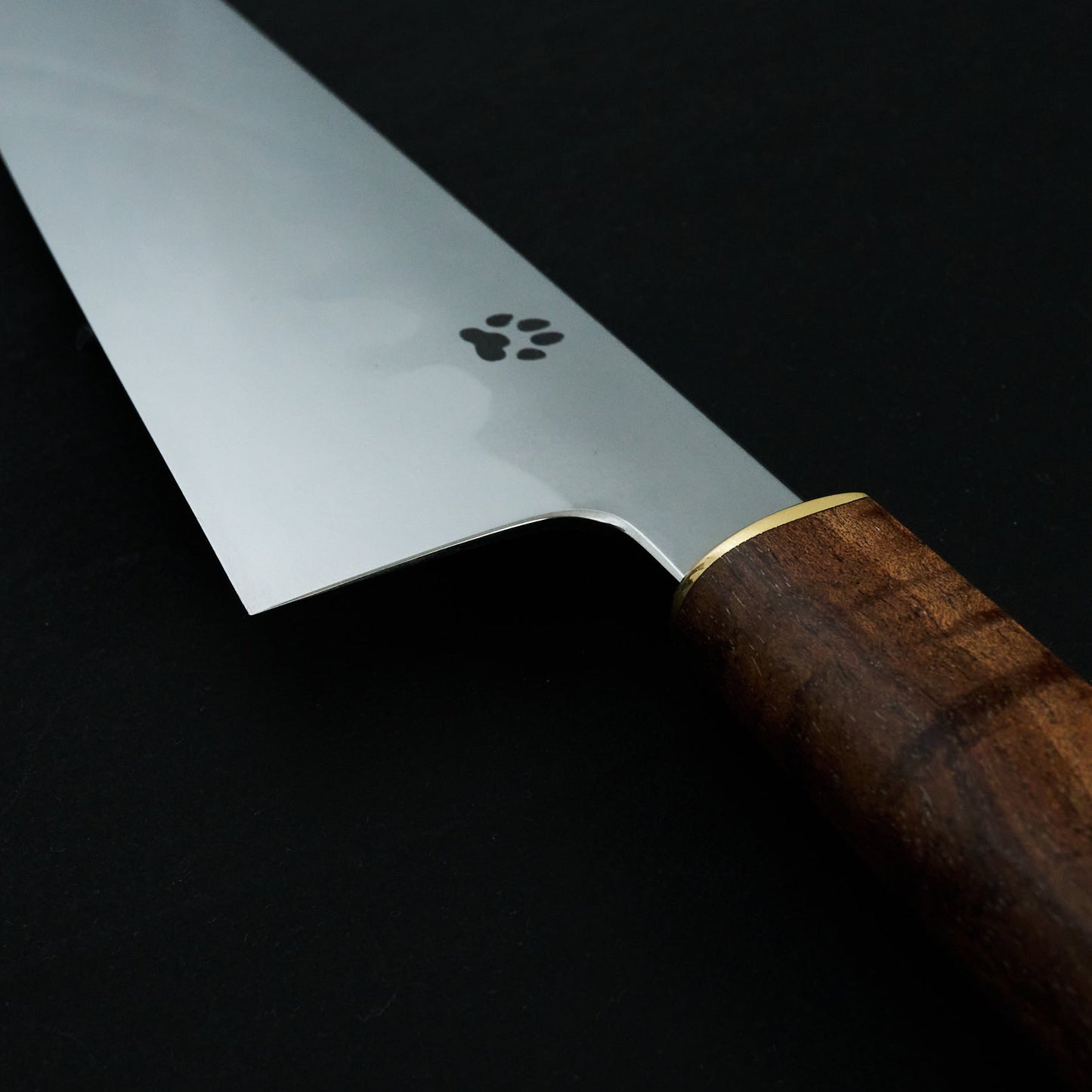
Isa Smedjan X Myojin Gyuto 245mm Spicy White, Tasmanian Blackwood & Brass
Isa Smedjan X Myojin Gyuto 245mm Spicy White, Tasmanian Blackwood & Brass
No longer available
Our Sydney workshop is closed until Monday 9 November. Orders placed now are very welcome and will ship in the order received from Tuesday 10 November. Shipping details
A rare fusion of European craftsmanship and Japanese precision, this limited series of Honyaki Gyuto represents the pinnacle of cutting performance, artistry, and exclusivity. With only four in existence, each piece is entirely unique—a true collector’s item for serious chefs and enthusiasts alike.
Each blade is hand-forged by the renowned Jonas Johnsson of Isa Smedjan, one of the finest Honyaki smiths in the world. His work is sought after for its impeccable heat treatment, meticulous forging, and unparalleled understanding of steel. Jonas has collaborated with some of the most respected names in the industry, including Benjamin Kamon and Birch & Bevel, and his work is renowned for its edge retention and cutting feel.
After forging, each piece is entrusted to world-class sharpener Naohito Myojin, whose mastery in grinding and finishing has made him a legend in the field. Myojin has earned an international reputation through his collaborations with Konosuke Sakai, Hashimoto Shoichi, and Satoshi Nakagawa, bringing out the best in already exceptional blades. His precision grinding and polishing techniques create a seamless harmony between form and function, delivering effortless performance with every cut.
Forged from 26C3 carbon steel, the result is extraordinary sharpness, hardness, and edge retention. Sometimes referred to as “Spicy White,” 26C3 is comparable to Japanese White #1 steel, yet exhibits even greater edge retention and fine carbide structure, making it ideal for Honyaki forging. When heat-treated by a master like Jonas Johnsson, this steel reaches remarkable levels of hardness while maintaining resilience, ensuring long-lasting sharpness with a truly refined cutting edge.
The differential hardening process of the Honyaki construction creates a stunning hamon—a visual testament to the skill and precision required to produce such a blade. Each hamon is entirely unique, reflecting the artistry and individuality of its creation.
Designed for unparalleled cutting feel, the distal taper and ultra-refined convex grind ensure effortless food release, while the precision-thinned edge allows for an incredibly smooth, controlled cut. Whether working with proteins, vegetables, or intricate techniques, this Gyuto performs at the highest level, making it the ultimate tool for professional chefs and collectors alike.
Each piece in the series is fitted with a meticulously crafted handle made from a curated selection of premium woods, including Australian Ringed Gidgee, Tasmanian Blackwood, and Eucalyptus Burl. These stunning woods are accented with brass and rosewood, enhancing both aesthetics and ergonomics. The result is a handle that is not only visually captivating but also perfectly weighted for balance and comfort in the hand.
With only four in existence, this collection represents a fleeting opportunity to own a truly unique masterpiece. A combination of European and Japanese craftsmanship, top-tier steel, and impeccable geometry, this Honyaki Gyuto is more than just a tool—it is functional art, designed to inspire and perform at the highest level.
Each piece is a once-in-a-lifetime acquisition, ensuring that its owner possesses something unlike any other in the world.
Product Specification
- Blade Type:
- Overall Length: 395mm
- Edge Length: 245mm
- Spine Heel: 3.5mm
- Spine Mid: 2.36mm
- Spine Tip (20mm before): 1.25mm
- Blade Height: 56.5mm
- Weight: 221g
- Cutting Edge Steel:
- Steel class: Carbon
- HRC: 65
- Blade Construction:
- Blade Finish: Mirror Polish
- Grind:
- Handle Construction:
- Handle Materials: Tasmanian Blackwood, Brass
- Handedness: Ambidextrous
Shipping & Returns
Shipping & Returns
Shipping
We process orders Monday to Friday from our Sydney workshop. Australian orders are shipped with Australia Post and international orders with DHL Express. Shipping charges are calculated at checkout based on destination, shipment size and weight, and the carrier service available for the order.
Returns
If you're not entirely happy with your purchase, you can return it within 14 days of delivery for a refund. The item must be in its original condition with all original packaging.
- Returns are accepted for 14 days
- The customer is responsible for return shipping costs
- A 15% restocking fee may be applied to change-of-mind returns
- We do not accept returns on second-hand items for change of mind
Faulty or Damaged Items
You must notify us within 5 business days of receiving your order. Photographic evidence of damage is required. Once approved, Modern Cooking will cover return shipping costs.
Product Care
Product Care
Cleaning: Clean by hand with warm water. Avoid wetting the handle when possible.
Sharpening: We advise using whetstones to sharpen your knives and a honing rod or steel to maintain the burr between sharpening sessions.
Reactive Steels: Reactive steels like Aogami Super, Apex Ultra or premium reactive German and Swedish steels are susceptible to rust if not properly cared for. Keep the knife dry between uses and when storing for longer periods, wiping the blade with Tsubaki oil or another food-safe oil is a wise choice. A patina can be a beautiful personal feature on your knife and helps to stop rust forming.
Handle Care: For non-stabilised wooden handles, apply Tsubaki oil or another food-safe oil from time to time. Food-safe wax can be applied to both stabilised and non-stabilised wooden handles. Never apply hot wax or oil as you risk warping or damaging the handle.