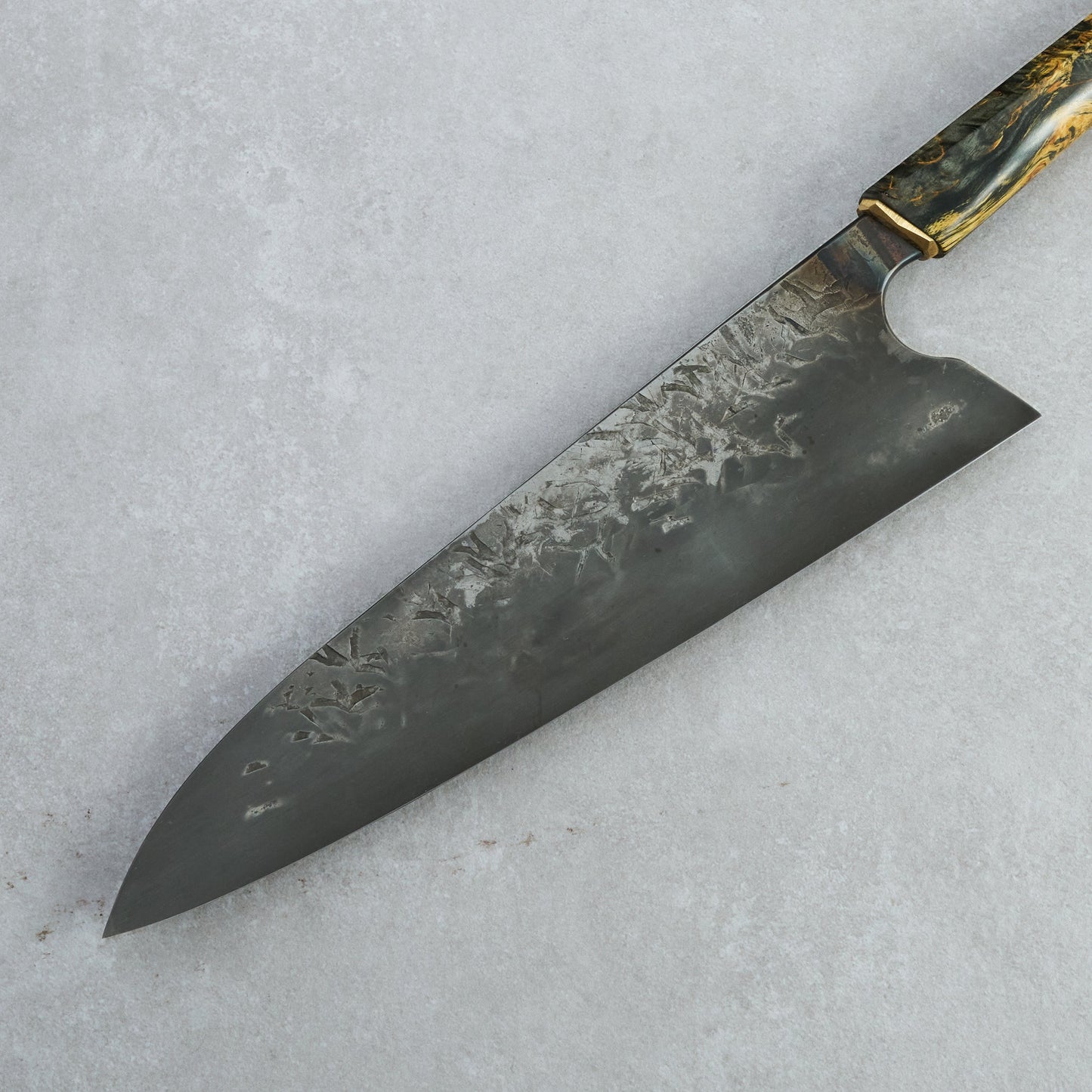
Gyuto 235mm Mono Apex Ultra Black Etch "Duille Liath" Flared Coffin Grip
Gyuto 235mm Mono Apex Ultra Black Etch "Duille Liath" Flared Coffin Grip
No longer available
Our Sydney workshop is closed until Monday 9 November. Orders placed now are very welcome and will ship in the order received from Tuesday 10 November. Shipping details
Introducing the exquisite "Duille Liath," a one-of-a-kind handmade kitchen knife masterfully forged by the renowned artisan Erik Gullikson. The name "Duille Liath," which translates to "Ashen Leaf" in Irish, is a fitting reflection of the knife’s organic elegance and timeless craftsmanship. Designed with a classic gyuto profile, this exceptional culinary tool embodies the perfect balance of tradition and innovation. The profile features a subtle, continuous radius from heel to tip, ideal for executing long, gentle slices and precise push cuts. In the hands of a skilled chef or passionate home cook, the "Duille Liath" becomes an extension of their own precision, enhancing every culinary creation with grace and ease. It’s not just a kitchen tool; it’s a celebration of craftsmanship, technique, and purpose.
At the heart of "Duille Liath" lies its superior blade geometry, which sets it apart from ordinary kitchen knives. Forged from the high-performance Apex Ultra steel, this material serves as the ultimate canvas for Erik Gullikson’s masterful execution of ultra-fine tapering. The result is a blade that feels incredibly nimble and agile, responding to the subtlest shifts in grip and motion. This tapering geometry reduces resistance as it glides through ingredients, making every cut smooth, precise, and virtually effortless. The iconic "branches" texture on the blade’s surface, paired with a black etched finish, not only enhances its visual appeal but also reflects Erik’s artistic mastery. This textured pattern offers a unique aesthetic while providing a tactile element that feels purposeful and deliberate. The artistry of the blade’s surface perfectly complements its performance, creating a knife that is as visually striking as it is technically superior.
Erik’s attention to detail extends to the handle, which features his new flared coffin taper "rokakku hanmaru" design. This ergonomic handle is crafted with a stabilised black and yellow masur birch, a material that exudes warmth and character. The heirloom-quality brass bolster, adorned with a geometric textured finish, provides both balance and durability, grounding the handle’s bold visual statement. The bolster features an heirloom fit or museum fit method, ensuring that the gaps between the bolster and the wooden section of the handle do not become uncomfortable over time should the wood move. Together, the brass bolster and the vibrant yellow and black birch create a stunning contrast against the dark, etched blade. The entire knife feels remarkably lightweight, perfectly balanced, and highly nimble, giving users the sensation of wielding a precision instrument of the highest caliber. Every aspect of "Duille Liath" showcases Erik Gullikson’s mastery of materials, geometry, and design, resulting in a kitchen knife that is as much a work of art as it is a functional masterpiece.
Product Specification
- Blade Type:
- Overall Length: 355mm
- Edge Length: 235mm
- Spine Heel: 4.66mm
- Spine Mid: 1.85mm
- Spine Tip (20mm before): 0.7mm
- Blade Height: 62.35mm
- Weight: 184g
- Cutting Edge Steel:
- Steel class: Carbon
- HRC: 66
- Blade Construction:
- Blade Finish: Matte Polish, Textured, Acid Etched (Forced Patina)
- Grind:
- Handle Construction:
- Handle Materials: Stabilised Black Yellow Masur Birch
- Handedness: Ambidextrous
Shipping & Returns
Shipping & Returns
Shipping
We process orders Monday to Friday from our Sydney workshop. Australian orders are shipped with Australia Post and international orders with DHL Express. Shipping charges are calculated at checkout based on destination, shipment size and weight, and the carrier service available for the order.
Returns
If you're not entirely happy with your purchase, you can return it within 14 days of delivery for a refund. The item must be in its original condition with all original packaging.
- Returns are accepted for 14 days
- The customer is responsible for return shipping costs
- A 15% restocking fee may be applied to change-of-mind returns
- We do not accept returns on second-hand items for change of mind
Faulty or Damaged Items
You must notify us within 5 business days of receiving your order. Photographic evidence of damage is required. Once approved, Modern Cooking will cover return shipping costs.
Product Care
Product Care
Cleaning: Clean by hand with warm water. Avoid wetting the handle when possible.
Sharpening: We advise using whetstones to sharpen your knives and a honing rod or steel to maintain the burr between sharpening sessions.
Reactive Steels: Reactive steels like Aogami Super, Apex Ultra or premium reactive German and Swedish steels are susceptible to rust if not properly cared for. Keep the knife dry between uses and when storing for longer periods, wiping the blade with Tsubaki oil or another food-safe oil is a wise choice. A patina can be a beautiful personal feature on your knife and helps to stop rust forming.
Handle Care: For non-stabilised wooden handles, apply Tsubaki oil or another food-safe oil from time to time. Food-safe wax can be applied to both stabilised and non-stabilised wooden handles. Never apply hot wax or oil as you risk warping or damaging the handle.