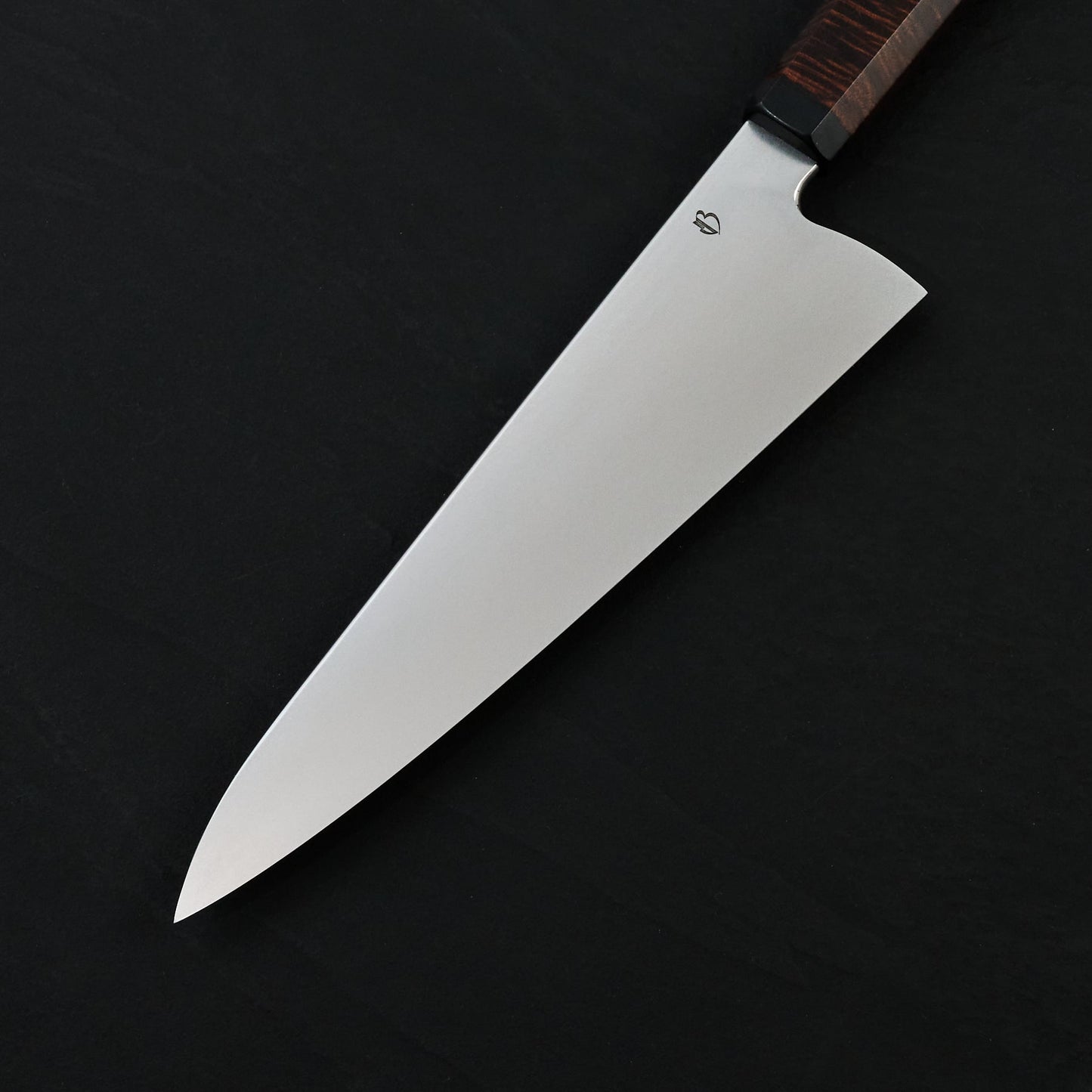
Gyuto 225mm AEB-L Orbital, Gidgee & Double Black canvas Micarta
Gyuto 225mm AEB-L Orbital, Gidgee & Double Black canvas Micarta
By Dan Bidinger
No longer available
Our Sydney workshop is closed until Monday 9 November. Orders placed now are very welcome and will ship in the order received from Tuesday 10 November. Shipping details
This exquisite, one-of-a-kind kitchen knife is the embodiment of masterful craftsmanship by artisanal knife maker Dan Bidinger. Inspired by the iconic Gyuto, it showcases a contemporary twist that sets it apart from traditional silhouettes. The blade features an aggressively tapered height, ensuring a robust spine that translates into a powerful and confident action on the cutting board. Whether you are slicing through delicate herbs or tackling dense root vegetables, the knife’s profile supports precise control and effortless maneuverability. The artistry in this design reflects Dan’s dedication to creating both beautiful and functional blades, resulting in a culinary tool that feels like an extension of the chef’s hand. His attention to detail can be seen in every inch of the knife, from the elegantly contoured spine to the carefully finished edge.
At the heart of this blade is Dan’sa Bidinger house favourite, AEB-L premium stainless steel—widely admired for its high sharpness potential and impressive edge retention. The thin convex bevels, paired with a tapering spine thickness, accentuate the blade’s ability to glide through ingredients with minimal resistance. This refined geometry, combined with the highly tapered profile, elevates overall performance and makes the knife exceptionally agile. AEB-L steel is known for its fine grain structure, which allows for an acute edge that stays sharper for longer. For those curious about the deeper metallurgical qualities of this stainless steel, a quick search on the web will reveal why it has become a favored choice among bespoke knife makers. The fusion of superior materials and meticulous engineering ensures the blade can handle everything from precise slicing to more demanding tasks without sacrificing its razor-sharp edge or its timeless elegance.
Adding to the knife’s uniqueness is the handle—a classic hidden tang construction crafted from premium Australian ringed gidgee and double-black canvas Micarta. This striking combination provides a durable and elegant touch full of subtle contrasting tones and textures. The octagonal shape is both ergonomic and comfortable, allowing for a secure grip that reduces hand fatigue during extended use. Furthermore, the blade’s orbital finish lends a distinct visual appeal, making each piece undeniably original while emphasizing the knife’s handcrafted heritage. Together with its exceptional cutting performance, this finish distinguishes the knife as a remarkable statement piece in any kitchen. Ultimately, every aspect of this creation—from the distinctive geometry to the masterful handle design—demonstrates Dan Bidinger’s commitment to excellence, resulting in a rare and extraordinary tool that you’ll cherish for years to come.
Product Specification
- Blade Type:
- Overall Length: 365mm
- Edge Length: 225mm
- Spine Heel: 4.55mm
- Spine Mid: 3.19mm
- Spine Tip (20mm before): 1.46mm
- Blade Height: 60.87mm
- Weight: 248g
- Cutting Edge Steel:
- Steel class: Stainless
- HRC: 65
- Blade Construction:
- Blade Finish: Brushed
- Grind:
- Handle Construction:
- Handle Materials: Gidget, Double Black canvas Micarta
- Handedness: Ambidextrous
Shipping & Returns
Shipping & Returns
Shipping
We process orders Monday to Friday from our Sydney workshop. Australian orders are shipped with Australia Post and international orders with DHL Express. Shipping charges are calculated at checkout based on destination, shipment size and weight, and the carrier service available for the order.
Returns
If you're not entirely happy with your purchase, you can return it within 14 days of delivery for a refund. The item must be in its original condition with all original packaging.
- Returns are accepted for 14 days
- The customer is responsible for return shipping costs
- A 15% restocking fee may be applied to change-of-mind returns
- We do not accept returns on second-hand items for change of mind
Faulty or Damaged Items
You must notify us within 5 business days of receiving your order. Photographic evidence of damage is required. Once approved, Modern Cooking will cover return shipping costs.
Product Care
Product Care
Cleaning: Clean by hand with warm water. Avoid wetting the handle when possible.
Sharpening: We advise using whetstones to sharpen your knives and a honing rod or steel to maintain the burr between sharpening sessions.
Reactive Steels: Reactive steels like Aogami Super, Apex Ultra or premium reactive German and Swedish steels are susceptible to rust if not properly cared for. Keep the knife dry between uses and when storing for longer periods, wiping the blade with Tsubaki oil or another food-safe oil is a wise choice. A patina can be a beautiful personal feature on your knife and helps to stop rust forming.
Handle Care: For non-stabilised wooden handles, apply Tsubaki oil or another food-safe oil from time to time. Food-safe wax can be applied to both stabilised and non-stabilised wooden handles. Never apply hot wax or oil as you risk warping or damaging the handle.