Skip to product information
1 of 7

Gyuto 260mm Aogami Super Stainless Clad San Mai

Gyuto 260mm Aogami Super Stainless Clad San Mai

By Jonas Johnsson


No longer available

Jonas Johnsson

Reserve your place

We'll only email you when there's something to say. Invitations go out in signup order as new work becomes available.

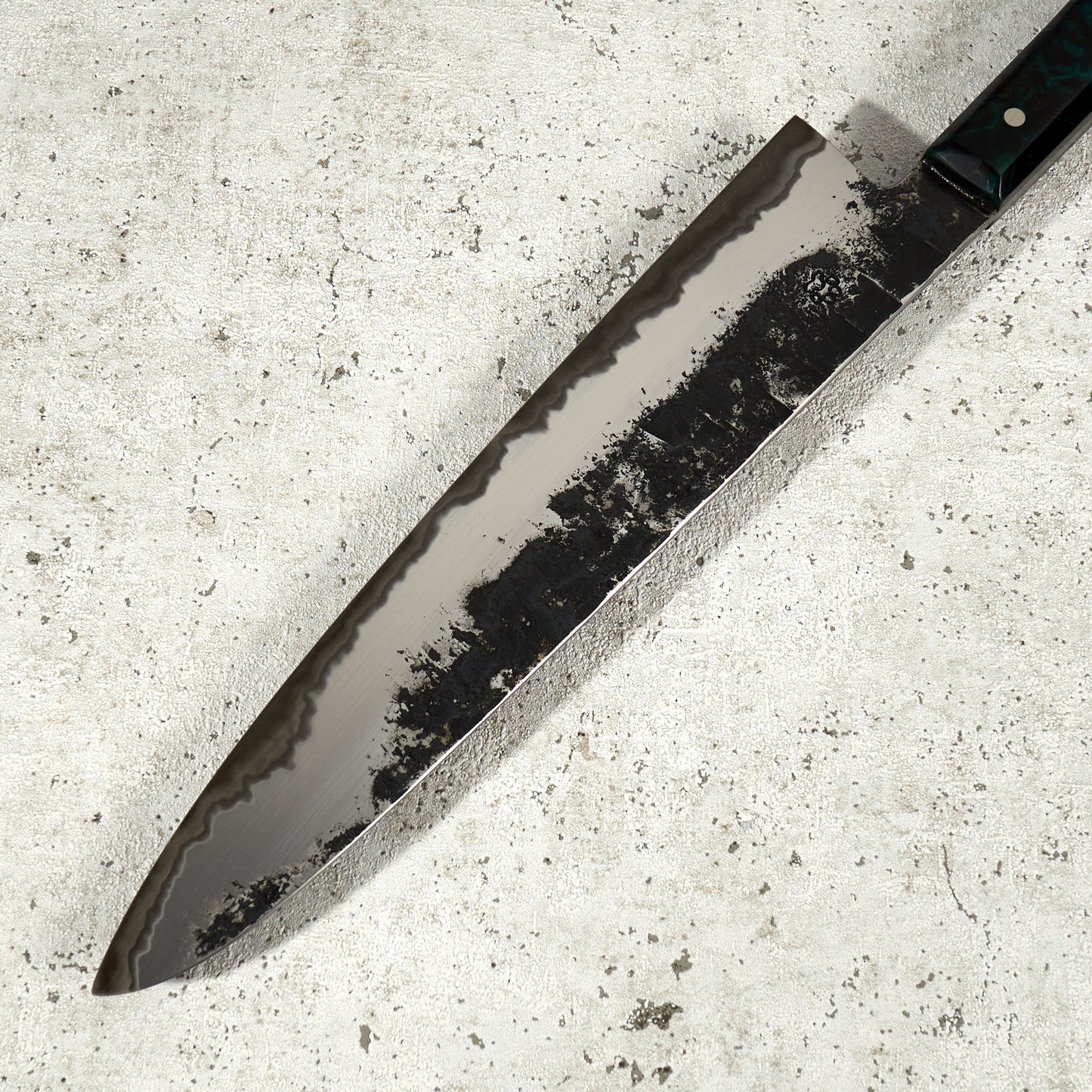
A stunning piece of work from Jonas, forged in Aogami Super and clad in 1.4034 stainless steel. Aogami Super core, which is acid etched, and full of beautiful alloy banding. At the spine the knife features black kurouchi and deep forge mark followed by a beautiful reflective statin polish. The contrasting layers look absolutely superb!

The profile is a classic Gyuto style with a santoku tip. An edge profile that consists of a large flat section, slowly curving up towards the tip. Almost 4mm thick at the spine and aggressively tapered down to just above 1mm before hitting the paper-thin tip. It’s an incredible piece of geometry from Jonas and performs flawlessly on the board.

The stunning piece work on the blade extends back to a full tapered tang handle with dyed and stabilised redwood burl scales and stainless pins.

This was a wildcard blade from Jonas, we played no roll in its design, he simple wanted to do something stainless clad and we are absolutely blown away by the results.

Product Specification
  • Blade Type:
  • Edge Length: 260mm
  • Spine Heel: 3.95mm
  • Spine Mid: 2.83mm
  • Spine Tip (20mm before): 1.2mm
  • Blade Height: 53mm
  • Weight: 2.79g
  • Cutting Edge Steel:
  • Steel class: Carbon
  • HRC: 65
  • Blade Construction:
  • Blade Finish: Brute de Forge, Matte Polish, Acid Etched (Forced Patina), Kurouchi
  • Grind:
  • Handle Construction:
  • Handle Materials: Dyed, Stabilised Redwood Burl, Stainless Pins
  • Handedness: Ambidextrous

Blade type

Gyuto

牛刀

The Japanese take on the Western chef's knife, and the most versatile blade in a modern kitchen. A gyuto carries a long, gently curved edge — most often 210 to 270 mm — that allows both push cuts and a rocking motion, with a pointed tip for fine work and enough height at the heel to keep knuckles clear of the board. It handles proteins, vegetables, and herbs without complaint, which is why most cooks reach for it first.

Compared with a European chef's knife, the gyuto is usually thinner, harder, and lighter, ground to a finer edge that rewards good board technique and regular honing. That same thinness is the trade-off: the edge is less forgiving of bone, frozen food, and twisting cuts, and it asks for a little more care in maintenance in exchange for its keenness.

View full knife type guide →

Cutting edge steel

Aogami Super

High-carbon tungsten-chromium-molybdenum steel

Typical HRC
63–66
Corrosion class
Carbon
Production
Conventional
Origin
Japan (Hitachi YSS / Proterial)

Aogami Super — Blue Super, in plain English — is the most heavily alloyed of Hitachi's blue-paper steels, and the one most associated with the long-edge-life end of the traditional Japanese kitchen knife world. Roughly 1.45 percent carbon, half a percent each of chromium and tungsten, plus molybdenum and vanadium additions, give it noticeably more carbide content than Aogami #2 or #1.

In a competent gyuto it typically lands at 63–65 HRC and holds an edge for an unusually long time for a non-powder steel. The trade-off, predictable from the chemistry, is that the larger carbides mean slightly more work at the stone and a slightly less smooth edge than Shirogami #1 at its peak. Most users do not notice; the ones who do tend to come from a finishing-stone tradition. Toughness is moderate — similar to or slightly below the white papers at the same hardness — and the steel will patina with normal use.

Aogami Super is the steel you reach for when you want a long-running edge from a maker who refuses to use powder metallurgy. It is widely used across the Sakai and Sanjō traditions and remains one of the most-asked-for Hitachi steels on the secondary market. Among the makers Modern Cooking carries, Neil Ayling, Konstantinos Noulis, and Jonas Johnsson work in Aogami Super. It is, in many ways, the canonical "blue paper" experience.

View full steel guide →

Blade construction

Laminated Steel

A category covering knives built from multiple layers of different steels forge-welded together. The hard cutting steel is sandwiched between softer outer layers (cladding) that protect the core, add toughness, and often contribute visual contrast.

The most common laminated constructions in the Modern Cooking catalogue are:

SanMai (三枚) — three layers: hard cutting steel in the centre, softer cladding on both sides. The traditional and most common form.

GoMai (五枚) — five layers: a hard core, two intermediate layers, and two outer layers. Adds visual depth and structural complexity.

KuMai (九枚) — nine layers: similar logic, with more cladding layers for additional pattern and structural variation.

GoMai and KuMai are often chosen not only for the additional layers and visual depth, but also because the intermediate layers can act as a nickel diffusion barrier — limiting carbon migration out of the core into the cladding during forge welding, and protecting the core's intended carbon content through the heat of the forging process.

In all cases the cutting performance is determined by the core steel; the outer layers are cosmetic and structural. The lamination contributes corrosion protection (when a stainless jacket clads a carbon core), reduced reactivity, and the visible boundary between core and cladding that gives the knife its character.

View full construction guide →

Grind

Convex

A grind whose bevel bulges outward in a gentle curve from spine to edge, rather than running flat. That extra steel directly behind the edge makes a convex grind notably strong and resistant to chipping, while the curved geometry helps food release and lets the blade glide through dense ingredients with less wedging than a flat grind.

The strength comes at the cost of ultimate thinness and ease of maintenance. A convex edge has more metal behind it, so it is not quite as effortlessly keen as a thinly flat-ground edge, and it is harder to sharpen freehand — holding the curve takes a stropping technique or a deliberate hand rather than a single fixed angle. The reward is an exceptionally tough, smooth-cutting edge.

View full grind guide →

Handle construction

Full Tang

A construction in which the blade steel runs the full length and width of the handle, forming a flat core between two handle scales. The scales are fixed to either face of the tang with pins, rivets, or adhesive, and the tang's outline stays visible as a strip of steel around the top, bottom, and butt of the handle — often with the pin heads showing as a row down each side. It is the dominant construction in Western kitchen and outdoor knives.

Because the steel continues all the way to the butt, the handle is essentially the tang dressed in two scales, and the grip is ground and shaped from that sandwiched assembly as a whole. The extra steel carries weight and balance back toward the hand, giving the solid, blade-and-handle-as-one feel that defines the style, and it leaves the edge of the tang on show as part of the knife's line.

View full construction guide →

Shipping & Returns

Shipping

We process orders 5 days a week (Monday - Friday) and ship from our shop in Sydney, Australia. We ship with FedEx, UPS and DHL.

We are happy to offer free international shipping on a variety of orders depending on location and order value.

Free Shipping Regions and Minimum Order Values

For Australia and New Zealand the minimum is $500AUD. For the rest of the world it is approximately €1000EUR. The discount is applied automatically when you reach the minimum cart value at checkout.

Returns

If you're not entirely happy with your purchase, you can return it within 14 days of delivery for a refund. The item must be in its original condition with all original packaging.

  • Returns are accepted for 14 days
  • The customer is responsible for return shipping costs
  • A 15% restocking fee may be applied to change-of-mind returns
  • We do not accept returns on second-hand items for change of mind

Faulty or Damaged Items

You must notify us within 5 business days of receiving your order. Photographic evidence of damage is required. Once approved, Modern Cooking will cover return shipping costs.

Product Care

Cleaning: Clean by hand with warm water. Avoid wetting the handle when possible.

Sharpening: We advise using whetstones to sharpen your knives and a honing rod or steel to maintain the burr between sharpening sessions.

Reactive Steels: Reactive steels like Aogami Super, Apex Ultra or premium reactive German and Swedish steels are susceptible to rust if not properly cared for. Keep the knife dry between uses and when storing for longer periods, wiping the blade with Tsubaki oil or another food-safe oil is a wise choice. A patina can be a beautiful personal feature on your knife and helps to stop rust forming.

Handle Care: For non-stabilised wooden handles, apply Tsubaki oil or another food-safe oil from time to time. Food-safe wax can be applied to both stabilised and non-stabilised wooden handles. Never apply hot wax or oil as you risk warping or damaging the handle.

View full details