Skip to product information
1 of 7

Gyuto Warikomi Forged By Björn Birgersson

Gyuto Warikomi Forged By Björn Birgersson

By MCX


Regular price Dhs. 2,191.00 AED
Regular price Sale price Dhs. 2,191.00 AED
Sale Sold out
Taxes included. Shipping calculated at checkout.

Out of stock

Size
Quantity
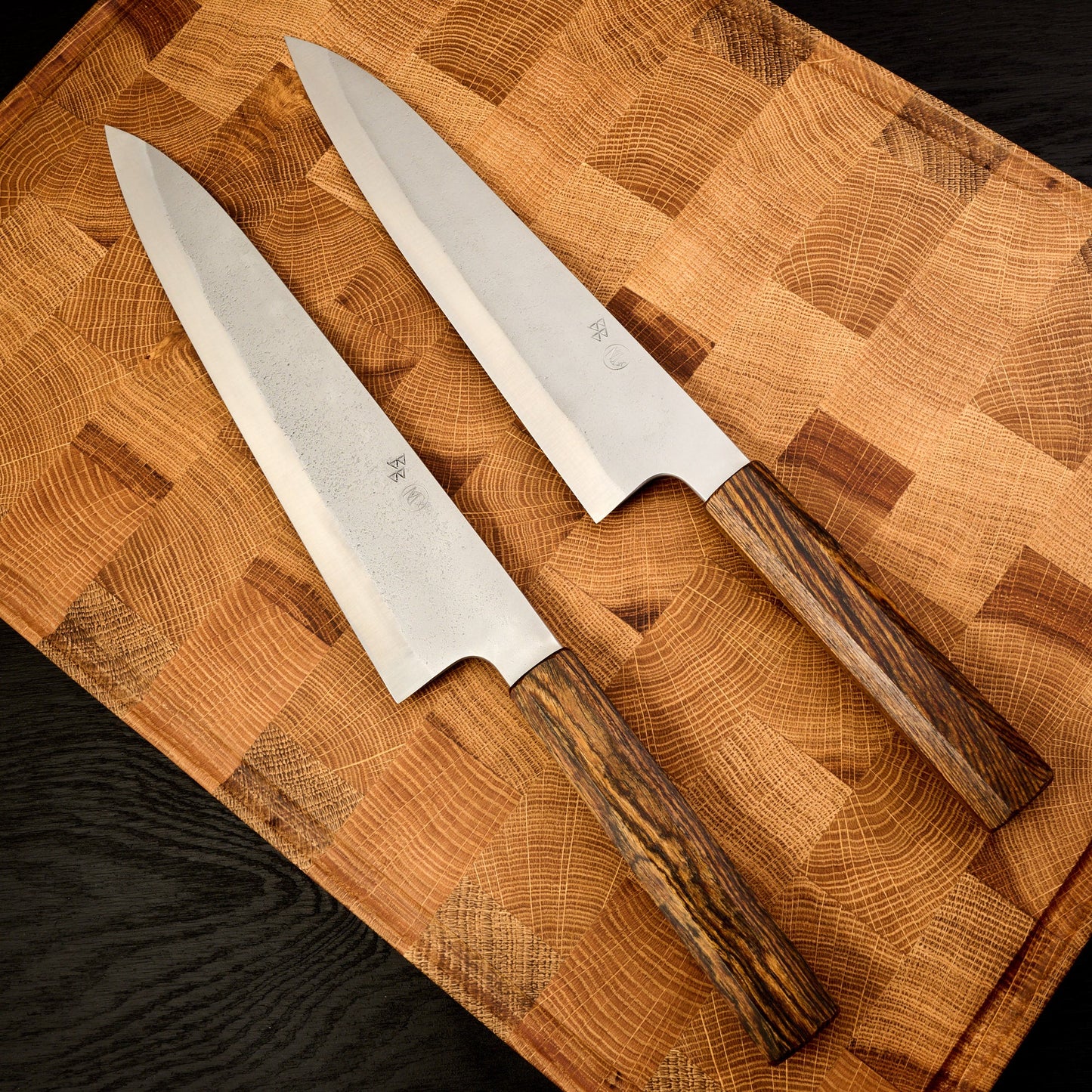
A slimline Gyuto designed to take full advantage of the incredible slicing capabilities of Björn's signature, ultra thin hollow grind. With an incredibly hard 66+ HRC core the edge is not only thin, but also able to be incredibly sharp. Björn has perfected the hardening process to give us an ultra hard and yet incredibly tough edge that will peel through produce like its not even there.
 
This lovely sharp cutting core is packaged up in a mild steel cladding, which is forged warikomi style. Giving you an incredibly sharp and resilient blade that is very thin, perfectly balanced and a joy to use on almost any task.
 
We chose this slimline santoku tipped profile to take full advantage of the signature Birgersson Blade features.
Product Specification
  • Blade Type:
  • Edge Length: 230mm | 250mm
  • Spine Heel: 3.5mm
  • Spine Mid: 1.8mm
  • Spine Tip (20mm before): 0.8mm
  • Blade Height: 52mm | 54mm
  • Weight: 183g | 198g
  • Cutting Edge Steel:
  • Steel class: Carbon
  • HRC: 66+
  • Blade Construction:
  • Blade Finish: Brute de Forge
  • Grind:
  • Handle Construction:
  • Handle Materials: Bocote
  • Handedness: Ambidextrous

Blade type

Gyuto

牛刀

The Japanese take on the Western chef's knife, and the most versatile blade in a modern kitchen. A gyuto carries a long, gently curved edge — most often 210 to 270 mm — that allows both push cuts and a rocking motion, with a pointed tip for fine work and enough height at the heel to keep knuckles clear of the board. It handles proteins, vegetables, and herbs without complaint, which is why most cooks reach for it first.

Compared with a European chef's knife, the gyuto is usually thinner, harder, and lighter, ground to a finer edge that rewards good board technique and regular honing. That same thinness is the trade-off: the edge is less forgiving of bone, frozen food, and twisting cuts, and it asks for a little more care in maintenance in exchange for its keenness.

View full knife type guide →

Cutting edge steel

High Carbon Steel

Generic descriptor

Typical HRC
Varies (58–66 depending on alloy)
Corrosion class
Varies
Production
Varies
Origin
N/A

"High carbon steel" is a category, not a recipe. It covers everything from simple plain-carbon grades like 1084 and 1095 through low-alloy carbons like 52100, 80CrV2, and 1.2419, all the way to the high-purity Japanese papers (Shirogami and Aogami families) and the modern engineered carbons (Apex Ultra, 26C3, Pop's ProCut).

Unfortunately, the phrase is also used as a marketing term, particularly on imported lower-end knives where the manufacturer is not willing to specify the exact alloy. A bare "high carbon steel" claim with no further specification on a knife under a hundred dollars usually indicates an undisclosed and probably unimpressive simple carbon — often something in the 1055 to 1065 range, reasonable but mass-market.

For the educated buyer, the rule is simple: if a maker can name the steel — 1095, 52100, White #2 — they will. If they cannot or will not, treat the omission as information.

View full steel guide →

Blade construction

Warikomi

The traditional Japanese insert construction — a small piece of hard cutting steel is split into a softer steel body, then forge-welded so the hard insert forms the cutting edge and the soft body forms the spine and bolster.

Warikomi is structurally similar to SanMai but the geometry is different: in SanMai the hard steel runs the full height of the blade and is clad on both sides; in warikomi the hard steel is a smaller insert at the edge only. The result is a knife with most of the toughness of the soft body and the cutting performance of the hard insert. Common in traditional Japanese single-bevel work.

View full construction guide →

Grind

Hollow

A grind with concave bevels, ground into the blade with a curved wheel so the sides scoop inward toward the edge. Removing that steel leaves an exceptionally thin, keen cutting edge and a noticeable air gap behind it, which can aid release on certain foods. The geometry produces a very sharp apex with minimal effort.

That thinness is also the weakness. A hollow-ground edge has little steel supporting it, so it is more prone to rolling or chipping under hard use and loses its bite once sharpening reaches the thicker steel above the hollow. It suits slicing tasks and precision work, and is poorly matched to heavy or careless cutting.

View full grind guide →

Handle construction

Hidden Tang

A construction in which the tang runs into the handle but stays concealed inside it, rather than showing between two scales. A narrower tang — a full-length stick or a shorter projection — is set into a drilled or burned channel in a one-piece handle and secured with adhesive, a friction fit, or a threaded fitting drawn up against the blade. This is the traditional construction of Japanese wa-handles and many European hidden-tang knives.

The design puts the handle material in charge of the look and feel: a single piece of wood, horn, or composite — often with a ferrule or spacers at the front — is shaped into any cross-section the maker wants, from the classic octagonal and D-shaped wa profiles to fully rounded Western forms. With no steel showing along the grip, the handle can be slim and light, and is frequently made to be removed and replaced, with the balance sitting toward the blade.

View full construction guide →

Shipping & Returns

Shipping

We process orders 5 days a week (Monday - Friday) and ship from our shop in Sydney, Australia. We ship with FedEx, UPS and DHL.

We are happy to offer free international shipping on a variety of orders depending on location and order value.

Free Shipping Regions and Minimum Order Values

For Australia and New Zealand the minimum is $500AUD. For the rest of the world it is approximately €1000EUR. The discount is applied automatically when you reach the minimum cart value at checkout.

Returns

If you're not entirely happy with your purchase, you can return it within 14 days of delivery for a refund. The item must be in its original condition with all original packaging.

  • Returns are accepted for 14 days
  • The customer is responsible for return shipping costs
  • A 15% restocking fee may be applied to change-of-mind returns
  • We do not accept returns on second-hand items for change of mind

Faulty or Damaged Items

You must notify us within 5 business days of receiving your order. Photographic evidence of damage is required. Once approved, Modern Cooking will cover return shipping costs.

Product Care

Cleaning: Clean by hand with warm water. Avoid wetting the handle when possible.

Sharpening: We advise using whetstones to sharpen your knives and a honing rod or steel to maintain the burr between sharpening sessions.

Reactive Steels: Reactive steels like Aogami Super, Apex Ultra or premium reactive German and Swedish steels are susceptible to rust if not properly cared for. Keep the knife dry between uses and when storing for longer periods, wiping the blade with Tsubaki oil or another food-safe oil is a wise choice. A patina can be a beautiful personal feature on your knife and helps to stop rust forming.

Handle Care: For non-stabilised wooden handles, apply Tsubaki oil or another food-safe oil from time to time. Food-safe wax can be applied to both stabilised and non-stabilised wooden handles. Never apply hot wax or oil as you risk warping or damaging the handle.

View full details